Select Page

Seacocks are often awkward to get at, awkward to open and close, and often ignored. Should they fail, the results can prove disastrous.

Most seacocks are sited well below the waterline, so they cannot be ignored if your vessel is to remain safe. If seacocks are always left open and neglected they can eventually seize which will prove a serious threat to boat safety should a connecting hose fail and the seacock refuses to close. There are three main types of seacock – ball valves, cone valves and gate valves.

Servicing seacocks

All through-hull fittings, including seacocks, should be serviced at least once a year. As well as cleaning and re-greasing the seacocks themselves, the condition of the hoses and stainless steel clips need to be checked and replaced as necessary. Make sure two hose clips are used at each end of the hoses connected to seacocks.

  • Ball valves – ball valves are hard wearing, but can stiffen and seize if they are not kept greased, which will also make them more likely to corrode. If a ball valve has become very stiff or seized, the first thing to do is use penetrating oil to try and loosen it. Even if it the valve is moving reasonably satisfactorily, it will still pay to take it apart and check it for corrosion, give it a clean and apply fresh waterproof grease to help keep it in good working condition. If on inspection the valve looks seriously corroded, then be prepared to replace it with a new one, even if it is still working, as trouble could be brewing. Remember to order a marine grade valve as they are also made for domestic systems.
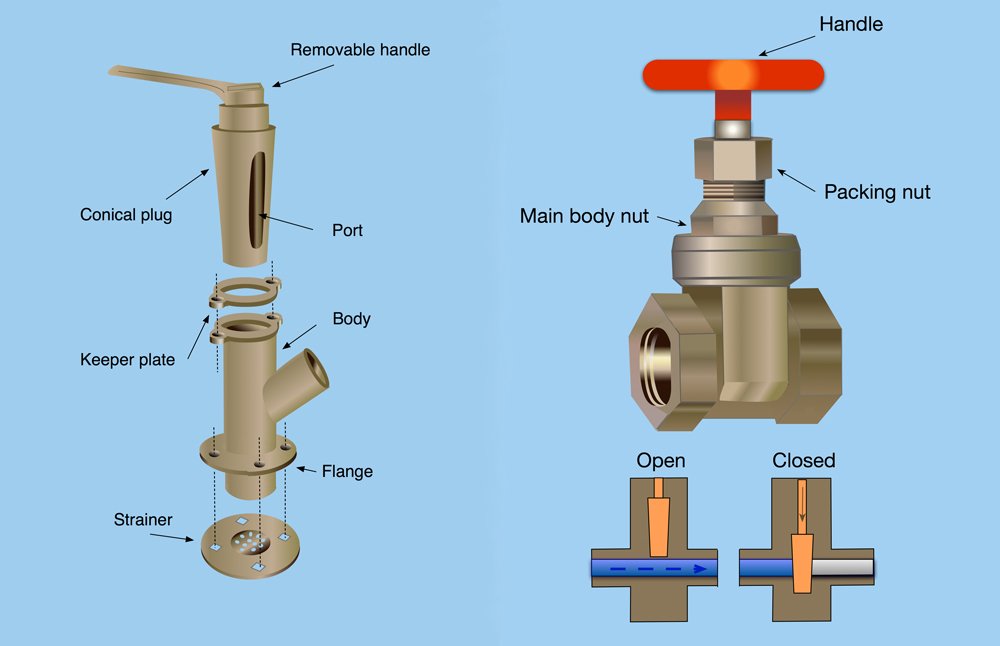
  • Cone valves – cone valves are usually made of bronze. They have a conical tube or plug that fits inside a cylindrical body which connects to a hose. The plug has a whole in one side and as it is turned by a handle the seacock is opened and closed. Although bronze is hard wearing the plug needs to be kept greased so that it can turn smoothly and to prevent corrosion. The plug is held in place by a keeper plate with two bolts and locking nuts which need careful adjustment to allow the valve to operate smoothly.

To service the valve, undo the keeper and remove the plug. Clean the plug and housing using a degreasing agent. Check the condition of the plug. Use grinding paste or fine wet and dry paper to polish the plug smooth before adding fresh seacock grease – note that any old grease is not recommended, it is best to use the manufacturer’s recommended waterproof grease, even if this is pricey. If the plug is badly pitted then it might need replacing.

  • Gate valves – gate valves should also be greased and inspected annually. They are usually made of brass with a circular handle connected to a threaded rod which moves up and down to open and close a gate in the valve. They are more prone to failure than cone and ball valves, being very susceptible to corrosion in the marine environment. The handles can get very stiff to operate and if they seize they will most like need to be replaced. If so, it would be best to replace with a ball or cone valve, which are considered more reliable. A big drawback with gate valves is there is no way of knowing whether the valve is open or closed when it is seized.
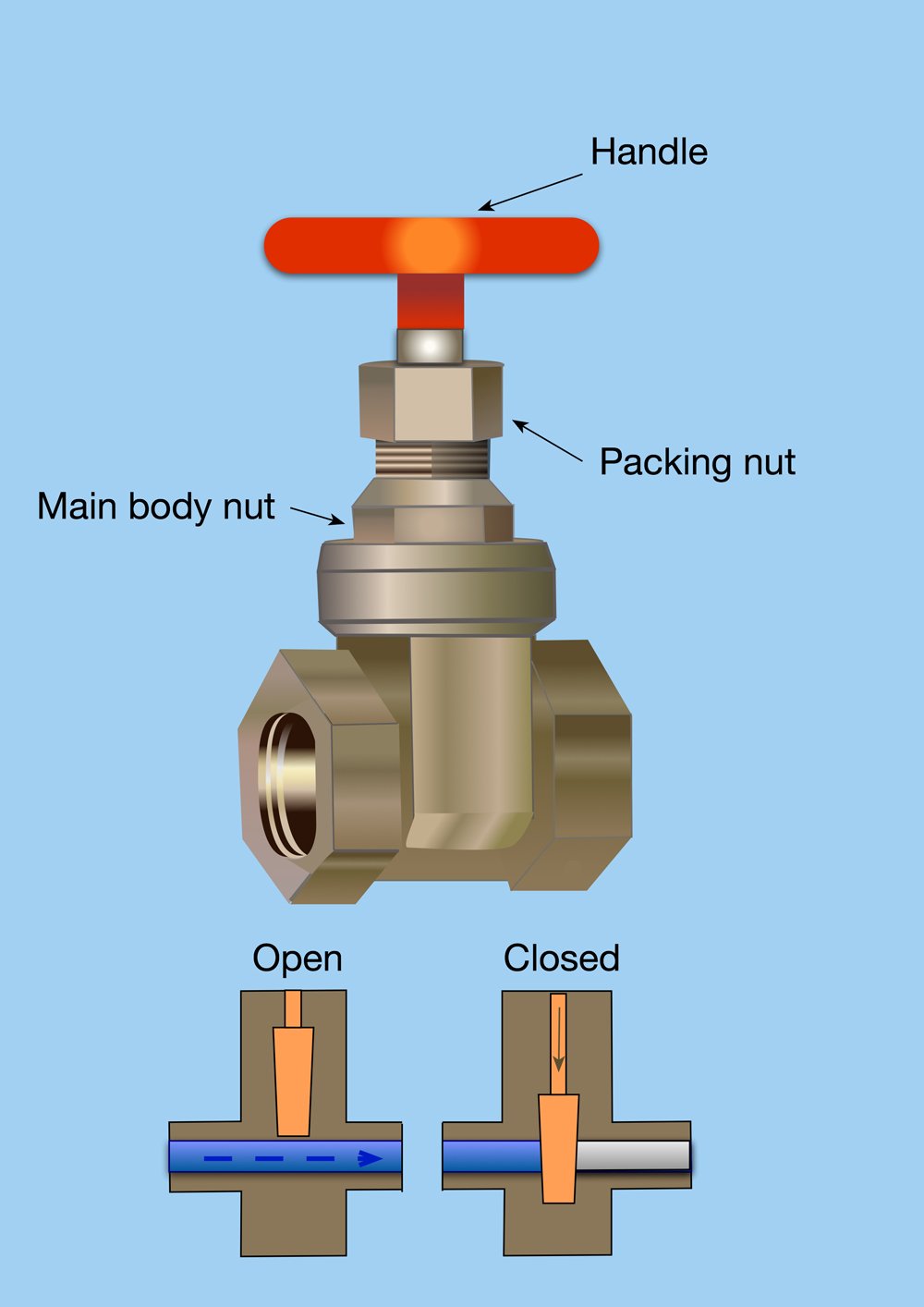
To service a gate valve, remove the valve body and dismantle it. Check for corrosion, clean and re-grease. Also check for damage to the bottom part of the gate which is quite common.

  • Jammed seacocks – seacocks can seize through lack of maintenance, corrosion or through lack of use. If a seacock is seized, start by spraying it with penetrating oil and leave it for an hour or two. Applying heat from a hot air gun also works. Resorting to a hammer is not good.

International Standard

The international standard for metal seacocks and through-hull fittings is ISO 9093-1:1998. When replacing a seacock check the replacement complies with this standard. Sub-standard fittings are more likely to corrode and fail.

Tips:

  • Make a note of where all seacocks and through-hull fittings are located.
  • Ensure all hoses attached to seacocks and through-hull fittings have two stainless steel hose-clips.
  • Tie a tapered softwood plug to each seacock and fitting. Plugs can be hammered into a hole in case of a fitting failure.

Passage planning and pilotage

Passage planning and pilotage help skippers navigate safely from one port to another. A passage plan takes into account all...

Engine failure at sea – keeping the boat safe

If the engine stops when you are underway, or your have to shut it down when a warning buzzer sounds, you also need to make sure the boat remains safe. It’s important therefore to recognise situations in which the boat would be immediately put in danger if the engine were to fail.

Navigating narrow channels

Navigating narrow channels can present challenges for boat operators due to limited space, restricted manoeuvrability, and potential hazards such as shallows, rocks, or other vessels. To ensure safe passage through narrow channels, it’s essential to follow specific strategies and techniques.

Jester Challenge 2022 – Sailing single handed from Plymouth UK to the Azores: Part 6 – Communications

Jester Challenge – A modern experiment in old-fashioned self-reliance, self sufficiency, and personal responsibility. This is the sixth of a 10-part post where solo sailor, Bernie Branfield, shares his first-hand account of his single-handed, 2022 Jester Challenge, from Plymouth, UK to the Azores, in his 26′ Invicta Mk2, Louisa.

Sailing at the touch of a button

Easier and more controlled sail handling can also be achieved by powering up a furling mast. I came across some interesting solutions at the Southampton Boat Show this week on the Selden Mast stand, where they were running demos of their E40i electric winch and SMF furling system.

Essential Yachting + Power Boat Safety Briefing

Yachting Safety Briefing   Down below Lifejackets and harnesses - fitting, when to wear, clipping on Gas - risks, precautions, gas bottles and...

Docking a Motorboat

Docking a motorboat can be a challenging task, especially for beginners, but with practice and attention to detail, it becomes much easier. Here’s a step-by-step guide to help you dock your motorboat safely and efficiently.

Competent crew skills: arriving and leaving a berth

Skilled boat handling is needed when entering or leaving harbour. Crew tasks include preparing the mooring lines and fenders before docking and...

ColRegs Nav Lights & Shapes, Rules Of The Road and IALA Buoys Apps

ColRegs Nav Lights & Shapes, Rules Of The Road and IALA Buoys Apps Make Learning Rules on iPhone, iPad, iPod and Android...

The Round The Island Race 2023

This year’s Round the Island Race turned out to be a really thrilling and competitive event. 1100 boats entered the race, which took place on Saturday 1st July. The race started from the world famous Royal Yacht Squadron line in Cowes UK, with the largest and fastest boats starting first, leaving the rest of us to wait our turn.

Navigating the Unknown: Boating in Limited Visibility

Sailing or Motor Boating in limited visibility, whether due to darkness, fog, or other adverse weather conditions, presents unique challenges for mariners. It requires a combination of skill, experience, and adherence to safety protocols to ensure a safe and enjoyable journey. In this article we will delve into the intricacies of sailing in such conditions, providing insights into preparation, navigation, and collision avoidance.

First Aid Afloat – Jellyfish Stings

Jellyfish stings are a common occurrence when boating or swimming in many parts of the world. While most stings are not serious, some can cause...

DIY boat upgrades: Budget-friendly projects to enhance your (older!) boat

DIY projects that can enhance both the functionality and aesthetics of your boat. In this article, we’ll explore a variety of DIY boat upgrades that won’t break the bank but will significantly enhance your boating experience.

Boating Rules of the Road – International ColRegs

    International ColRegs Rule 7: Risk of Collision Anyone who is responsible for a vessel at sea, from the...

Sail care and maintenance – Part 2

At the end of the sailing season sails should be washed and inspected carefully for damage, including small tears, stitching failure, ultraviolet damage, stains and mildew.

Boat Security: Protecting your vessel from theft & vandalism

Boats are susceptible to theft and vandalism. Protecting your vessel from these risks requires a proactive approach to boat security. In this comprehensive guide, we’ll explore the various threats to boat security and provide practical strategies and technologies to safeguard your investment and enjoy peace of mind on the water.

Hull inspection – the annual checks

With the boat ashore for the winter it is time to do a hull inspection - the annual checks. Are there any scratches and chips in the...

VHF DSC radio – how best to communicate at sea

There are many ways to communicate with others at sea. What makes the VHF DSC radio the best form of short range...

Medical Emergency at Sea

How to deal with a medical emergency afloat   If you are planning a boating trip, it is important to have at least one...

Dripless shaft seals

Dripless shaft seals are designed to completely stop water from entering a boat’s hull via the stern tube. There are two main types of dripless seals known as face seals and lip seals which many boat manufacturers now fit to production boats.

Keel maintenance and Repair – Part 2

If you have ever witnessed a boat colliding with a rock or other submerged obstacle you will know that there is an almighty thump and the whole boat shakes and judders. While such hard groundings seldom result in catastrophic keel failure, something has to give and even the sturdiest keels can easily be damaged by such an impact.

Rudders and steering systems – Part 3

In the third of our three blog articles on rudders and steering systems, we look at how to replace rudder bearings and repair a water-saturated core.

Sail trimming for cruisers

Sail trimming tips for cruisers. Whether racing or cruising, a well tuned boat will sail faster and tend to heel less than a boat with badly adjusted sails.

Tidal heights and the rule of twelfths

For those skippers who need to make a quick calculation or don’t have access to specific tidal curves for their location, it is possible to make an approximation using a system called the Rule of Twelfths. This is a simple method used to estimate the height of tide at any given time during the tidal cycle. It is based on the idea that the rise and fall of the tide is not constant, but follows a predictable pattern than can be divided into twelve parts.

Competent crew skills: mooring lines

Mooring lines are used when arriving or leaving a berth. One of the most important competent crew skills is to know how to...