Select Page

A medical emergency aboard a boat at sea requires immediate attention to ensure the safety of the casualty and the crew in general. The skipper needs to know which crew members, if any, have had medical training or have a first aid qualification. All boats should carry first aid handbooks to help an untrained crew cope with a medical emergency.

Here are a few tips on what to do in the event of some of the most common medical emergencies at sea:

Communications

Remember:

If you require immediate assistance, don’t delay, send a MAYDAY.

If you need urgent medical advice, make an all stations PAN PAN.

Before using the radio, write down a medical checklist with as much information as possible about the casualty so you can pass on details clearly and quickly. There is clearly a limit to what can be achieved over the radio, a better option is to be prepared and trained to be as self-reliant as possible, especially if you plan to be at sea for several days or weeks. If in doubt, do not hesitate to make contact with help ashore.

Primary survey

Bleeding

Minor cuts and bruises have a habit of happening frequently at sea and are easily dealt with. However if someone suffers a deep wound, a major blood vessel may be punctured and swift action needs to be taken to prevent severe blood loss. The casualty will most likely suffer from shock and need to be treated accordingly.

Step 1  Raise the wounded limb above the level of the heart to help reduce blood loss.

Step 2  Clean the wound with antiseptic lotion.

Step 2  Place a sterile dressing pad over the wound and hold it firmly in place.

Step 3  Secure the dressing in place with a bandage. If blood seeps out, add another sterile dressing pad over the first.  Add further pads, if necessary. Do not over tighten the bandage as this could cut off the blood circulation and cause further problems.

Step 4  If bleeding is severe, treat for shock (see below) and call for medical help.

Step 5  Keep the wounded limb raised. After 10 minutes check the circulation is ok and the bandage is not too tight.

Internal bleeding

Internal bleeding may occur if a casualty has a fracture, crush injury, or receives a severe blow to their body. The casualty should be treated for shock, made comfortable and needs to be evacuated ashore as soon as possible.

Signs of internal bleeding:

  • Cold, clammy skin.
  • Rapid, weak pulse.
  • Shallow, rapid breathing.
  • Thirst
  • Confused, restless, irritable.
  • Dizziness.
  • Bleeding from body openings.
  • Abdomen may be tender and rigid.
  • Signs of shock.

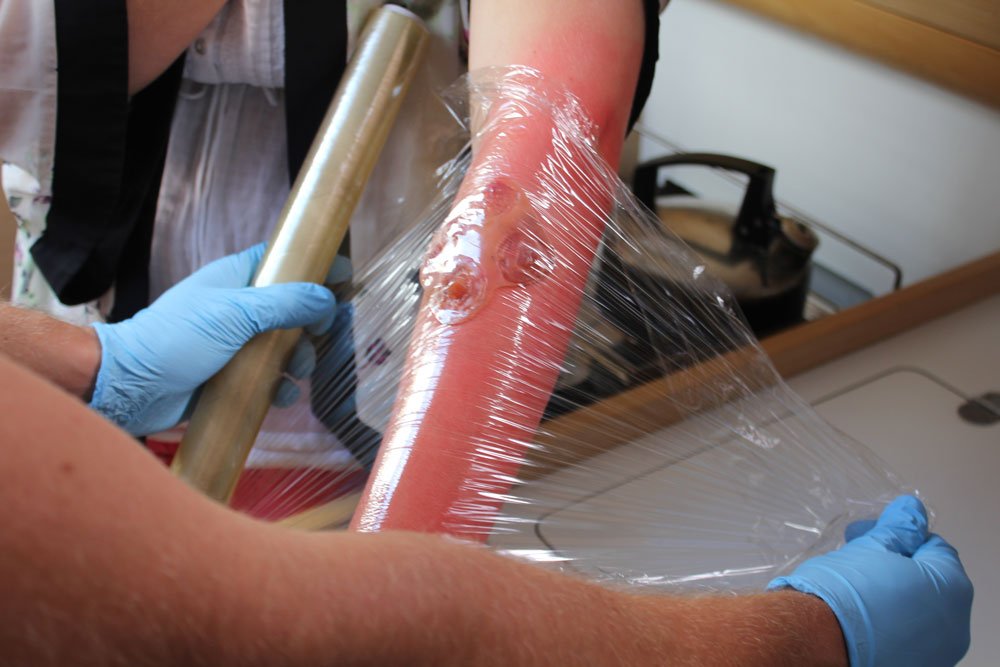
burn clingfilm

Burns

Minor burns and scalds are quite common at sea, especially for those working in a galley. These can be prevented by wearing protective clothing and footwear, but that is hardly going to be popular in hot summer temperatures.

Severe burns can cause deep tissue damage and there is a risk of shock for sufferers. Seek medical advice and be prepared to describe the area of the burn as well as the thickness of the skin affected. For the most severe cases you may need to administer CPR.

Treatment of burns:

Step 1  Immerse burnt area in cold water for a minimum of 15 minutes.

Step 2  Gently remove loose clothing but be careful not to remove clothing that has stuck to the skin.

Step 3  Apply sterile, non-stick dressings. Cling film can be used, but do not wrap tightly.

Step 4  Elevate the limb.

Step 5  Give antibiotics, painkillers and plenty of liquid with added sugar and a little salt.

Step 6  Treat for shock (see below).

Note: do not prick blisters, or cover facial burns or put ointments on broken skin.

Sunburn

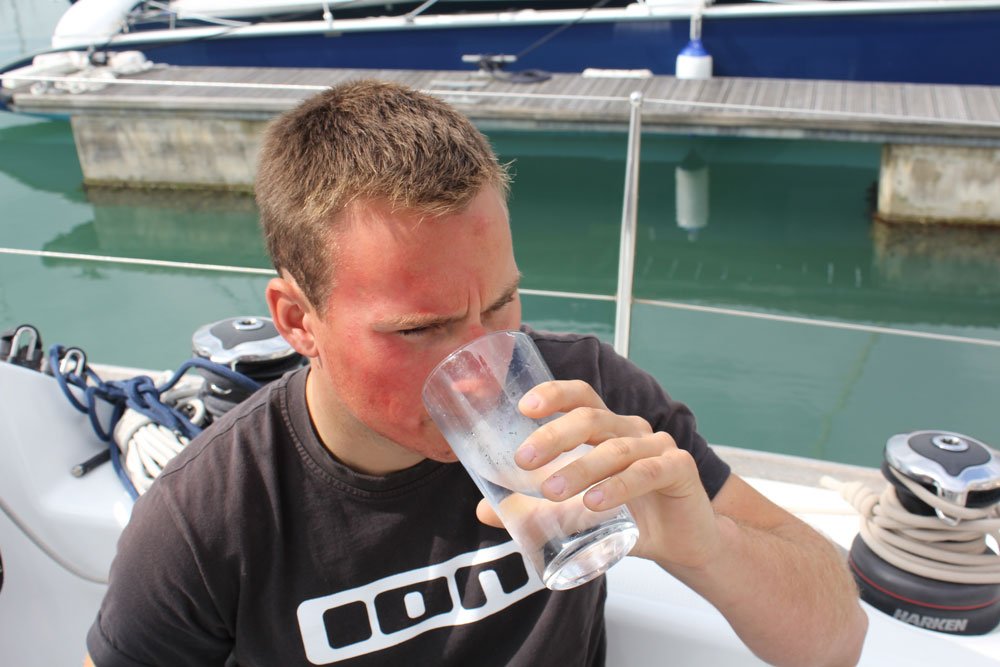
If a crew member is suffering from severe sunburn, cool the affected skin with lukewarm water, then apply calamine, after sun lotion or aloe vera gel. Cover up with loose clothing and keep the sufferer in the shade and well hydrated.

Liferafts

Liferafts should be stowed where they are ready for immediate launching. All crew should know the location of the liferaft and know how to launch, inflate and board it. They should also know what equipment it contains.

Fire safety advice at sea from the Marine & Coastguard Agency

Fire safety advice for boaters Top fire safety advice at sea: 1. Fit smoke alarms, carbon monoxide and gas detectors 2. Turn...

Jester Challenge 2022 – Sailing single handed from Plymouth UK to the Azores: Part 7 – Motivation

Jester Challenge – A modern experiment in old-fashioned self-reliance, self sufficiency, and personal responsibility. This is the seventh of a 10-part post where solo sailor, Bernie Branfield, shares his first-hand account of his single-handed, 2022 Jester Challenge, from Plymouth, UK to the Azores, in his 26′ Invicta Mk2, Louisa.

Hull inspection – the annual checks

With the boat ashore for the winter it is time to do a hull inspection - the annual checks. Are there any scratches and chips in the...

Tidal heights and the rule of twelfths

For those skippers who need to make a quick calculation or don’t have access to specific tidal curves for their location, it is possible to make an approximation using a system called the Rule of Twelfths. This is a simple method used to estimate the height of tide at any given time during the tidal cycle. It is based on the idea that the rise and fall of the tide is not constant, but follows a predictable pattern than can be divided into twelve parts.

Cutless bearing replacement

Cutless bearings can last for many years but if the propeller shaft is out of alignment they will wear through more quickly. If you have noticed a clunking sound when motoring then it could be a worn cutless bearing that is causing the problem.

Engine failure at sea – keeping the boat safe

If the engine stops when you are underway, or your have to shut it down when a warning buzzer sounds, you also need to make sure the boat remains safe. It’s important therefore to recognise situations in which the boat would be immediately put in danger if the engine were to fail.

Distress flares – which flare, how & when to use?

How to use distress flares at sea To effectively use distress flares at sea, you need to understand the different types, their purpose, and the...

Peer to Peer yacht charter – How can you monetize your boat?

There is a growing trend in peer to peer yacht charter. How does it work? People already rent rooms, cars and bikes from one...

Marine engine electrical system

The typical basic electrical system associated with a marine engine includes a dedicated engine starting battery, a starter motor, a charger in the form of an alternator, a solenoid and some engine sensors and instruments.

Sailing into a storm

Weather forecasting has become increasingly accurate, but despite this, I was caught out recently by a forecast that considerably underestimated the wind strengths and consequently was sailing single handed in to a Force 8 gale, which proved to be challenging!

Boat engine basics

Boat engines come in all shapes and sizes and include inboards, outboards, petrol, diesel, electric and hybrid systems. Some engines are...

Understanding your boat’s compass

Article submitted by Mike Rossiter, Certificated Compass Adjuster. Since the magnetic compass was first used by the Chinese...

Navigating narrow channels

Navigating narrow channels can present challenges for boat operators due to limited space, restricted manoeuvrability, and potential hazards such as shallows, rocks, or other vessels. To ensure safe passage through narrow channels, it’s essential to follow specific strategies and techniques.

Boating emergency – how to broadcast a MAYDAY emergency call

How to broadcast a MAYDAY emergency call   How to broadcast a MAYDAY emergency call if a vessel or person is in grave...

Estimating your position at sea

Navigators use a combination of techniques to estimate their position at sea. The primary method used today is GPS (Global Positioning System), a network of 24 satellites that became fully operational in the 1990s and was originally restricted for use by the United States military.

VHF DSC radio – how best to communicate at sea

There are many ways to communicate with others at sea. What makes the VHF DSC radio the best form of short range...

ColRegs Nav Lights & Shapes, Rules Of The Road and IALA Buoys Apps

ColRegs Nav Lights & Shapes, Rules Of The Road and IALA Buoys Apps Make Learning Rules on iPhone, iPad, iPod and Android...

Safe Skipper – crew management tips

Effective crew briefings are a vital part of the good on-board communication that helps everything to run smoothly on a sailing vessel at sea, whether it is cruising or racing.

Essential Knots: Figure of eight

Essential Knots: Figure of eight Use: Stopper knot, prevents a rope from being pulled through a hole e.g. through a block or...

Rudders and steering systems – Part 3

In the third of our three blog articles on rudders and steering systems, we look at how to replace rudder bearings and repair a water-saturated core.

How to improve a yacht’s upwind performance

There are several ways to improve the upwind performance of a sailing yacht. Read on for some useful tips including headsail reefing, heavy weather jibs and motor sailing.

Sail care and maintenance – Part 2

At the end of the sailing season sails should be washed and inspected carefully for damage, including small tears, stitching failure, ultraviolet damage, stains and mildew.

Boat maintenance below decks

While most interior maintenance work can be done when a boat is afloat, some jobs such as servicing the seacocks have to be done ashore. It makes sense to do any major interior repairs and improvements with the boat hauled out in the boatyard.

Tools and spares for your boat

Tools and Spares to take to sea!

You won’t regret taking a look at our essential tips and checklist to make sure you’re prepared for routine maintenance and those unexpected jobs that come up whilst you’re afloat!