Select Page

Reducing the risks of an accident happening at sea is a priority for every skipper of a leisure vessel, as is reducing the chance of any of the crew becoming ill.

The first line of defence against a medical emergency at sea is to avoid it in the first place, which may sound obvious but should be at the forefront of a skipper’s mind. This can be done in a positive, relaxed manner and it is worth reassuring your crew that medical emergencies at sea are a rarity.  At the same time there is a genuine need for the skipper to adopt a responsible attitude which means looking out for early signs of seasickness, making sure everyone moves about the boat safely, is wearing appropriate clothing, using sunscreen, is keeping hydrated and getting adequate rest.

It is important to make your crew aware of the potential hazards that a yacht underway presents, things like correct winch handling, the companionway steps and the boom, and ensure no one works on the engine when it is running.  It is also important to be aware of any of the crew’s medical conditions and to make a note of any medication they have with them before you depart.

first aid at sea shock

Knowledge and skills

At least one person on board should be trained in first aid and know how to administer the contents of the first aid kit, ensuring there are adequate supplies for the planned duration of the trip. All skippers and people who crew regularly are advised to do their basic marine first aid training ashore.

In the UK the one day RYA First Aid At Sea Course provides basic support and a working knowledge of first aid for those sailing within 60 nautical miles from a safe haven.

first aid at sea bleeding

What to do in an emergency

If there is a medical emergency aboard, a swift response plus basic knowledge and first aid skills can help you get a dangerous situation under control and a potential disaster avoided.  As skipper, you will need to decide which of the following courses of action to take:

  1. Does the situation call for immediate evacuation of the casualty?
  2. Should you sail directly to the nearest port?
  3. Should you sail to a port that is more convenient for you?
  4. Should you continue with your original passage plan?

In the absence of professional medical advice on board, it is vital to know how to assess the casualty’s condition and if needs be to administer first aid, to communicate the casualty’s condition accurately to professionals ashore and to understand what can be done to alleviate and control the situation.  With this information, the skipper can then decide on a course of action.

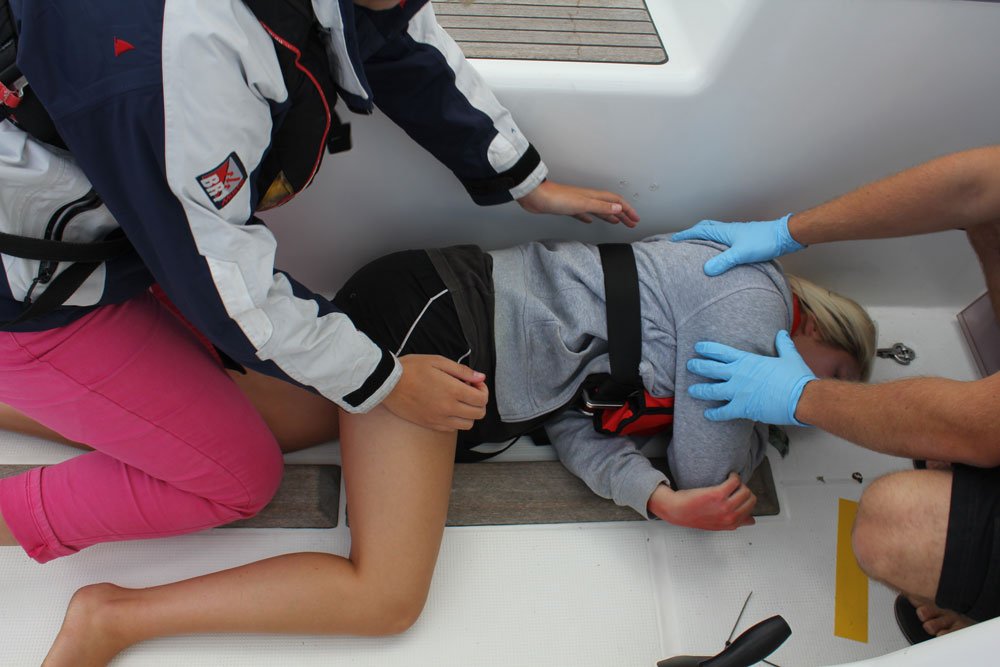
While first aid is being given to the casualty, the safety of the crew and vessel must remain paramount. Ensure the vessel is kept well under control and out of danger. If necessary, slow the vessel down and alter course to prevent the casualty being bumped about.

first aid at sea compressions

Assessing a casualty

Start with a Primary Survey. The Primary Survey is also referred to as the ABC check: A for Airway, B for Breathing and C for Circulation.

Airway – First check that the casualty’s airway is open. If conscious, check for choking or suffocation. If unconscious, lift the chin with two fingers and gently tilt the head back to open the airway.

Breathing – Check the casualty’s breathing. Look, listen and feel for breathing for 10 seconds. If the casualty is not breathing, begin CPR immediately – ie chest compressions and rescue breathing (mouth-to-mouth).

Circulation –  Check for signs of external or internal bleeding. Control severe bleeding with direct or indirect pressure.

Right boat vs Wrong boat – Over 30 Ways to Cut the Cost of Your Sailing and Cruising

Sailing and cruising offer unparalleled freedom and adventure, but they can quickly become costly. Fortunately, there are numerous strategies to help you enjoy the open water without breaking the bank. Here are over 30 practical ways to cut your sailing and cruising costs.

Rudders and steering systems – Part 3

In the third of our three blog articles on rudders and steering systems, we look at how to replace rudder bearings and repair a water-saturated core.

Sailing & Motoring in Fog

Sailing & Motoring in Fog You can only measure the visibility accurately if sailing & motoring in fog when you have...

Keel maintenance and Repair – Part 2

If you have ever witnessed a boat colliding with a rock or other submerged obstacle you will know that there is an almighty thump and the whole boat shakes and judders. While such hard groundings seldom result in catastrophic keel failure, something has to give and even the sturdiest keels can easily be damaged by such an impact.

Narrowboating on the Kennet and Avon Canal

A recently cancelled sailing event I was due to take part in left us with a free weekend in the diary. Given that my wife and I were celebrating a bumper wedding anniversary and the weather forecast was for fine weather, we decided to hunt around for a last minute canal holiday.

What boating skills should you have before you buy a yacht?

Many people dream of owning a yacht and sailing off into the blue yonder. What boating skills should you have before you buy...

Essential boat engine checklist

Boat engine checklist Engine oil level check Even if you have checked it previously, confirming the engine oil level is up...

Top five windvane self steering installation questions

Top five windvane self steering installation questions answered by Sarah Curry of Hydrovane International Marine, courtesy of Viki Moore from Island Cruising NZ

Fire safety advice at sea from the Marine & Coastguard Agency

Fire safety advice for boaters Top fire safety advice at sea: 1. Fit smoke alarms, carbon monoxide and gas detectors 2. Turn...

Five dangers a vessel may encounter at sea

What are the main dangers a vessel may face at sea and what should skippers do to reduce the risk of these happening?

Boat electrics

All boat owners should have a basic knowledge of electrics, both to avoid encountering electrical problems at sea and to stand a chance of solving them should they occur.

Fire prevention on boats

  Fire prevention on boats - common causes of fire: • Smoking below decks • Galley cookers • Build-up of butane or...

Antifouling for leisure boats – Part 1

Boats that are kept afloat can very quickly become a home for small marine organisms such as barnacles, weed and slime. Applying an antifouling paint to your hull is necessary to protect it from these micro-organisms, as a fouled hull can cause problems and will slow down a boat’s maximum speed considerably if left unchecked.

How to read nautical charts

Whilst most sailors today rely on GPS to find their way at sea, nautical charts are a crucial tool for any sailor to navigate safely and effectively. Here is a reminder of some of the basic steps involved in reading a nautical chart:

Sail care and maintenance – Part 2

At the end of the sailing season sails should be washed and inspected carefully for damage, including small tears, stitching failure, ultraviolet damage, stains and mildew.

Competent crew skills: arriving and leaving a berth

Skilled boat handling is needed when entering or leaving harbour. Crew tasks include preparing the mooring lines and fenders before docking and...

Sailing at the touch of a button

Easier and more controlled sail handling can also be achieved by powering up a furling mast. I came across some interesting solutions at the Southampton Boat Show this week on the Selden Mast stand, where they were running demos of their E40i electric winch and SMF furling system.

Competent crew skills: mooring lines

Mooring lines are used when arriving or leaving a berth. One of the most important competent crew skills is to know how to...

Jester Challenge 2022 – Sailing single handed from Plymouth UK to the Azores: Part 7 – Motivation

Jester Challenge – A modern experiment in old-fashioned self-reliance, self sufficiency, and personal responsibility. This is the seventh of a 10-part post where solo sailor, Bernie Branfield, shares his first-hand account of his single-handed, 2022 Jester Challenge, from Plymouth, UK to the Azores, in his 26′ Invicta Mk2, Louisa.

Jester Challenge 2022 – Sailing single handed from Plymouth UK to the Azores: Part 3 – Preparations

Jester Challenge – A modern experiment in old-fashioned self-reliance, self sufficiency, and personal responsibility. This is the third of a 10-part post where solo sailor, Bernie Branfield, shares his first hand account of his single-handed, 2022 Jester Challenge, from Plymouth, UK to the Azores, in his 26′ Invicta Mk2, Louisa.

Boat plumbing maintenance & troubleshooting

A boat’s fresh water system needs annual maintenance to keep it in good condition. Some boats have far more complex systems than others, with pressurised hot and cold water, associated pumps, an accumulator, calorifier and pressure valves, all to keep a boat owner busy.

Boat interior varnishing

Most boat interiors have a combination of varnished and painted surfaces including solid wooden joinery, plywood laminates with thin hardwood veneers and glass reinforced plastic. When making your assessment of what you are going to do, bear in mind that the varnishing process consumes a lot of time, especially if the existing surfaces are in poor shape.

Stress cracks on GRP boats

It is quite common to find cracks in the gelcoat when inspecting the deck and superstructure of a GRP boat. It is important to differentiate between a gelcoat crack and a scratch.

How to operate a winch

Winches are drum shaped mechanical devices used to handle halyards, sheets and control lines. One of the important crew...

How to cope with an emergency at sea

A safe skipper will be mentally prepared for all kinds of potential emergencies happening at sea, including medical emergencies, engine failure, fire, a holed hull, capsize and dismasting.