Select Page

Essential boat engine checklist

Essential boat engine checklist

Boat engine checklist

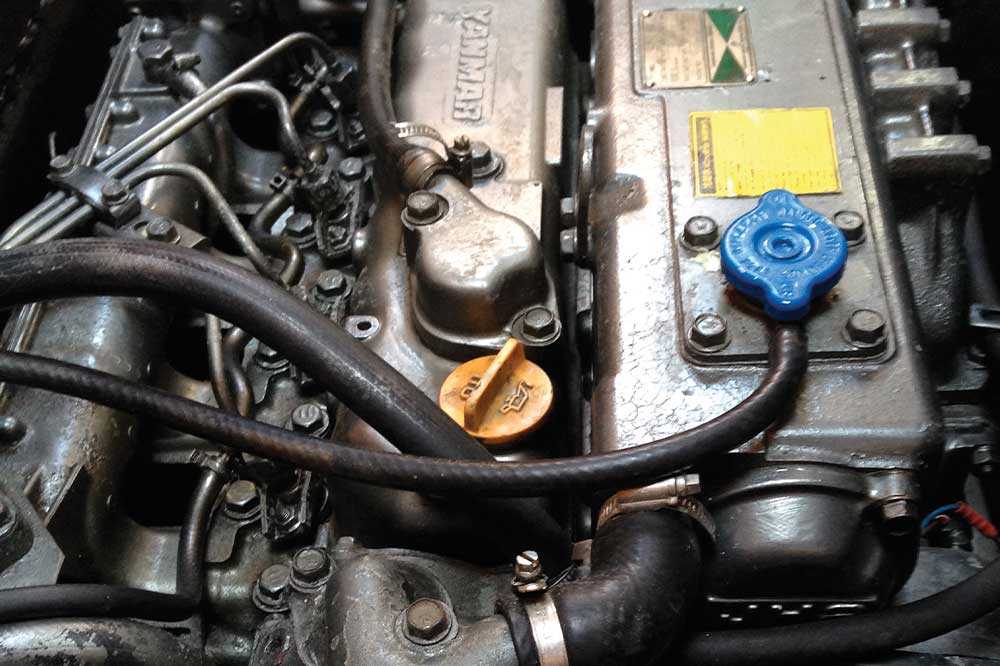
Engine oil level check

Even if you have checked it previously, confirming the engine oil level is up to scratch will give you peace of mind on a passage.

Cooling water check

It is the same with the cooling water in the engine. Check the water level before you start up the engine.

Spare oil on board

Carrying some spare oil for the engine is a wise precaution just in case a leak develops.

Fuel filter check

If your primary fuel filter has a glass bowl then a quick check to confirm that there is no water or dirt in the bowl will give you peace of mind on the passage.

Sea water intake filter check

Most water intakes have a clear top so you can check that there is no debris or seaweed inside that might block the filter.

Seacocks open

You will often close the seacocks when in harbor so make sure that they have been opened before you start the main engine and check that all other necessary seacocks are also open.

Loose equipment stowed and secured

The last thing you want in the engine room and steering compartment is any loose equipment or tools wandering around when the boat starts moving in a seaway, so check that everything is secure.

Battery and electrical switches

The battery switches should all be open before going to sea and check that switches with multiple choices are set to the right position.

Check the belt drive for the water pumps and the alternator

A quick feel of the amount of slack in the drive belts will confirm that they will work correctly, thus reducing the chance of slipping or breakage when out at sea.

Stern gland

This may be of the type that needs greasing at regular intervals so make sure the greaser is full and screw it down a turn or two.


From the new app for iPhone & Android:

Dag Pike’s Boating Checklists

ag Pike began his career as a merchant captain, went on to test lifeboats, and took up fast boat navigation, winning a string of trophies for powerboat races around the world, including navigating Richard Branson's Virgin Atlantic Challenger on the record-breaking fastest Atlantic crossing by powerboat.

About the author:

Dag Pike began his career as a merchant captain, went on to test lifeboats, and took up fast boat navigation, winning a string of trophies for powerboat races around the world, including navigating Richard Branson’s Virgin Atlantic Challenger on the record-breaking fastest Atlantic crossing by powerboat.


Engine failure at sea – common causes and how to avoid them

Many engine failures are caused by lack of maintenance, resulting in fuel filter blockages, water pump failures, overheating and other breakdowns. Indeed, one of the most common reasons for marine rescue service call outs is for one of the most basic reasons possible – boats that have run out of fuel.

Rewiring a boat – overcoming the challenges involved

Skippers need to have a basic knowledge of boat electrics, to avoid potential problems and to be able to solve them when they happen.

Marine toilets – care and maintenance

There are a number of different types of marine toilet, or heads. They fall into one of three categories – manual, electric and vacuum, the most common being the manual, hand pumped type. These have double acting piston-pumps which both discharge the waste and flush the toilet with sea water.

How to predict wind direction and strength by reading a weather chart

Weather charts, also known as surface pressure or synoptic charts, contain a lot of information that helps weather...

How diesel engines work

The basic principle of a diesel engine is less complex than that of a petrol engine. No spark plug or ignition system is needed, making the basic diesel engine a comparatively straightforward system that results in fewer faults and has lower maintenance costs than a petrol engine.

Wooden Hull Repairs

While wooden boat hull maintenance is mostly straightforward, it is always a good idea to take expert advice on any repair job needed doing to a wooden boat, unless you have done the job before and know what you are doing.

Jester Challenge 2022 – Sailing single handed from Plymouth UK to the Azores: Part 5 – Boat Management

Jester Challenge – A modern experiment in old-fashioned self-reliance, self sufficiency, and personal responsibility. This is the fifth of a 10-part post where solo sailor, Bernie Branfield, shares his first hand account of his single-handed, 2022 Jester Challenge, from Plymouth, UK to the Azores, in his 26′ Invicta Mk2, Louisa.

Fixing position at sea using traditional methods

This post looks at some traditional methods used for fixing a vessel’s position at sea, within sight of land. Electronic fixes using chart plotters are very straightforward to record, but if for some reason a vessel’s electronics are faulty it is essential that a skipper knows how to use traditional methods.

Jester Challenge 2022 – Sailing single handed from Plymouth UK to the Azores: Getting to the Start

Jester Challenge – A modern experiment in old-fashioned self-reliance, self sufficiency, and personal responsibility. This is the start of a 10-part post where solo sailor, Bernie Branfield, shares his first hand account of his single-handed, 2022 Jester Challenge, from Plymouth, UK to the Azores, in his 26′ Invicta Mk2, Louisa.

2023 Rolex Fastnet Race

Safe Skipper’s Simon Jollands took part in the 2023 Rolex Fastnet Race – a classic offshore sailing event. This is the first of several articles on the race and focuses on the start.

Sailing at the touch of a button

Easier and more controlled sail handling can also be achieved by powering up a furling mast. I came across some interesting solutions at the Southampton Boat Show this week on the Selden Mast stand, where they were running demos of their E40i electric winch and SMF furling system.

Learn ColRegs: Traffic Separation Schemes

Learn ColRegs Rule 10: Traffic Separation Schemes. (c) A vessel shall, so far as practicable, avoid crossing traffic lanes...

Antifouling for leisure boats – Part 1

Boats that are kept afloat can very quickly become a home for small marine organisms such as barnacles, weed and slime. Applying an antifouling paint to your hull is necessary to protect it from these micro-organisms, as a fouled hull can cause problems and will slow down a boat’s maximum speed considerably if left unchecked.

Pleasure craft safety equipment recommendations

Safety equipment is an important part of boat preparation and it is advisable for all pleasure craft skippers to check their vessel is...

Top Tips For Learning The ColRegs Boating Rules Of The Road

Colregs Boating Rules Of The Road
The International Regulations for Preventing Collisions at Sea (COLREGs) are a set of rules designed to prevent collisions between vessels. They are essentially the “rules of the road” for boats. Some key concepts within the COLREGs include:

Galvanic and electrolytic corrosion

Galvanic corrosion is an electrochemical reaction between two or more different metals, in the presence of an electrolyte (note salt water is a good electrolyte).

Understanding your mast and rigging

The rig of a sailing boat is put under huge stresses and strains so it is important for inspections of a yacht's spars and rigging to be...

How to ensure your boat is in proper working condition

In this article Eva Tucker from Volvo Penta presents a handy check list of all the things that you need to check regularly in order to make sure that your boat is in a seaworthy condition. Including maintenance, safety gear and electrical checks.

Boat gas system maintenance

There are correct types of hose for marine plumbing, sewerage, exhaust, cooling and gas and all hoses should be checked regularly for wear and deterioration.

Boat interior varnishing

Most boat interiors have a combination of varnished and painted surfaces including solid wooden joinery, plywood laminates with thin hardwood veneers and glass reinforced plastic. When making your assessment of what you are going to do, bear in mind that the varnishing process consumes a lot of time, especially if the existing surfaces are in poor shape.

Leaking decks

Leaking decks are perceived as a nuisance by some boat owners, but if leaks are ignored a much more serious situation may well be developing, especially in the case of boats with balsa or plywood deck cores. So deck leaks do need to be investigated and dealt with.

Rudders and steering systems – Part 3

In the third of our three blog articles on rudders and steering systems, we look at how to replace rudder bearings and repair a water-saturated core.

Boat decks and superstructure

The deck of a boat is constantly exposed to the elements and should be inspected on an annual basis. Particular attention needs to be given to the overall condition of deck fittings such as the stanchions, cleats and chainplates.

Steel and Aluminium Hulls

The two metals used for hull construction are steel and aluminium. These are both very strong materials and will last a long time as long as they are cared for, which primarily means protecting steel boats from rust and aluminium boats from electrolytic action.

Boating emergency – how to broadcast a MAYDAY emergency call

How to broadcast a MAYDAY emergency call   How to broadcast a MAYDAY emergency call if a vessel or person is in grave...