Select Page

Why is engine winterisation so important? The answer is because an inactive boat engine needs to be protected from corrosion during the winter, caused by the rising humidity levels through the cold months and the salty coastal air. This applies whether the boat is left afloat or hauled out over the winter.

Assuming the boat is coming ashore, it is best to winterise the engine in two stages – firstly when the boat is still in the water so you can run the engine and secondly as soon as possible after the boat is secure in the boatyard. You need to allow a few hours to do the work. If other commitments prevent you from doing this within a couple of weeks of lift out, then it would be a good idea to make arrangements for a service engineer to do this for you as winterising should be carried out before corrosion can set in.

Diesel boat engine winterisation

Winterisation will vary a little from engine to engine, so it is always best to check the manual. The following is a basic guide that applies to most engines:

Stage 1 – boat in the water

  1. Run the engine until it is warm. Check all the fuel lines and engine cooling hoses for leaks.
  2. Stop the engine, drain the oil and change the oil filter. Note: it is much easier to pump warm oil out of an engine than trying to do it when the engine is cold.
  3. Refill the engine with new oil as recommended by the manufacturer.
  4. Run the engine to check the oil filter is properly sealed. Switch off and double-check the oil level is correct.
  5. Fill up the fuel tank to eliminate water condensation in the tank – this is also easier to do before lift out as you can come alongside a fuel berth. Water entering the fuel injection system can cause considerable damage. Added to this, water in the fuel stimulates the growth of bacteria which clogs up the filters. Smear some vaseline around the fuel filler cap threads to make it 100% watertight and easier to open in the spring – there is nothing more maddening than a seized fuel filler cap that will not budge.

diesel boat engine impeller

Stage 2 – in the boatyard

  1. Once ashore, protect engine cylinders by removing the injectors and spraying anti-corrosion oil into the cylinders while turning the engine by hand – plain engine oil can be used but special anti-corrosion oil is best. Use a ring spanner on the crank pulley to help turn the engine.
  2. Engines with closed circuit fresh water cooling systems should contain a 50:50 solution of antifreeze, or as recommended by the engine manufacturer. Drain the circuit and replace as necessary.
  3. Drain and flush the sea or raw water circuit with fresh water before filling it with an antifreeze mixture to protect it over the winter months. Do this as follows:

(i) Close the inlet seacock to the engine (engine stopped).

(ii) Disconnect the sea water inlet pipe and dip it into a bucket containing 50:50 antifreeze solution.

(iii) Start the engine (out of gear) and run for 10 seconds or so until the antifreeze is used up and can be seen coming out of the exhaust outlet.

(iv) Shut the engine off and reconnect the inlet pipe to the seacock.

  1. Remove the water pump impeller. The reason for doing this is that if the vanes remain in one position for months on end then they can become permanently deformed and more prone to failure.
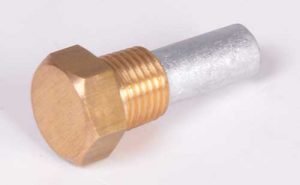
  2. Most engines with raw water cooling have sacrificial zinc anodes to protect the engine from corrosion. On someboat engine zinc anode engines the anode is attached to a bolt which screws into one of the end caps of the heat exchanger. The easiest time to replace this is during winterisation. Check your manual to find out where it is.
  3. Slacken the alternator and water pump drive belts to extend their life.
  4. Protect the instrument panel and give the key switch a spray with WD40 or equivalent.
  5. Also protect the engine electrical circuit by disconnecting the connections and spraying them with WD40 or a water repellant spray.
  6. Clean and inspect the engine from all angles, making sure there are no water, fuel or oil leaks and that all the jubilee clips are in good condition and tight. Also clean the bilges to help reduce humidity and to make it easier to check for leaks that might develop.
  7. Lubricate the throttle and gear levers and linkages.
  8. Plug the exhaust outlet and air intake with rags to prevent any moisture from reaching the engine.
  9. Disconnect the engine battery and clean the terminals. Take the batteries home so they can be trickle charged and stored where they cannot freeze. Note that some owners store batteries on board if they have shore power for trickle charging and can keep the boat interior above freezing through the winter.

Jester Challenge 2022 – Sailing single handed from Plymouth UK to the Azores: Part 6 – Communications

Jester Challenge – A modern experiment in old-fashioned self-reliance, self sufficiency, and personal responsibility. This is the sixth of a 10-part post where solo sailor, Bernie Branfield, shares his first-hand account of his single-handed, 2022 Jester Challenge, from Plymouth, UK to the Azores, in his 26′ Invicta Mk2, Louisa.

Preparing for sailboat cruising

Preparing for a sailing trip entails a lot of planning. In this blog, we take a look at some of the many safety aspects that a skipper needs to consider before heading off on a cruise.

Boat electrics

All boat owners should have a basic knowledge of electrics, both to avoid encountering electrical problems at sea and to stand a chance of solving them should they occur.

Learn ColRegs: Traffic Separation Schemes

Learn ColRegs Rule 10: Traffic Separation Schemes. (c) A vessel shall, so far as practicable, avoid crossing traffic lanes...

Steel hull maintenance

A steel boat owner’s biggest enemy is corrosion. You don’t have to worry about osmosis or rotting timbers, instead rust is the number one issue that will keep you awake at night.

Five dangers a vessel may encounter at sea

What are the main dangers a vessel may face at sea and what should skippers do to reduce the risk of these happening?

Understanding tide tables and tidal curves

There are many factors that influence local tidal patterns and it’s essential for every sailor to have a good understanding of tide tables and tidal charts to ensure they can calculate the level of tide at any given time.

Wooden Hulls – Part 1

Traditional wooden boats have a plank on frame construction, a centuries old boat building method that is still in use today. Variations of the traditional method include carvel, clinker and strip planking, which all relate to the way the planking is attached to the frame.

Cleaning & polishing gelcoat topsides

The gelcoat topsides of a GRP boat can be pampered and restored to their former glory relatively easily when it is ashore. Gelcoat is only a very thin outer layer of the hull, often less than 1mm thick, so you should avoid cleaning it with highly abrasive cleaners, or an-ything that could potentially damage its surface.

The Round The Island Race 2023

This year’s Round the Island Race turned out to be a really thrilling and competitive event. 1100 boats entered the race, which took place on Saturday 1st July. The race started from the world famous Royal Yacht Squadron line in Cowes UK, with the largest and fastest boats starting first, leaving the rest of us to wait our turn.

Essential Knots: Clove hitch

Essential Knots: Clove hitch Use: Tying a rope to posts, bollards, rings or a guardrail. Step 1. Make a turn around the object and lay...

Navigating Through Rough Waters: Tips for Handling Adverse Weather Conditions in a Sailboat

Navigating through rough waters in a sailboat requires skill, preparation, and a good understanding of both your vessel and the environment. Here are some tips for handling adverse weather conditions including Preparation, Techniques, Safety and much more..

Docking a Motorboat

Docking a motorboat can be a challenging task, especially for beginners, but with practice and attention to detail, it becomes much easier. Here’s a step-by-step guide to help you dock your motorboat safely and efficiently.

Cleaning & polishing painted topsides

The gelcoat topsides of a GRP boat can be pampered and restored to their former glory relatively easily when it is ashore. Gelcoat is only a very thin outer layer of the hull, often less than 1mm thick, so you should avoid cleaning it with highly abrasive cleaners, or an-ything that could potentially damage its surface.

Navigating the Unknown: Boating in Limited Visibility

Sailing or Motor Boating in limited visibility, whether due to darkness, fog, or other adverse weather conditions, presents unique challenges for mariners. It requires a combination of skill, experience, and adherence to safety protocols to ensure a safe and enjoyable journey. In this article we will delve into the intricacies of sailing in such conditions, providing insights into preparation, navigation, and collision avoidance.

How to predict wind direction and strength by reading a weather chart

Weather charts, also known as surface pressure or synoptic charts, contain a lot of information that helps weather...

An explanation of the IALA maritime buoyage systems – IALA A and IALA B

What are the differences between the two IALA buoyage systems, IALA Region A and IALA Region B, and where are they used?   As recently as the 1970s...

Stress cracks on GRP boats

It is quite common to find cracks in the gelcoat when inspecting the deck and superstructure of a GRP boat. It is important to differentiate between a gelcoat crack and a scratch.

How to tackle osmosis

Many owners of old GRP boats live in fear of osmosis, but what exactly is osmosis and what can be done about it? Osmosis comes about...

Boating emergency – how to broadcast a MAYDAY emergency call

How to broadcast a MAYDAY emergency call   How to broadcast a MAYDAY emergency call if a vessel or person is in grave...

Capsize – understanding the risks

A skipper should know how their boat will cope with rough seas. By working within known limits and understanding the risks,...

The VHF DSC Radio jargon buster

AIS - Automatic Identification System This system is used by shipping. It allows another vessel or coast station to use...

Getting a tow for your sail or power boat at sea or on inland waterways

FREE tips from the Safe Skipper App for iPhone/iPad/Android: Getting a tow for your sail or power boat Plan how to secure a...

Seized fixings and fastenings

Maintaining a boat can be a rewarding experience but at times it can also be frustrating. A prime example of this is when you come across a seized fixing or fastening that refuses to budge. Read our tips on how to release and fix them:

Boat plumbing maintenance & troubleshooting

A boat’s fresh water system needs annual maintenance to keep it in good condition. Some boats have far more complex systems than others, with pressurised hot and cold water, associated pumps, an accumulator, calorifier and pressure valves, all to keep a boat owner busy.