


Antifouling for leisure boats – Part 2
It is a good idea to carry out an inspection of your boat’s hull condition as soon as possible after it has been lifted out and pressure washed. Check all the surfaces of the hull below the waterline and remove any signs of remaining barnacles using a scraper. A...
Antifouling for leisure boats – Part 1
Boats that are kept afloat can very quickly become a home for small marine organisms such as barnacles, weed and slime. Applying an antifouling paint to your hull is necessary to protect it from these micro-organisms, as a fouled hull can cause problems and will slow...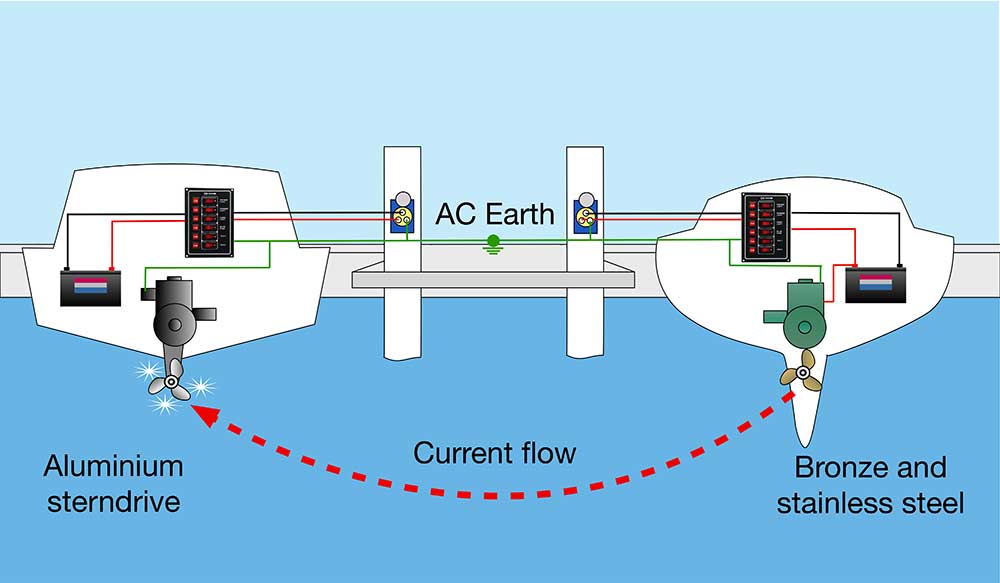
Galvanic and electrolytic corrosion
If sacrificial anodes are disappearing very quickly this can indicate there is a galvanic or electrolytic problem caused by electrical currents, which means an electrical circuit is being made for some reason. In order to understand what could be going on, it is worth...
Steel hull maintenance
A steel boat owner’s biggest enemy is corrosion. They don’t have to worry about osmosis or rotting timbers, instead rust is the number one issue that will keep them awake at night. Steel hull maintenance mainly involves checking inside and outside the hull...
Steel and Aluminium Hulls
The two metals used for hull construction are steel and aluminium. These are both very strong materials and will last a long time as long as they are cared for, which primarily means protecting steel boats from rust and aluminium boats from electrolytic action. Metal... Download from iTunes
Download from Google Play
 Download from iTunes
Download from Google Play
 Download from iTunes
Download from Google Play
 Download from iTunes
Download from Google Play
 Download from iTunes
Download from Google Play
 Download from iTunes
Download from Google Play
 Download from iTunes
Download from Google Play
 Download from iTunes
Download from Google Play

⚓️ Pre-start engine checks = fewer breakdowns at sea![]()
![]() Nearly 1 in 3 marine callouts are caused by mechanical failure - many avoidable with a simple routine before you start up!!
Nearly 1 in 3 marine callouts are caused by mechanical failure - many avoidable with a simple routine before you start up!!![]()
![]() 🔧 Key checks to run through:
🔧 Key checks to run through:![]() ❑ Cooling system clear & water flowing
❑ Cooling system clear & water flowing![]() ❑ Fuel level (plus reserve) & clean filters
❑ Fuel level (plus reserve) & clean filters![]() ❑ Engine & gearbox oil topped up
❑ Engine & gearbox oil topped up![]() ❑ Belts, hoses & leaks inspected
❑ Belts, hoses & leaks inspected![]() ❑ Battery switched on & electrics set
❑ Battery switched on & electrics set![]() ❑ Seacocks open & raw water filter clean
❑ Seacocks open & raw water filter clean![]() ❑ Bilge blower run (if fitted)
❑ Bilge blower run (if fitted)![]()
![]() 👍 Bottom line: a quick pre-start check can prevent costly breakdowns, improve safety, and give peace of mind before heading out.
👍 Bottom line: a quick pre-start check can prevent costly breakdowns, improve safety, and give peace of mind before heading out.![]() More tips here: safe-skipper.com/pre-start-engine-checks/
More tips here: safe-skipper.com/pre-start-engine-checks/![]()
![]() #BoatingSafety #Seamanship #PreDepartureChecks #Sailing #Yachting #SafetyAtSea #Boating #Watercraft #Sailboat #SafeSkipper
#BoatingSafety #Seamanship #PreDepartureChecks #Sailing #Yachting #SafetyAtSea #Boating #Watercraft #Sailboat #SafeSkipper
This content isn't available right now
When this happens, it's usually because the owner only shared it with a small group of people, changed who can see it or it's been deleted.
