Select Page

If engines are installed and serviced correctly then most marine engines are very reliable, but they are not infallible and problems are more likely to occur if an engine is not taken care of and inspected from time to time, in addition to carrying out the all important engine servicing. One of the most important parts of the engine to check and service is the fuel system.

Fuel system checks

Regular checks of the fuel system are necessary throughout the year, especially the primary filter of a diesel engine fuel system. With the boat in the boatyard, it is a good opportunity to replace the fuel filters and then bleed the system to remove any air that might have entered the system as a result of replacing the filters. You will need to buy replacement filters as recommended by your engine manufacturer in advance.

Primary filter – this catches any water and dirt that might be in the fuel. Typically, this has a filter beneath which is a sealed glass bowl where dirt and water get trapped. To replace the filter do as follows:

Diesel engine primary filter

  1. Make sure the tank fuel stopcock is closed.
  2. Diesel is harmful to the skin, so wear protective gloves in case of fuel spillage (which is more than likely to occur). Also have some rags or paper towels at hand.
  3. Use a suitable container such as a glass jar or plastic container to catch all the fuel which will drain from the filter and bowl.
  4. Undo the drain screw at the base of the glass bowl to drain off the fuel into the jar.
  5. Now undo the central retaining bolt that holds the glass bowl and filter in place, carefully separating these from the retaining bracket above. There are normally rubber O-ring type seals between the bracket, filter and bowl. New seals are normally supplied with filters – it is best to check when ordering.
  6. Clean all the parts, paying particular attention to all the contact surfaces
  7. Reassemble with the new parts, including the new seals, taking care not to over tighten the bolt securing the bowl, filter and bracket together – only moderate pressure is required. Smear some diesel on the seals to help them bed in properly.
  8. Open the fuel stopcock and check for leaks.

Secondary filter – also known as a fine filter, the secondary filter is needed to separate the extra fine particles in diesel fuel that could damage the injectors. It does not need replacing as often as a primary filter, normally manufacturers recommend doing this after 200 hours’ use. There are two main types of secondary filters: spin-on style where the filter is contained in a metal canister and cartridge type filters where only the filter medium is replaced.

diesel engine secondary fuel filter

The replacement procedure for a spin-on filter is as follows:

  1. Make sure the tank fuel stopcock is closed.
  2. Unscrew the filter a half turn using a filter wrench, pipe wrench or strap.
  3. Now hold a plastic bag around the filter and continue to undo it by hand, being aware that it will be full of fuel. Then dispose of it in the boatyard’s recycling containers.
  4. Replace the rubber seal, smearing a little diesel fuel on the new seal to help it bed in.
  5. Carefully pour some diesel fuel into the new filter. This will help make bleeding the fuel system quicker. Note, to prevent spillage do not attempt to do this with a primary filter as in my experience assembling the new filter, seals and glass bowl is tricky enough without the new filter having fuel in it.
  6. Screw on the new filter and hand tighten it only.
  7. Bleed the fuel system and check for leaks.
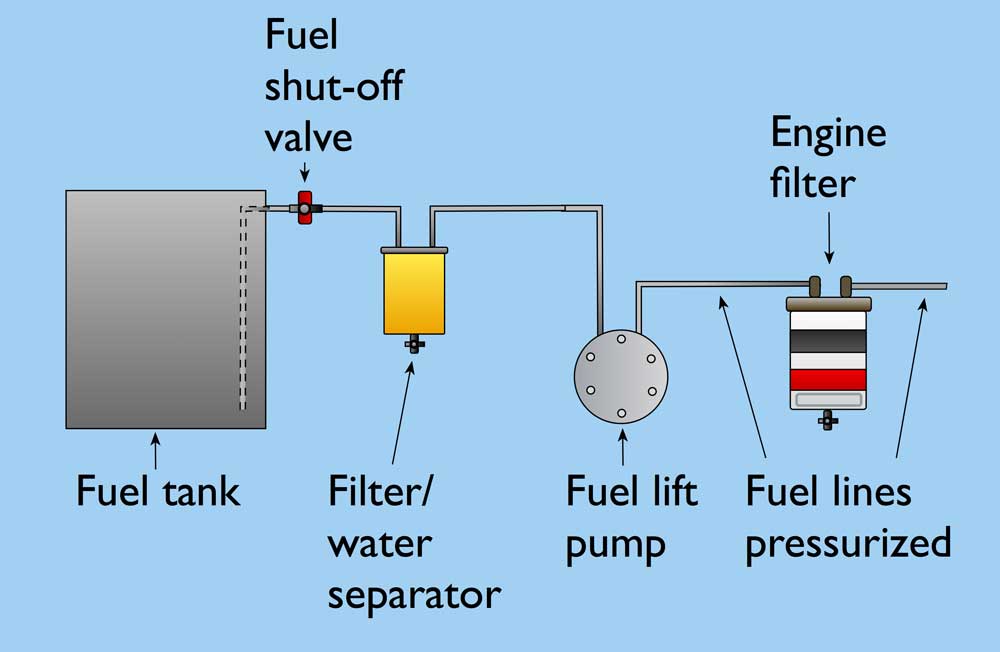
Diesel fuel system

 Bleeding the fuel system

When you replace the fuel filters, air gets trapped in the fuel system. This also happens if you run out of fuel. When you try to start the engine the trapped air prevents the fuel from flowing properly, hence the engine will run badly and may not start at all. This happens because if air bubbles get into the injector pipes the injector valve does not operate. Some engines do not require this as they are self-bleeding, but many do. These are the steps to take to bleed a fuel system:

  1. Turn the fuel tank stopcock on.
  2. You need a container and rags to catch drips from the fuel system as you bleed it and a small screw driver and/or spanner as required. If in doubt you may need to consult the manual. Wearing protective gloves is also a good idea.
  3. Identify where the hand priming lever is on the fuel lift pump and where the bleed screws are on the filter bodies and injection pump. These can be a little tricky to find for the first time in a cramped engine bay.
  4. If the primary filter is at a lower level than the fuel in the tank undo the bleed screw. Note you do not need to unscrew it completely.
  5. Fuel with bubbles will begin to appear, so hold a container beneath the filter to catch the drips. When the fuel runs clear, close the bleed screw.
  6. Wipe the primary filter dry.
  7. Unscrew the bleed screw on top of the secondary filter.
  8. Operate the hand priming lever on the fuel lift pump. If the lever won’t move, this will most likely be because the engine will have stopped where the pump is at the end of its travel. Try turning the engine over a little either with the starter or by hand, then try the pump again.
  9. Keep working the priming lever until clear fuel comes out with no bubbles and then tighten the bleed screw.
  10. Wipe the secondary filter dry.
  11. At this point the system should be bled and the engine should start but if not the injection pump and high pressure line may need bleeding.
  12. Bleed the injection pump next, having located the upper bleed screw.
  13. The last parts to bleed but only if necessary are the injector pipes. By this point an extra pair of hands will be of help to operate the starter.
  14. To do this, slacken the pipe connectors that join the pipes to the injectors one by one, cranking the engine in short bursts and checking for fuel escaping from the unions. Take care as fuel escaping from the injection pipes will be under very high pressure.
  15. Finally re-tighten all the fittings through the system, shut off the fuel tank stopcock, wipe everything dry and dispose of any spilt fuel.

A final note on this. Some boat owners prefer to wait and bleed the fuel system when the boat is back in the water. This enables the engine to be run for a while and checked over with the cooling system operational.

Seized fixings and fastenings

Maintaining a boat can be a rewarding experience but at times it can also be frustrating. A prime example of this is when you come across a seized fixing or fastening that refuses to budge. Read our tips on how to release and fix them:

Essential Knots: Round turn and two half hitches

Essential Knots: Round turn and two half hitches Use: Tying a rope to a pole or a ring. Step 1. Pass the end around the object. Step 2....

Boat interior varnishing

Most boat interiors have a combination of varnished and painted surfaces including solid wooden joinery, plywood laminates with thin hardwood veneers and glass reinforced plastic. When making your assessment of what you are going to do, bear in mind that the varnishing process consumes a lot of time, especially if the existing surfaces are in poor shape.

The Round The Island Race 2023

This year’s Round the Island Race turned out to be a really thrilling and competitive event. 1100 boats entered the race, which took place on Saturday 1st July. The race started from the world famous Royal Yacht Squadron line in Cowes UK, with the largest and fastest boats starting first, leaving the rest of us to wait our turn.

Liferafts

Liferafts should be stowed where they are ready for immediate launching. All crew should know the location of the liferaft and know how to launch, inflate and board it. They should also know what equipment it contains.

Jester Challenge 2022 – Sailing single handed from Plymouth UK to the Azores: Part 8 – Arriving at the Azores

Jester Challenge – A modern experiment in old-fashioned self-reliance, self sufficiency, and personal responsibility. This is the eighth of a 10-part post where solo sailor, Bernie Branfield, shares his first-hand account of his single-handed, 2022 Jester Challenge, from Plymouth, UK to the Azores, in his 26′ Invicta Mk2, Louisa.

Marine engine electrical system

The typical basic electrical system associated with a marine engine includes a dedicated engine starting battery, a starter motor, a charger in the form of an alternator, a solenoid and some engine sensors and instruments.

How diesel engines work

The basic principle of a diesel engine is less complex than that of a petrol engine. No spark plug or ignition system is needed, making the basic diesel engine a comparatively straightforward system that results in fewer faults and has lower maintenance costs than a petrol engine.

How to operate a winch

Winches are drum shaped mechanical devices used to handle halyards, sheets and control lines. One of the important crew...

How to read nautical charts

Whilst most sailors today rely on GPS to find their way at sea, nautical charts are a crucial tool for any sailor to navigate safely and effectively. Here is a reminder of some of the basic steps involved in reading a nautical chart:

How to cope with an emergency at sea

A safe skipper will be mentally prepared for all kinds of potential emergencies happening at sea, including medical emergencies, engine failure, fire, a holed hull, capsize and dismasting.

Sailing Safely at Night – Best Practice

Sailing at night can be a magical experience – the peaceful solitude, starry skies, and gentle lapping of waves create an unforgettable atmosphere. However, nighttime sailing also presents unique challenges and risks that require careful preparation and vigilance. This comprehensive guide will cover essential safety practices to ensure your nocturnal nautical adventures are both enjoyable and secure.

Finding your way at sea: waypoints

Any sea voyage needs a certain amount of planning before it is undertaken. It makes sense to think about where you are going, how you will get there and what factors might influence your plan. Planning the route itself is also critical. One of the essential parts of modern navigation is the use of waypoints.

Medical Emergency at Sea

How to deal with a medical emergency afloat   If you are planning a boating trip, it is important to have at least one...

Essential Knots: Sheet bend

Essential Knots: Sheet bend Use: Joining two ropes together. A sheet bend is particularly useful for joining two ropes of different...

Antifouling for leisure boats – Part 1

Boats that are kept afloat can very quickly become a home for small marine organisms such as barnacles, weed and slime. Applying an antifouling paint to your hull is necessary to protect it from these micro-organisms, as a fouled hull can cause problems and will slow down a boat’s maximum speed considerably if left unchecked.

Diesel engine winterisation

An inactive boat engine needs to be protected from corrosion during the winter, caused by the rising humidity levels through the cold months and the salty coastal air. This applies whether the boat is left afloat or hauled out over the winter. Read here about the two important stages of winterisaton for a diesel boat engine.

Essential Knots: Bowline

Essential Knots: Bowline Use: Making a secure eye or loop in the end of a rope. Bowlines have many uses on a boat, for example to make a...

Top Tips For Learning The ColRegs Boating Rules Of The Road

Colregs Boating Rules Of The Road
The International Regulations for Preventing Collisions at Sea (COLREGs) are a set of rules designed to prevent collisions between vessels. They are essentially the “rules of the road” for boats. Some key concepts within the COLREGs include:

Boating emergency – how to broadcast a MAYDAY emergency call

How to broadcast a MAYDAY emergency call   How to broadcast a MAYDAY emergency call if a vessel or person is in grave...

Wooden Hulls – Part 2

It is important to ensure the essential hull maintenance of a wooden boat is done, even if you are paying others to look after your boat for you. The priority is to prevent rot from taking hold. The protective layers of paint and varnish over wood are far more critical than on GRP boats, where the topsides are painted more for cosmetic reasons.

Sending distress signals

In an emergency situation at sea, it is a top priority is to know how to send and receive emergency radio calls and alert others of your predicament. Likewise, if you receive a distress signal, you must be ready to go to the help of others.

Light characteristics – how do navigators identify lights at night?

How do navigators identify the different types of light around our coasts at night and what are their characteristics?Navigating at...

What boating skills should you have before you buy a yacht?

Many people dream of owning a yacht and sailing off into the blue yonder. What boating skills should you have before you buy...

Boat gas system maintenance

There are correct types of hose for marine plumbing, sewerage, exhaust, cooling and gas and all hoses should be checked regularly for wear and deterioration.