Select Page

Whatever their size or type, all skippers have a responsibility to avoid collisions with other boats at sea.  It is important for all boat skippers to know the give-way hierarchy at sea to help avoid accidents. But how similar are the rules of the road on land and at sea?

On land, road users have signs to show them the way and warn them of hazards they are approaching.  They avoid collisions with others by following the road rules.  They use light and sound signals to indicate what their intentions are. 

Broadly speaking, all this happens at sea too.  There are navigation marks which act like road signs; there are road rules to prevent collisions and there are sound and light signals to tell others of a vessel’s intentions.  In addition there are some extra factors to get to grips with:

  • As there are no roads on the water, boats tend to move around in all directions. 
  • There are more diverse shapes and sizes of vessels on the water than there are vehicles on land.
  • There is a give way hierarchy between the types of vessel, which needs to be followed by all boat users.
  • Vessels display lights at night to tell others which direction they are moving in and what type and size of vessel they are.
  • Vessels display shapes during the day to tell others what type of vessel they are and certain activities which they may be involved in. 
  • There are navigation marks which identify safe water channels and hazards to be avoided.
  • There are light beacons which guide vessels safely towards land and into harbour at night.

Learn all of the nautical ColRegs Rules of the Road for power boating and sailing, in our comprehensive reference app, which includes a quiz to test yourself!

The give way hierarchy

If you are in charge of a boat you need to know what to do in a potentially dangerous close quarters situation and act accordingly.  It is important to know the ‘who gives way to whom’ hierarchy and this should be learnt by all boat operators.

Sailing boat hierarchy

Port tack gives way to starboard tack.

If on the same tack, the windward boat gives way.

If it is unclear to a sailing boat on port tack which tack another sailing boat to windward is on, then the boat on port tack must give way.

Power boat hierarchy
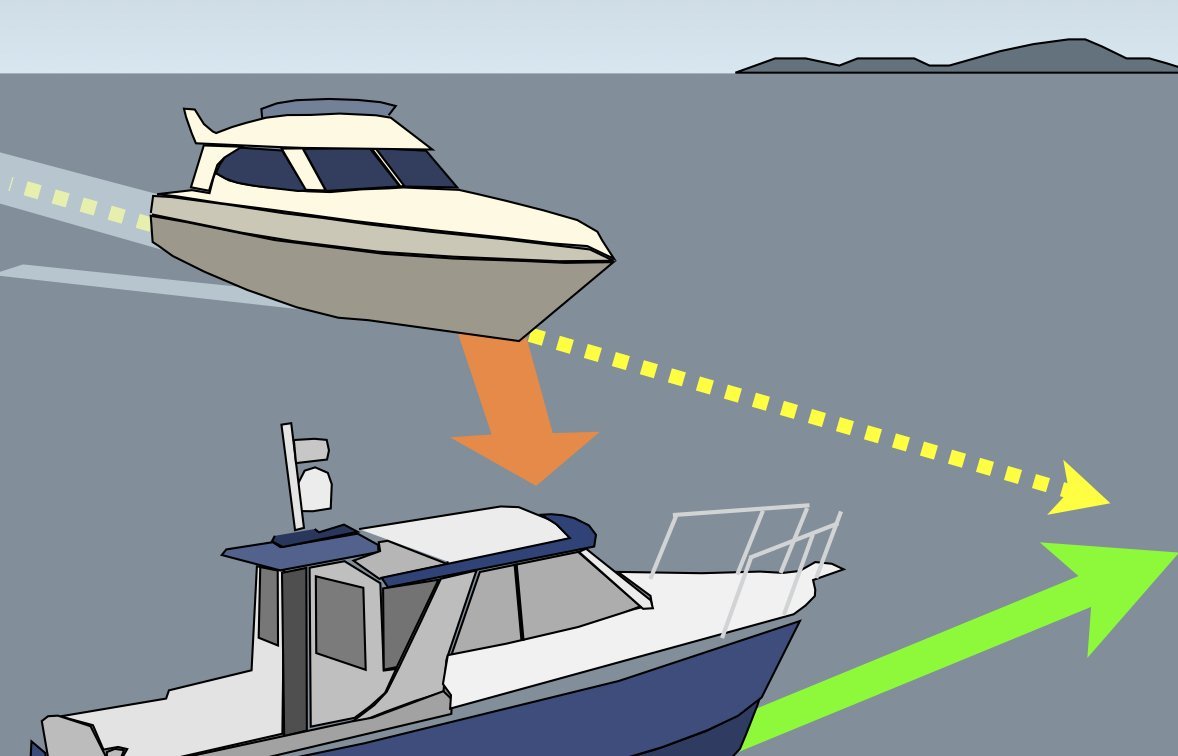
If two power boats are heading towards each other, both boats should alter course to starboard, so their port sides will pass each other.

If two power boats are crossing paths and there is a risk of collision, then the vessel which has the other on its starboard side must give way.  It must also avoid crossing ahead of the stand-on boat.

Narrow channels

All boats should keep to the right of narrow channels. Vessels of less than 20 metres in length and sailing vessels must stay clear of larger vessels who can only navigate within the channel.  It is often the case that smaller craft can operate safely outside a buoyed channel.

Give-way vessel

When two similar vessels are crossing, the one that has the other to its starboard side is the give-way vessel.

The ‘give-way’ boat is responsible for keeping clear and altering course where necessary to avoid a collision. The give-way boat should make an obvious course direction in plenty of time, so the stand-on vessel is in no doubt it has taken avoiding action.

Stand-on vessel

If you have the right of way you are the stand-on boat, keep to your course and speed to make it easier for the give-way boat to manoeuvre out of your way. If the give-way vessel does not take avoiding action, the stand-on vessel must be ready to turn quickly out of the way or stop as a last resort.

Overtaking

All vessels, whatever their size and type, must keep well clear of others when overtaking.

A vessel is said to be overtaking another if it is approaching more than 22.5º behind the other vessel’s beam.  This overtaking sector covers an arc of 135º, which is the same as the arc of a stern light.  At night, it is easy to tell if you are overtaking a vessel because you can see its stern light as you approach it. 

During the day, it is not always as easy to be sure you are in the overtaking sector.  Are you overtaking or alternatively are you crossing the other vessel’s path, in which case you could have right of way? If in doubt, it is always best to proceed with caution and keep well clear of the other vessel. 

Learn all of the nautical ColRegs Rules of the Road for power boating and sailing, in our comprehensive reference app, which includes a quiz to test yourself!

Rig check – how to prevent failure at sea

Regular rig checks prevent the risk of mast and rigging failure at sea. This includes regular rig inspections of the spars, ...

A simple guide to understanding tides when passage planning

Understanding tides when passage planning When planning a trip in tidal waters, check the tides before going afloat. Use...

Galvanic and electrolytic corrosion

Galvanic corrosion is an electrochemical reaction between two or more different metals, in the presence of an electrolyte (note salt water is a good electrolyte).

Estimating and plotting your position at sea

This post covers how we go about estimating and plotting our position using traditional methods, when out of sight of land – covering Dead Reckoning, Estimated Position, Tidal Streams, Leeway and more…

Keel maintenance and Repair – Part 2

If you have ever witnessed a boat colliding with a rock or other submerged obstacle you will know that there is an almighty thump and the whole boat shakes and judders. While such hard groundings seldom result in catastrophic keel failure, something has to give and even the sturdiest keels can easily be damaged by such an impact.

Boat maintenance below decks

While most interior maintenance work can be done when a boat is afloat, some jobs such as servicing the seacocks have to be done ashore. It makes sense to do any major interior repairs and improvements with the boat hauled out in the boatyard.

Sailboat rig checks – Part 2

In part two of Sail boat rig checks we run through some useful rig maintenance tips and then finish with a brief look at what a professional rig check involves.

Essential yacht tender safety for skippers and crew

Essential yacht tender safety - the dangers inherent in using a dinghy to get ashore from a moored or anchored yacht are all too easily...

ColRegs – avoiding collisions at sea

ColRegs - avoiding collisions at sea ColRegs Rule 8: Action to avoid collision (a) Any action taken to avoid collision shall...

Rudders and steering systems – Part 2

One thing all rudders have in common is that they have three main parts that need to be checked: the rudder, or a steerable drive leg in the case of many power boats; the system that joins the rudder to the steering; the steering control itself.

Jester Challenge 2022 – Sailing single handed from Plymouth UK to the Azores: Part 5 – Boat Management

Jester Challenge – A modern experiment in old-fashioned self-reliance, self sufficiency, and personal responsibility. This is the fifth of a 10-part post where solo sailor, Bernie Branfield, shares his first hand account of his single-handed, 2022 Jester Challenge, from Plymouth, UK to the Azores, in his 26′ Invicta Mk2, Louisa.

Boat ownership – some fundamentals

Owning a boat is a big commitment that should bring no end of satisfaction, but the costs of maintaining and keeping a boat are significant and should never be underestimated.

VHF DSC radio – how best to communicate at sea

There are many ways to communicate with others at sea. What makes the VHF DSC radio the best form of short range...

ColRegs Rule 14 – Head-on Situation

  ColRegs Rule 14: Head-on Situation (a) When two power-driven vessels are meeting on reciprocal or nearly reciprocal...

Tidal heights and the rule of twelfths

For those skippers who need to make a quick calculation or don’t have access to specific tidal curves for their location, it is possible to make an approximation using a system called the Rule of Twelfths. This is a simple method used to estimate the height of tide at any given time during the tidal cycle. It is based on the idea that the rise and fall of the tide is not constant, but follows a predictable pattern than can be divided into twelve parts.

An explanation of the IALA maritime buoyage systems – IALA A and IALA B

What are the differences between the two IALA buoyage systems, IALA Region A and IALA Region B, and where are they used?   As recently as the 1970s...

DIY boat upgrades: Budget-friendly projects to enhance your (older!) boat

DIY projects that can enhance both the functionality and aesthetics of your boat. In this article, we’ll explore a variety of DIY boat upgrades that won’t break the bank but will significantly enhance your boating experience.

Rewiring a boat – overcoming the challenges involved

Skippers need to have a basic knowledge of boat electrics, to avoid potential problems and to be able to solve them when they happen.

First Aid Afloat – Jellyfish Stings

Jellyfish stings are a common occurrence when boating or swimming in many parts of the world. While most stings are not serious, some can cause...

Top 5 Reasons Why an Inflatable SUP Should Be Your Next Yacht Accessory

In this article, inflatable paddle board expert Jason Paul gives the top 5 reasons why an inflatable SUP should be your next...

Distress flares – which flare, how & when to use?

How to use distress flares at sea To effectively use distress flares at sea, you need to understand the different types, their purpose, and the...

How to operate a winch

Winches are drum shaped mechanical devices used to handle halyards, sheets and control lines. One of the important crew...

Essential Boat Buying Tips for First-Time Boat Owners

The first question that comes to mind when thinking about buying a boat is: what type of boat? There are more than 20 different kinds, of different sizes, for different purposes, and different pockets. So, your first step is to decide your boat type.

Boat interior inspection and checks

While a boat is ashore, the most critical interior checks to carry out are those that concern the safety of the boat. This entails the integrity of all through-hull fittings and seacocks, the gas system and the electrical system.

Jester Challenge 2022 – Sailing single handed from Plymouth UK to the Azores: Part 10 – The Return Trip

Jester Challenge – A modern experiment in old-fashioned self-reliance, self sufficiency, and personal responsibility. This is the final instalment of a 10-part post where solo sailor, Bernie Branfield, shares his first-hand account of his single-handed, 2022 Jester Challenge, from Plymouth, UK to the Azores, in his 26′ Invicta Mk2, Louisa.