Select Page

Sailing & Motoring in Fog

You can only measure the visibility accurately if sailing & motoring in fog when you have another object in sight so assume that it is less than you think. It can take time to ‘see’ another vessel as you may not be looking directly at it when it first appears.

Speed in fog

You should be able to stop in half the distance of the visibility because a conflicting vessel will need a similar distance to stop. Slow speed is demanded.

Keeping a lookout in fog at sea

Post a crew member to keep a visual lookout, preferably stationed outside as you will be monitoring the radar and the chart plotter as well as trying to keep a lookout.

Using radar at sea

Radar is an important aid in fog but don’t expect it to pick up all the vessels around you particularly when the sea may be lively and wave clutter obstructs the centre of the display, obscuring small vessels.

Using the autopilot

The autopilot can be vital in fog as it avoids you having to concentrate on the steering and allows you to focus on the navigation. Make sure you know where the disconnect button is in case you need manual steering in a hurry.

Navigation in fog

You will not get many visual clues in fog so you will be heavily reliant on the chart plotter and/or the radar. Use both to check each other as well as the depth sounder.

Types of fog

Radiation fog is the one you get in the early morning mainly in harbours and it should clear when the sun warms things up. Advection fog is found at sea when warm moist air flows over a cold sea and needs a change of wind or sea temperature before clearing.

Sailing in fog

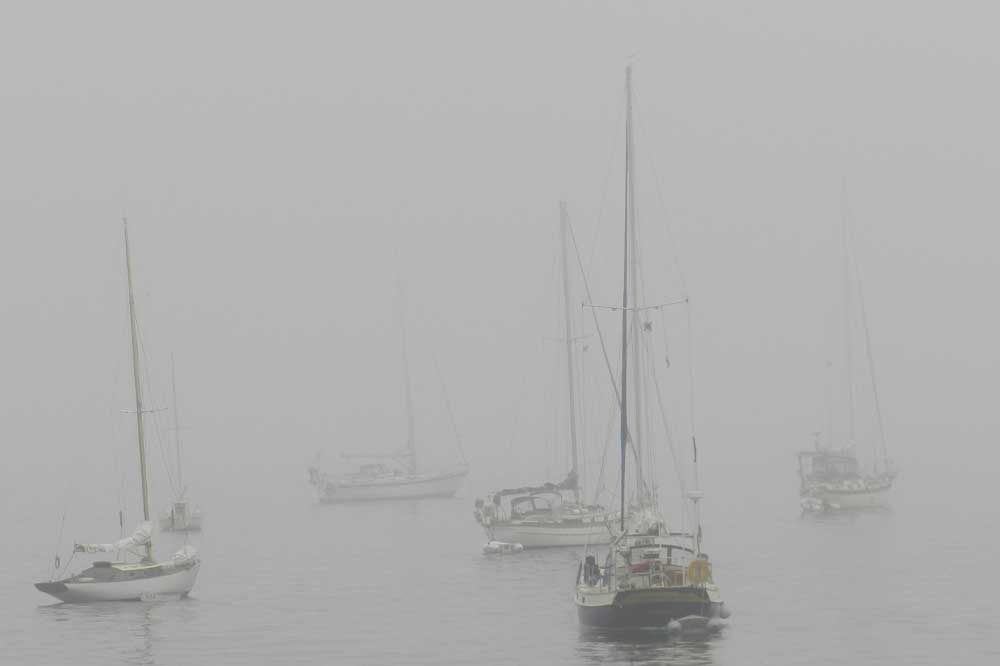
Ideally you should not be under sail in fog. You may not be able to manoeuvre quickly, the sail can obstruct visibility and white sails do not show up in fog.

Safety margins

Allow larger safety margins in fog particularly for making a landfall. Moderate your speed so you can stop or take avoiding action in good time.

Make your boat more visible

Have the navigation lights on even in daylight and if you have a searchlight have that one as well facing forward. The radar reflector should be up and working.

ag Pike began his career as a merchant captain, went on to test lifeboats, and took up fast boat navigation, winning a string of trophies for powerboat races around the world, including navigating Richard Branson's Virgin Atlantic Challenger on the record-breaking fastest Atlantic crossing by powerboat.

About the author:

Dag Pike began his career as a merchant captain, went on to test lifeboats, and took up fast boat navigation, winning a string of trophies for powerboat races around the world, including navigating Richard Branson’s Virgin Atlantic Challenger on the record-breaking fastest Atlantic crossing by powerboat.

He is now a navigation and powerboat journalist in demand all round the world.

Boat interior varnishing

Most boat interiors have a combination of varnished and painted surfaces including solid wooden joinery, plywood laminates with thin hardwood veneers and glass reinforced plastic. When making your assessment of what you are going to do, bear in mind that the varnishing process consumes a lot of time, especially if the existing surfaces are in poor shape.

Navigating Through Rough Waters: Tips for Handling Adverse Weather Conditions in a Sailboat

Navigating through rough waters in a sailboat requires skill, preparation, and a good understanding of both your vessel and the environment. Here are some tips for handling adverse weather conditions including Preparation, Techniques, Safety and much more..

2023 Rolex Fastnet Race – Part 3

This is our third and final article about the 2023 Rolex Fastnet Race. It is a first hand account by Simon Jollands who was one of the crew of Lancelot II, a Beneteau First 40 skippered by John Gillard.

Common medical emergencies at sea

A medical emergency aboard a boat at sea requires immediate attention to ensure the safety of the casualty and the crew in general. The skipper needs to know which crew members, if any, have had medical training or have a first aid qualification. All boats should carry first aid handbooks to help an untrained crew cope with a medical emergency.

Tacking a sailing boat

Tacking is the sailing manoeuvre used to change a boat's direction through an oncoming wind. Tacking a sailing boat calls for the crew to work as a...

Stern gear maintenance

The stern gear of a boat needs to be checked carefully when the boat is ashore as this is something that can only be done when it is out of the water. The same applies for any maintenance and repairs that may need doing, so it is best to check it all over as soon after an end of season lift out as possible.

VHF DSC radio – how best to communicate at sea

There are many ways to communicate with others at sea. What makes the VHF DSC radio the best form of short range...

Boat Handling – anchoring

Anchoring your yacht or motorboat Anchoring is one of the most important boat handling skills. If you can set an anchor...

Learn ColRegs: Traffic Separation Schemes

Learn ColRegs Rule 10: Traffic Separation Schemes. (c) A vessel shall, so far as practicable, avoid crossing traffic lanes...

Marine engine oil system maintenance

The regular maintenance of a marine diesel is key to preventing engine failure at sea. This means doing regular checks of the fuel, cooling, electrical and oil systems.

Diesel engine winterisation

An inactive boat engine needs to be protected from corrosion during the winter, caused by the rising humidity levels through the cold months and the salty coastal air. This applies whether the boat is left afloat or hauled out over the winter. Read here about the two important stages of winterisaton for a diesel boat engine.

Five dangers a vessel may encounter at sea

What are the main dangers a vessel may face at sea and what should skippers do to reduce the risk of these happening?

Sailing into fog – being prepared and staying safe

Most skippers will sensibly delay their departure, if fog is forecast. However, if fog begins to form when you are at sea it is important to be prepared, and know what precautions to take, to help make your vessel detectable or visible in fog and keep the crew safe.

How to trim a genoa sail

I recently had two new sails made by Sanders Sails, based in Lymington UK. The first to arrive was the new genoa and it took me a little while to get to know it and learn how to adjust it correctly. Here is an aide memoire for getting to know how to trim a genoa so that it will deliver the best performance.

How to cope with an emergency at sea

A safe skipper will be mentally prepared for all kinds of potential emergencies happening at sea, including medical emergencies, engine failure, fire, a holed hull, capsize and dismasting.

Competent crew skills: mooring lines

Mooring lines are used when arriving or leaving a berth. One of the most important competent crew skills is to know how to...

Distress flares – which flare, how & when to use?

How to use distress flares at sea To effectively use distress flares at sea, you need to understand the different types, their purpose, and the...

Sail care and maintenance – Part 2

At the end of the sailing season sails should be washed and inspected carefully for damage, including small tears, stitching failure, ultraviolet damage, stains and mildew.

Cutless bearing replacement

Cutless bearings can last for many years but if the propeller shaft is out of alignment they will wear through more quickly. If you have noticed a clunking sound when motoring then it could be a worn cutless bearing that is causing the problem.

Jester Challenge 2022 – Sailing single handed from Plymouth UK to the Azores: Part 7 – Motivation

Jester Challenge – A modern experiment in old-fashioned self-reliance, self sufficiency, and personal responsibility. This is the seventh of a 10-part post where solo sailor, Bernie Branfield, shares his first-hand account of his single-handed, 2022 Jester Challenge, from Plymouth, UK to the Azores, in his 26′ Invicta Mk2, Louisa.

Liferafts

Liferafts should be stowed where they are ready for immediate launching. All crew should know the location of the liferaft and know how to launch, inflate and board it. They should also know what equipment it contains.

Galvanic and electrolytic corrosion

Galvanic corrosion is an electrochemical reaction between two or more different metals, in the presence of an electrolyte (note salt water is a good electrolyte).

Boat maintenance log

Keeping a boat maintenance log is an ideal way of reminding owners what needs to be done to a boat and when. Read on for some tips,...

Cleaning & polishing painted topsides

The gelcoat topsides of a GRP boat can be pampered and restored to their former glory relatively easily when it is ashore. Gelcoat is only a very thin outer layer of the hull, often less than 1mm thick, so you should avoid cleaning it with highly abrasive cleaners, or an-ything that could potentially damage its surface.

Essential yacht tender safety for skippers and crew

Essential yacht tender safety - the dangers inherent in using a dinghy to get ashore from a moored or anchored yacht are all too easily...