Select Page

All boat owners should have a basic knowledge of electrics, both to avoid encountering electrical problems at sea and to stand a chance of solving them should they occur.

It goes without saying that the marine environment is bad news for electric systems and all their components, so maintaining them in good order is one boating essential that should not be overlooked.

Each and every boat has a unique combination of electronics, equipment, batteries and means of generating power. There is no one instruction manual that will talk you through your boat’s specific set up. So, in order to make sense of their specific boat’s electrical system an owner needs to have a reasonable grasp of how electrics work, especially with regards to boats. Understanding the basics means knowing about current, voltage, resistance and power.

While minor electrical repairs and updates can be carried out when a boat is afloat, major electrical installation work and re-wiring are best done when the boat is ashore. Undertaking a major job such as a complete re-wire is a time consuming operation and this does require more than a grasp of the basics. Unless you are confident you have the necessary skills it is best done by a qualified marine electrician or with the help of someone with advanced skills and experience of boat electrics, as has been my experience. It also calls for careful planning, problem solving skills, plenty of patience, dexterity and good eyesight. Being a contortionist can also help as well.

As with most boatyard jobs, time spent researching, planning, sourcing parts and having the right tools will pay dividends later on.

boat electrics

Basic electrics

Many first time boat owners have little knowledge and practical experience of electrics, sometimes little more than knowing how to wire a plug, change a fuse or reset a trip switch. This can be a little daunting at first, depending on the type and age of the boat, but the good news is that getting started is not that challenging.

The three basic concepts to get your head around are current (I), voltage (V) and resistance (R). Understanding what each means is key to understanding how electricity works –

Current – electric current is the flow of electrons. The number of electrons flowing through a wire per second is measured in amps (A). When used in a formula the abbreviation (I) is used.

Voltage – voltage is the force that pushes the current through a wire – it makes the current move. It is measured in volts (V).

Resistance – electrical resistance is the opposition or obstruction to the flow of an electric current. It is measured in ohms (Ω).

Voltage, current and resistance are closely related to one another and this relationship is known as Ohm’s Law where:

Current (I) through a wire can be calculated by dividing the voltage (V) by the resistance (Ω) or I=V/R.

Voltage (V) through a wire can be calculated by multiplying the current (I) by the resistance (Ω) or V=IxR.

Resistance (Ω) can be calculated by dividing the voltage (Ω) by the current (I) or R=V/R.

There is a fourth basic concept which needs introducing here and that is Power. Electrical power is measured in watts (W) and refers to the rate of energy consumed by a component or appliance. For example, in a domestic household a 2500 watt electric heater consumes electricity at a far higher rate than a 25 watt bulb – 100 times as much.

Power (W) can be calculated by multiplying the voltage (V) by the current (I) or W=VxI.

boat electrics

Essential boat electrics

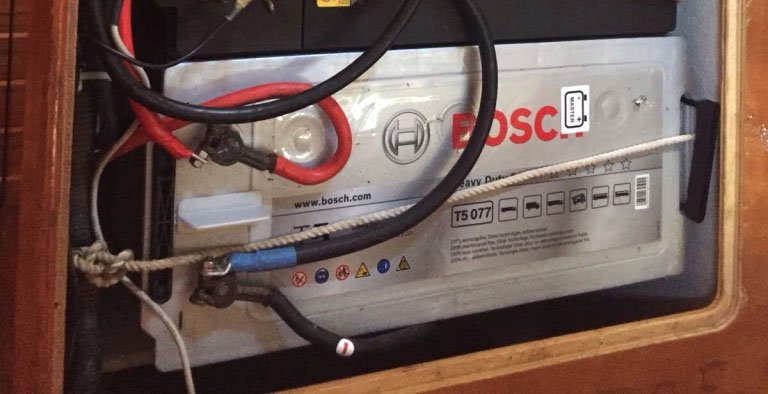
Small yachts and power boats have 12-volt DC (direct current) systems, although larger vessels will have 24-volt electrics. In most cases the system is split into two parts, one for starting the engine, the other for running all the other electrical equipment on board. There are usually two batteries (or banks of batteries) to ensure there’s always a well-charged battery for starting the engine that’s never used for anything else. In some cases there will also be a third system, with another dedicated battery (or bank of batteries) for powering high current equipment such as electric windlasses, bow thrusters and electric winches.

AC systems

Larger boats often have an alternating current (AC) generator to power domestic electrics. The generator can also charge the DC batteries instead of using the main engine.

The more common type of AC system relies on connecting to shore power when the boat is docked. This can be used to run domestic appliances and also to charge the batteries. Note that AC and DC systems must be kept separate.

Boat interior inspection and checks

While a boat is ashore, the most critical interior checks to carry out are those that concern the safety of the boat. This entails the integrity of all through-hull fittings and seacocks, the gas system and the electrical system.

Finding your way at sea: waypoints

Any sea voyage needs a certain amount of planning before it is undertaken. It makes sense to think about where you are going, how you will get there and what factors might influence your plan. Planning the route itself is also critical. One of the essential parts of modern navigation is the use of waypoints.

Essential Knots: Figure of eight

Essential Knots: Figure of eight Use: Stopper knot, prevents a rope from being pulled through a hole e.g. through a block or...

ColRegs Nav Lights & Shapes, Rules Of The Road and IALA Buoys Apps

ColRegs Nav Lights & Shapes, Rules Of The Road and IALA Buoys Apps Make Learning Rules on iPhone, iPad, iPod and Android...

Wooden Hulls – Part 2

It is important to ensure the essential hull maintenance of a wooden boat is done, even if you are paying others to look after your boat for you. The priority is to prevent rot from taking hold. The protective layers of paint and varnish over wood are far more critical than on GRP boats, where the topsides are painted more for cosmetic reasons.

Jester Challenge 2022 – Sailing single handed from Plymouth UK to the Azores: Part 7 – Motivation

Jester Challenge – A modern experiment in old-fashioned self-reliance, self sufficiency, and personal responsibility. This is the seventh of a 10-part post where solo sailor, Bernie Branfield, shares his first-hand account of his single-handed, 2022 Jester Challenge, from Plymouth, UK to the Azores, in his 26′ Invicta Mk2, Louisa.

Hull inspection – the annual checks

With the boat ashore for the winter it is time to do a hull inspection - the annual checks. Are there any scratches and chips in the...

Steel hull maintenance

A steel boat owner’s biggest enemy is corrosion. You don’t have to worry about osmosis or rotting timbers, instead rust is the number one issue that will keep you awake at night.

What boating skills should you have before you buy a yacht?

Many people dream of owning a yacht and sailing off into the blue yonder. What boating skills should you have before you buy...

Dripless shaft seals

Dripless shaft seals are designed to completely stop water from entering a boat’s hull via the stern tube. There are two main types of dripless seals known as face seals and lip seals which many boat manufacturers now fit to production boats.

Understanding tide tables and tidal curves

There are many factors that influence local tidal patterns and it’s essential for every sailor to have a good understanding of tide tables and tidal charts to ensure they can calculate the level of tide at any given time.

Boat Security: Protecting your vessel from theft & vandalism

Boats are susceptible to theft and vandalism. Protecting your vessel from these risks requires a proactive approach to boat security. In this comprehensive guide, we’ll explore the various threats to boat security and provide practical strategies and technologies to safeguard your investment and enjoy peace of mind on the water.

Boatyard Health and Safety

Boat storage facilities are potentially hazardous environments and it is the responsibility of both boat owners and boatyards to ensure that the...

Tools and spares for your boat

Tools and Spares to take to sea!

You won’t regret taking a look at our essential tips and checklist to make sure you’re prepared for routine maintenance and those unexpected jobs that come up whilst you’re afloat!

Narrowboating on the Kennet and Avon Canal

A recently cancelled sailing event I was due to take part in left us with a free weekend in the diary. Given that my wife and I were celebrating a bumper wedding anniversary and the weather forecast was for fine weather, we decided to hunt around for a last minute canal holiday.

Rudders and steering systems – Part 2

One thing all rudders have in common is that they have three main parts that need to be checked: the rudder, or a steerable drive leg in the case of many power boats; the system that joins the rudder to the steering; the steering control itself.

Boat batteries

Under-sized battery banks are one of the key factors behind power failure at sea, as well as the premature failure of batteries, so make sure that your boat battery measures up to the use you want to put it to.

How to predict wind direction and strength by reading a weather chart

Weather charts, also known as surface pressure or synoptic charts, contain a lot of information that helps weather...

Sailboat rig checks – Part 1

Sailing boat rigs need to be checked regularly to reduce the risk of rig failure at sea. In part one of Sail boat rig checks we run through a series of useful checks that owners and skippers can carry out.

Anchoring – getting it right

If you can set an anchor correctly with confidence and know your boat will be safe in a secure anchorage, then you can rest in comfort and will not...

Safety Briefings – leave nothing to chance

Before giving your crew a safety briefing, it is worth considering the specific circumstances of the planned trip, the...

Wooden Hull Repairs

While wooden boat hull maintenance is mostly straightforward, it is always a good idea to take expert advice on any repair job needed doing to a wooden boat, unless you have done the job before and know what you are doing.

2023 Rolex Fastnet Race – Part 3

This is our third and final article about the 2023 Rolex Fastnet Race. It is a first hand account by Simon Jollands who was one of the crew of Lancelot II, a Beneteau First 40 skippered by John Gillard.

Propeller care and maintenance

Propellers are complicated and repairs should be done by specialists but owners can carry out checks and some routine maintenance themselves when the boat is in the boatyard. A propeller is critical to a boat’s performance, fuel consumption and ride, so it makes sense to keep a propeller in good working order.

Sailing into fog – being prepared and staying safe

Most skippers will sensibly delay their departure, if fog is forecast. However, if fog begins to form when you are at sea it is important to be prepared, and know what precautions to take, to help make your vessel detectable or visible in fog and keep the crew safe.