Select Page

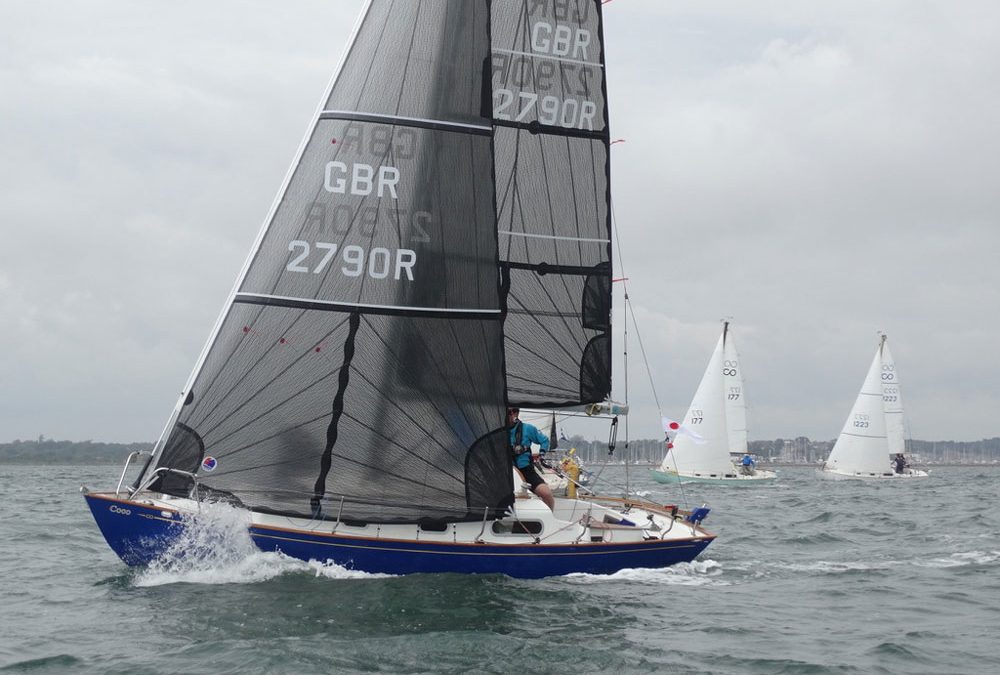
For most sailors, sailing upwind is the most exhilarating point of sail as you tack your way to your destination. Sailing to windward is a bit like zig-zagging your way up a mountain road through a series of hairpin bends – great fun but also calling for concentration and hard work. Your passengers might not necessarily share your enthusiasm, especially in strong winds as the boat’s motion and angle of heel can become uncomfortable and pounding through waves can give everyone on deck a thorough soaking.   As the winds strengthen, there’s a lot that can be done to make the boat more comfortable and go faster.

One of the most common mistakes is to point too close to the wind. If you’re not an accomplished racing helm, and don’t have a race prepared boat it’s almost always faster to bear away 5-10 degrees, ease the sheets a fraction and aim for increasing boat speed at the expense of a super-close angle to the wind. The reduction in leeway will instantly give you back half the angle, while your speed may increase by as much as 20 per cent. The boat will also be easier to steer and many will not slam as much into the waves.

Sailing to Windward

Wind shifts

The wind rarely blows from a constant direction for any length of time. Instead it can either oscillate every few minutes each side of an average direction, or will have a tendency towards a permanent slow swing in one direction or the other. Both these effects can be harnessed to make a windward passage faster.

With an oscillating wind, if you tack with the biggest wind shifts you may gain up to 20 degrees in terms of direction, simply by making sure you’re on the favoured tack as much of the time as possible. For instance, if you’re beating against a wind that is, on average, from a northerly direction, you will benefit from being on port tack when it backs west of north and on starboard tack when it veers east of north.

Traditionally, racing sailors would remember their average course on each tack, or make notes, but figuring out which tack is favoured is much easier now as some chart plotters display a graph of historic wind data for up to one hour.

A different strategy is needed if the wind is swinging (or forecast to swing) in one direction. Here we’re not really interested in any short term oscillations, instead if we simply start on the tack that takes us towards the new wind direction, when the big wind shift comes we will be on the favoured tack and may even have a free wind.

For instance, if you know that a northerly wind will swing into the northeast, start out heading in that direction on port tack. If you then tack onto starboard when the wind shift arrives you’ll have an easy sail to your destination. However, a boat that started out at the same time on port tack will again be directly downwind of the destination port after the wind shift.

Tips on sailing to windward:

  • Study the weather forecast before you depart. This should show you if and when the wind will change direction. Plan your route to take advantage of these predicted wind patterns.
  • Start out on the favoured tack, sailing the longest leg first.
  • In light winds, wind shifts may vary by 10º or more in oscillating winds. The best time to tack is when these shifts occur, which can save hours in a long upwind passage.
  • Keep a check of your compass course and if you are headed off course by a wind shift, then tack and take advantage of the new wind direction.
  • Point higher on lifts to help you towards your destination.

Steel and Aluminium Hulls

The two metals used for hull construction are steel and aluminium. These are both very strong materials and will last a long time as long as they are cared for, which primarily means protecting steel boats from rust and aluminium boats from electrolytic action.

Keel maintenance and Repair – Part 2

If you have ever witnessed a boat colliding with a rock or other submerged obstacle you will know that there is an almighty thump and the whole boat shakes and judders. While such hard groundings seldom result in catastrophic keel failure, something has to give and even the sturdiest keels can easily be damaged by such an impact.

How to improve a yacht’s upwind performance

There are several ways to improve the upwind performance of a sailing yacht. Read on for some useful tips including headsail reefing, heavy weather jibs and motor sailing.

Galvanic and electrolytic corrosion

Galvanic corrosion is an electrochemical reaction between two or more different metals, in the presence of an electrolyte (note salt water is a good electrolyte).

Cleaning & polishing painted topsides

The gelcoat topsides of a GRP boat can be pampered and restored to their former glory relatively easily when it is ashore. Gelcoat is only a very thin outer layer of the hull, often less than 1mm thick, so you should avoid cleaning it with highly abrasive cleaners, or an-ything that could potentially damage its surface.

Antifouling for leisure boats – Part 2

To prepare for antifouling, as soon as your boat has been lifted out and pressure washed, you need to check all the surfaces of the hull below the waterline, remove any remaining barnacles and check for blisters.

Sailboat rig checks – Part 2

In part two of Sail boat rig checks we run through some useful rig maintenance tips and then finish with a brief look at what a professional rig check involves.

Repairing chips and dings in gelcoat

The gelcoat topsides of a GRP boat can be pampered and restored to their former glory relatively easily when it is ashore. Gelcoat is only a very thin outer layer of the hull, often less than 1mm thick, so you should avoid cleaning it with highly abrasive cleaners, or an-ything that could potentially damage its surface.

Jester Challenge 2022 – Sailing single handed from Plymouth UK to the Azores: Part 8 – Arriving at the Azores

Jester Challenge – A modern experiment in old-fashioned self-reliance, self sufficiency, and personal responsibility. This is the eighth of a 10-part post where solo sailor, Bernie Branfield, shares his first-hand account of his single-handed, 2022 Jester Challenge, from Plymouth, UK to the Azores, in his 26′ Invicta Mk2, Louisa.

Boat ownership

Owning a boat is a big commitment that should bring no end of satisfaction for the owner as well as the owner's family and friends. In...

How to Avoid Collisions At Sea With The ColRegs

      Every Skipper Needs Accurate Knowledge of the IRPCS ColRegs As a responsible skipper it is every skipper’s duty to learn and apply the IRPCS...

Sending distress signals

In an emergency situation at sea, it is a top priority is to know how to send and receive emergency radio calls and alert others of your predicament. Likewise, if you receive a distress signal, you must be ready to go to the help of others.

Is Boating Good for Your Health and Happiness?

Absolutely! Boating offers a wealth of benefits for both your physical and mental well-being, making it a fantastic activity for overall health and...

VHF DSC radio – how best to communicate at sea

There are many ways to communicate with others at sea. What makes the VHF DSC radio the best form of short range...

Essential yacht tender safety for skippers and crew

Essential yacht tender safety - the dangers inherent in using a dinghy to get ashore from a moored or anchored yacht are all too easily...

Tacking a sailing boat

Tacking is the sailing manoeuvre used to change a boat's direction through an oncoming wind. Tacking a sailing boat calls for the crew to work as a...

Know your Navlights & Shapes – essential for all skippers

Know your Navlights & Shapes International Regulations for Preventing Collisions at Sea (ColRegs) Anyone who is...

Boat electrics

All boat owners should have a basic knowledge of electrics, both to avoid encountering electrical problems at sea and to stand a chance of solving them should they occur.

Boat interior inspection and checks

While a boat is ashore, the most critical interior checks to carry out are those that concern the safety of the boat. This entails the integrity of all through-hull fittings and seacocks, the gas system and the electrical system.

Light characteristics – how do navigators identify lights at night?

How do navigators identify the different types of light around our coasts at night and what are their characteristics?Navigating at...

Fixing position at sea using traditional methods

This post looks at some traditional methods used for fixing a vessel’s position at sea, within sight of land. Electronic fixes using chart plotters are very straightforward to record, but if for some reason a vessel’s electronics are faulty it is essential that a skipper knows how to use traditional methods.

Engine failure at sea – keeping the boat safe

If the engine stops when you are underway, or your have to shut it down when a warning buzzer sounds, you also need to make sure the boat remains safe. It’s important therefore to recognise situations in which the boat would be immediately put in danger if the engine were to fail.

ColRegs Rule 14 – Head-on Situation

  ColRegs Rule 14: Head-on Situation (a) When two power-driven vessels are meeting on reciprocal or nearly reciprocal...

Essential Knots: Sheet bend

Essential Knots: Sheet bend Use: Joining two ropes together. A sheet bend is particularly useful for joining two ropes of different...

Boat Engine Failure – what to check

Engine failure If your engine fails or is overheating there are a number of things to check immediately: • Air filter...