Boat engines come in all shapes and sizes and include inboards, outboards, petrol, diesel, electric and hybrid systems. Some engines are far more complex than others and should only be looked after by qualified engineers while others can be maintained fairly easily by a savvy boat owner.
Irrespective of what kind of engine a boat is equipped with and who does the work, the care and maintenance of it is imperative. The most common cause of marine engine failure is widely known to be lack of maintenance.
Let’s be honest, few boat owners want to spend the winter bent over double in cold, cramped engine bays. On the other hand, nor do we want to spend half the summer working on our engines either, when we could be having fun out on the water. Most of us simply want to do the essential things which need to be done as quickly and efficiently as possible without costing us excessive amounts of time, energy and money. This usually means spending a few hours changing the oil, replacing filters, draining and flushing the cooling system with fresh water, topping up with antifreeze, checking the impeller – which should be well within the DIY capabilities of most boat owners. Or, alternatively, paying a professional to do this work.
At the same time, as boat owners we also know that it is important to understand our boat engines as well as possible so that in the event of an engine failure at sea we will have some idea of how to fix the problem ourselves. Most of us also know that the best way of avoiding engine failure is to carry out regular maintenance, some of which is simple, some of which is quite technical and some which might require professional assistance, all depending on our levels of expertise.
A few years ago this led me to remove my boat’s Beta 14 diesel engine one winter and take it home for a complete overhaul and re-paint. I knew this was going to be a bit of a gamble as the last engine I had stripped down was a 175cc motorbike engine when I was 17 years old. In the end things worked out ok and doing this gave me the chance to become more fully acquainted with the boat engine well away from the very cramped engine bay in which it is housed – and it saved me quite a bit of money into the bargain.
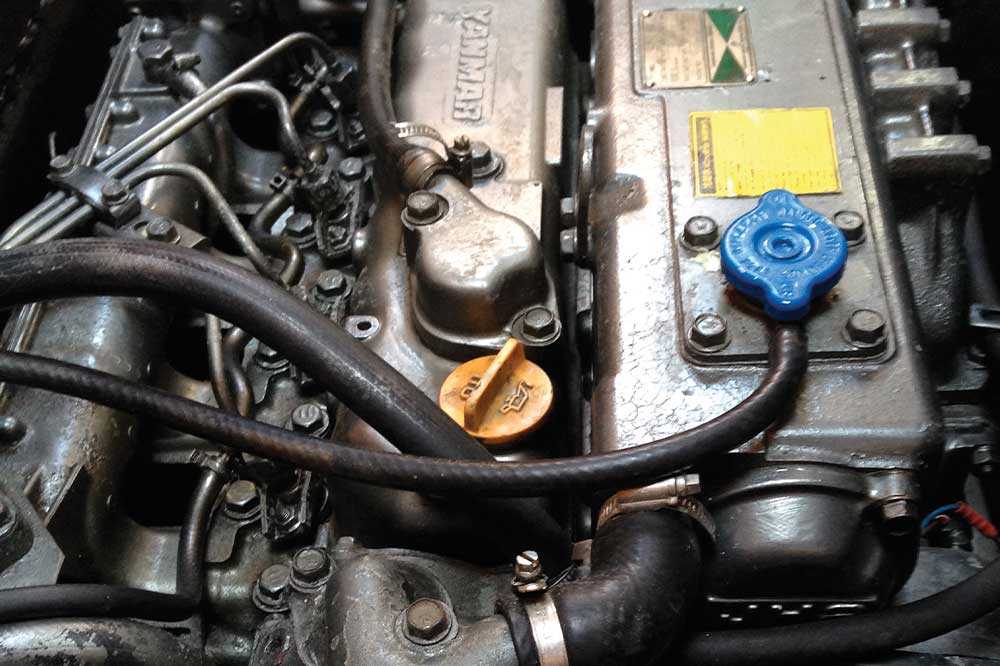
Know your engine
Here are some thoughts about getting to know your engine. There are plenty of good illustrated reference books available on diesel engine maintenance and repair for boat owners as well as online forums and YouTube videos. While these reference sources may have lots of useful information about diesel engines in general they are unlikely to include specific information about your own make and model of engine. So although these are worth buying or taking a look at, the most important reference by far is a copy of the engine maintenance manual for your specific engine.
Engine manual
Your boat engine manual will most likely be a little dull to read, but it really is the best place to start and will provide you with the essential information you will need to get started and gain confidence with working on your engine. The engine manual should cover the following essentials:
- Technical elements of the engine.
- Maintenance and repair worksheets.
- Recommended lubrication for engine and gearbox.
- Common causes of breakdown and troubleshooting.
- Winterising the engine.
In addition to these essentials, the engine manual will include other specific information like torque settings, how to bleed the fuel system, wiring diagrams and spare parts listings.
Engine manufacturers’ manuals tend to be full of commonly used technical terms that may not be familiar to all boat owners, so be prepared to spend a little time deciphering precisely what all these mean. They include terms like bore, stroke, compression ratio and specific fuel consumption, which are not too challenging but I can’t resist including a couple of examples of what I mean from my engine’s operating manual “Operation at parameters outside the test parameters may affect the outputs/powers which in any case are subject to the ISO tolerance bands.” and here is another “The exhaust back pressure, measured with the exhaust system connected and the engine running at full speed, must not exceed 80mmHg (3.1 inches Hg/42 inches WG).
Technical terms:
- Bore – cylinder diameter.
- Bottom dead centre (BDC) – a piston’s lowest position at the bottom of the downward stroke.
- Compression ratio – the ratio of maximum cylinder volume at bottom dead centre to minimum cylinder volume at top dead centre.
- Displacement volume – the total volume of all the cylinders in an engine (litres or cubic centimetres).
- Four-stroke engine – completes a power cycle every four strokes.
- Power – engine power or horsepower is the maximum power that an engine can produce, expressed in kilowatts or horsepower. In physics, power is defined simply as the rate of doing work.
- Specific fuel consumption – the amount of fuel consumed for each unit of power output, eg the quantity of fuel in grams needed by the engine to produce 1 W/h (Watt per hour).
- Stroke – either a phase of an engine’s cycle during which the piston travels from top to bottom or vice versa; or the type of power cycle used by a piston engine; or the stroke length, the distance travelled in the cylinder by the piston in each cycle.
- Top Dead Centre (TDC) – a piston’s uppermost position or the end of the upward stroke.
- Torque – a force that causes something to rotate, measured in Newton-metres or lb/ft.
- Total Volume – the volume swept by a piston multiplied by the number of cylinders.
- Two-stroke engine – completes a power cycle every two strokes.
- Volume swept by the piston – the volume displaced by the piston between the top dead centre and bottom dead centre in cubic centimetres.

Engine tools
Keep a small dedicated toolkit for working on your engine to ensure you have the correct sized spanners and screwdrivers for maintenance purposes – this will save you a lot of time and avoid the frustration of spending ages hunting around for the correct tools to use.
Always choose good quality tools as although they will be more expensive they will last longer. Cheap tools have a habit of not fitting properly and quickly rust. Give some careful thought when buying tools – for example there is no need to buy a 200 piece socket set when you will only need 10 at most for your engine.
Some engine manuals give a basic list of tools and sizes. If not, here are some of the tools you will need:
- Spanners: open ended and ring spanners are both useful. Having both is advisable. Note: engines manufactured in Europe use metric sized spanners while engines manufactured in the USA use spanners sized in inches
- Socket spanners – these can be very useful when accessing fastenings in confined space.
- Screwdrivers – flat blades and Philips head in several sizes, short and long handles. Also small socket type heads are very useful.
- Adjustable spanners and mole grips – these are useful to have on board anyway but can come in handy when working on the engine.
- Pliers – square-ended and long nose pliers.
- Allen keys – essential to have on board, as are the socket types.
- Hacksaw – a small hacksaw with spare blades
- Hammer – occasionally invaluable.
- Inspection mirror – a telescopic inspection mirror is very useful for locating fittings which are out of sight or awkward to reach.
- Multimeter – every boat should have one.
- Feeler gauges – a set will be required for checking alignments and precise settings.
- Filter wrench – for removing used filters
- Torque wrench – you will need this to tighten bolts according to the manufacturer’s specifications.
Tips:
- I have two copies of the engine manual for my boat, one I keep on the boat and the other is at home.
- Keep the engine and the engine bay as clean as possible. This will make it easier to spot any leaks in hoses and seals.
- For those with little or no engine maintenance experience, the RYA diesel engine one day course is well worth doing. The course includes basic maintenance and engine care, explaining the basics of the four stroke cycle, cooling and air systems, engine electrics, winterisation and servicing. See www.rya.org.uk for information.