Select Page

If sacrificial anodes are disappearing very quickly this can indicate there is a galvanic or electrolytic problem caused by electrical currents, which means an electrical circuit is being made for some reason. In order to understand what could be going on, it is worth trying to get to grips with the differences between these two forms of corrosion.

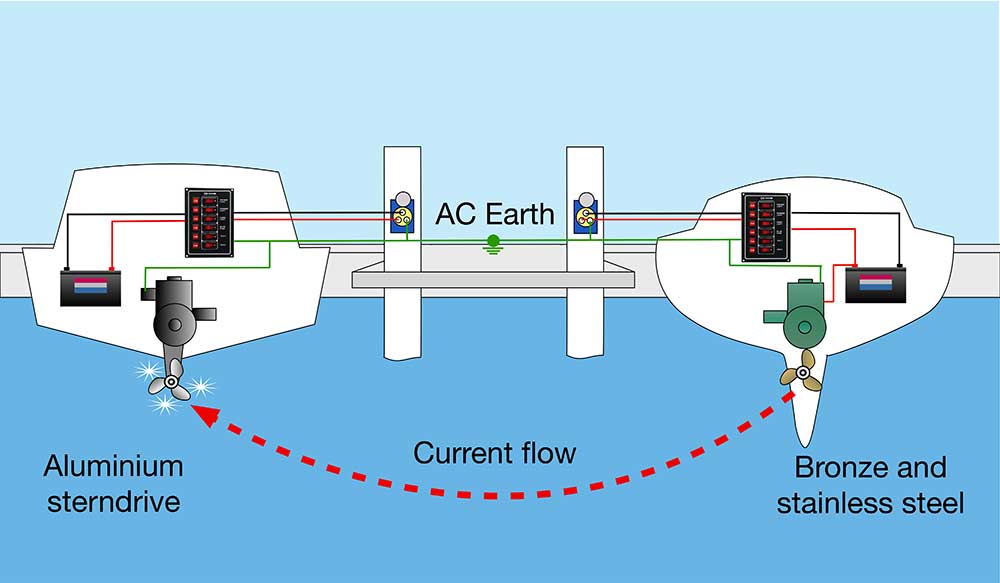
Galvanic corrosion is an electrochemical reaction between two or more different metals, in the presence of an electrolyte (note salt water is a good electrolyte). In other words, one piece of metal will be corroded, known as the anode, and the other piece of metal will be unaffected, known as the cathode. Common examples of galvanic corrosion are where an aluminium outdrive comes into contact with a stainless steel propeller, causing the aluminium to corrode, or where aluminium comes into contact with copper or bronze fittings. The first signs of galvanic corrosion is blistering of paint below the waterline and the formation of a white powdery substance on exposed metal. The exposed metal areas become deeply pitted as the metal is eaten away by the corrosion.

Electrolytic corrosion, also known as stray current corrosion, is an electrochemical process where a metallic surface is corroded by another metal it is in contact with, due to an electrolyte and the flow of an electrical current between the two metals, caused from an external source of electromotive force (EMF). In other words, electrolytic corrosion is caused by a current such as a boat’s battery or a shore supply. Metal hull boats are particularly at risk because their hulls are good conductors and stray wires or connections use the hull as a ground.

Preventing electrolytic corrosion requires good electrical installation where marine grade wiring should be insulated return with two wires rather than earth return. Metal hulls must never be used as the earth return.

Risks from electrolytic and galvanic corrosion

Aluminium boats are at risk from electrolytic and galvanic corrosion. Aluminium boat owners need to take precautions that would not be of concern to owners of GRP boats. For example, it is wise not to stay too long berthed next to a steel-hulled boat in a marina, where both vessels are connected to shore power. The reason for this is an electric circuit can form between the two vessels with the aluminium hull acting as an anode and the steel hull acting as a cathode, resulting in galvanic corrosion of the aluminium hull.

Owners also need to make sure that the shore power polarity is correctly wired in marinas as this can lead to corrosion too. They also pay particular attention to the condition of their wiring and electrical systems, to protect the boat from electrolytic corrosion.

Some aluminium boats are equipped with current leakage meters which display real time corrosion potential that warns of problems with electrolytic and galvanic corrosion.

Protecting an aluminium hull

  • Electrolytic action – all stray currents must be removed from the boat’s electrical system.
  • Anodes – zinc anodes should should be positioned on the outside of the hull and replaced when 80% consumed.
  • Stern gear – to protect the stern gear, the propeller shaft should be fitted with an electro-eliminator brush and earthed to the hull.
  • Insulation – insert plastic seals between aluminium and other metals. For example, ensure gaskets are fitted between aluminium and the flange of a stainless steel or brass valve. The same applies to lead or iron keels, where insulating washers and gaskets between the hull and keel.
  • Painting – while aluminium topsides do not need to be painted, antifouling coating beneath the waterline does need to be applied. Only use coatings that are designed for use with aluminium.


Sending distress signals

In an emergency situation at sea, it is a top priority is to know how to send and receive emergency radio calls and alert others of your predicament. Likewise, if you receive a distress signal, you must be ready to go to the help of others.

Essential Knots: Figure of eight

Essential Knots: Figure of eight Use: Stopper knot, prevents a rope from being pulled through a hole e.g. through a block or...

Essential Knots: Reef knot

Essential Knots: Reef knot Use: Tying two ends of rope together, often used for tying up a bundle of loose sail around the boom. Step...

Keeping boat records and doing checks

A boat’s records should provide information about maintenance schedules, when major work was done and when equipment was replaced or added to the boat. Without this information you are left guessing when things are likely to need replacing in the future and also what the costs are likely to be.

Boating Rules of the Road – International ColRegs

    International ColRegs Rule 7: Risk of Collision Anyone who is responsible for a vessel at sea, from the...

Gybing a sailing boat

Gybing is the sailing manoeuvre used to change a boat's direction through a following wind. As with the tacking manoeuvre,...

Hull inspection – the annual checks

With the boat ashore for the winter it is time to do a hull inspection - the annual checks. Are there any scratches and chips in the...

Sailing to windward – how to take advantage of wind shifts

For most sailors, sailing upwind is the most exhilarating point of sail as you tack your way to your destination. Sailing to windward is a bit like zig-zagging your way up a mountain road through a series of hairpin bends – great fun but also calling for concentration and hard work.

Passage planning and pilotage

Passage planning and pilotage help skippers navigate safely from one port to another. A passage plan takes into account all...

Safety at sea principles

Safety at sea is not as simple as just spending money adding shiny new emergency equipment such as liferafts, danbuoys, distress flares, EPIRBs and so on.

Sailing & Motoring in Fog

Sailing & Motoring in Fog You can only measure the visibility accurately if sailing & motoring in fog when you have...

Rewiring a boat – overcoming the challenges involved

Skippers need to have a basic knowledge of boat electrics, to avoid potential problems and to be able to solve them when they happen.

Engine failure at sea – common causes and how to avoid them

Many engine failures are caused by lack of maintenance, resulting in fuel filter blockages, water pump failures, overheating and other breakdowns. Indeed, one of the most common reasons for marine rescue service call outs is for one of the most basic reasons possible – boats that have run out of fuel.

Right boat vs Wrong boat – Over 30 Ways to Cut the Cost of Your Sailing and Cruising

Sailing and cruising offer unparalleled freedom and adventure, but they can quickly become costly. Fortunately, there are numerous strategies to help you enjoy the open water without breaking the bank. Here are over 30 practical ways to cut your sailing and cruising costs.

Boat Improvements

My Boat - practical improvements Author - Mike Rossiter Most boat owners who have had their craft for any length of time will have made what they...

Boat batteries

Under-sized battery banks are one of the key factors behind power failure at sea, as well as the premature failure of batteries, so make sure that your boat battery measures up to the use you want to put it to.

Boat decks and superstructure

The deck of a boat is constantly exposed to the elements and should be inspected on an annual basis. Particular attention needs to be given to the overall condition of deck fittings such as the stanchions, cleats and chainplates.

You Need To Understand The IRPCS ColRegs To Pass Your Yachtmaster, Master of Yachts and Coxswain Certificate of Competence

IRPCS ColRegs Rules of the Road at Sea and Yachtmaster Learning, understanding and remembering the International Regulations...

Crew Overboard Drill – Updated

How to respond to crew overboard A Man Overboard (MOB) drill is a crucial safety procedure that every boater should practice regularly. It simulates...

Dag Pike’s Boat Survey

We're really pleased to be working with Dag Pike on some great new apps for iPhone & Android. Here'a a bit more about the first app: Dag Pike's...

The VHF DSC Radio jargon buster

AIS - Automatic Identification System This system is used by shipping. It allows another vessel or coast station to use...

Rudders and steering systems – Part 1

Rudders and steering systems. A rudder is one of the most critical parts of a boat. Rudder failure is a common occurrence on neglected or overworked boats and a very unpleasant and potentially dangerous thing to happen when you are out at sea.

Tidal heights and the rule of twelfths

For those skippers who need to make a quick calculation or don’t have access to specific tidal curves for their location, it is possible to make an approximation using a system called the Rule of Twelfths. This is a simple method used to estimate the height of tide at any given time during the tidal cycle. It is based on the idea that the rise and fall of the tide is not constant, but follows a predictable pattern than can be divided into twelve parts.

Understanding boat engines

Irrespective of what kind of engine a boat is equipped with and who does the work, the regular care and maintenance of a marine engine is essential. The most common cause of marine engine failure is widely known to be lack of maintenance.

Tools and spares for your boat

Tools and Spares to take to sea!

You won’t regret taking a look at our essential tips and checklist to make sure you’re prepared for routine maintenance and those unexpected jobs that come up whilst you’re afloat!