Select Page

Jester Challenge – A modern experiment in old-fashioned self-reliance, self sufficiency, and personal responsibility.


The Jester Challenge was created for skippers of small boats who want to test their skill and self-reliance, is a uniquely successful experiment in single-handed ocean sailing. This site tells you everything you need to know about it: its history, philosophy, guidelines and future events, along with the views and experiences of skippers who have taken part over the years.

There is a Challenge every single year and new skippers are always welcome. If you like the idea of developing your offshore seamanship in a relaxed and supportive environment, visit the Jester Challenge website. 

This is the ninth of a 10-part post where solo sailor Bernie Branfield shares his first hand account of his single-handed, 2022 Jester Challenge, from Plymouth, UK to the Azores, in his 26′ Invicta Mk2, Louisa. You can read more about Bernie at the end of the post.

Sao Jorge

After 10 days in Angra do Heroismo I was ready to test my sailing confidence so decided on a gentle run over to Velas on São Jorge Island. It was 55nm and should take a full day. I set off early after paying for my time in the Angra marina, 110 Euros for 10 days including extras (showers). The wind was from the NW and light so as soon as I passed the peninsula that forms a natural breakwater around Angra I had the sails up and the engine off. I made reasonable progress but about hallway between Terceira and Sao Jorge I was hit by the acceleration zone, F7 for a couple of hours was a good wake up call. Under a small head sail I crossed the gap but ended up further north than I had hoped and was in Martha’s Anguish, an area where the south going current is forced up by the underwater sea mounts off the SW tip of Sao Jorge. I quickly headed south until things calmed down.

It had rained pretty much non-stop since leaving Angra but on the way up the channel between Pico and Sao Jorge the rain stopped, the sun came out and the wind died. I motored for 20 miles up the coast past Manadas (see photo below) Riberia Seca, Calheta and the airport until I reach Velas.
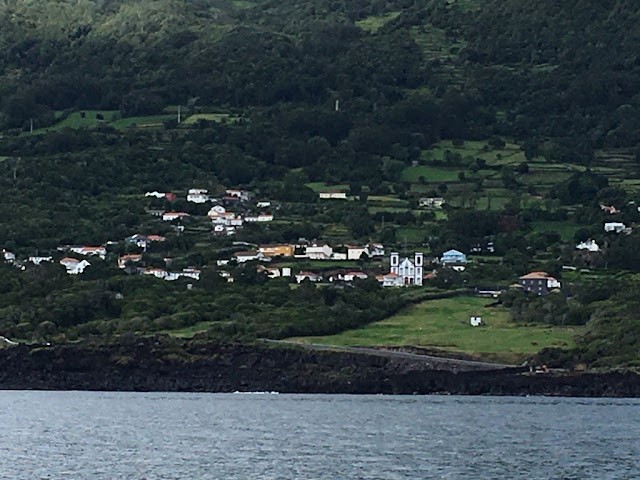
The villages are built on rock outflows from past volcanic activity and all have beautiful churches and appear to cling on to the island. A couple have small ports.

In Velas harbour I tried to anchor but wasn’t happy with the set so I moved into the marina. It had been a long day, 16 hours, but it felt great to be in this beautiful little marina. At night there was a very strange noise, initially I thought it was children messing around in the marina with cazoos but I later found out that the noise was nesting Cory Shearwaters.

The next day a lovely couple who have been cruising the world for 13 years came over to say hi. It was obvious from the first chat that we shared similar views about a lot of things and we got on very well. The next day they hired a car and the three of us toured the island. We went to several Fajas (villages built on rock out flows by the coast) and to the main towns of Topo and Calheta where we had a very nice lunch by the harbour. We visited a cheese factory, they only make one type of cheese and sell it by age. The three year old cheese was wonderful and we bought some.

Back in Velas we went for dinner to a local restaurant and had a fabulous meal, we querried the bill, wine was 1Euro for a large glass! The bill was correct but seemed far too small.

I visited the church in Velas and another in Riberia Seca. They are of a similar style with amazing interiors.

The museum in Velas was interesting and I was the only person there. As cheese plays a significant role in island life, much of the infrastructure and facilities are set up around its production. The island is extensively farmed and apart from some small fruit and veg production is given over to dairy. There are about 6 cheese co-operatives on the island and each area has an unmanned miniature cheese museum. These have large windows through which the local cheese production history is visible.

Sao Jorge was an excellent alternative to Terceira, much quieter with beautiful rolling countryside and a sense of purpose around cheese production. It would be worth visiting Sao Jorge with walking boots and a bit more time to explore the coastal paths.

About Bernie Branfield

I have been sailing since I was 7, I started in Mirror dinghies at the local gravel pit and made my way up to VLCCs for a large oil company as Third Mate. After a break for family life I bought a MacWester Rowan 22’, Chantilly, which I sailed to Holland, Belgium, France and Ireland as well as around the UK East Coast. I still have Chantilly. For a short time I owned an Achilles 24, Mischief, that I had hoped to sail to the Azores but abandoned this plan after an eventful trip back from Ireland. My current boat is an Invicta 26’ Mk2, Louisa, which I bought just before the Covid lockdown. Due to timing, work commitments and various other factors I decided to enter the 2022 Jester Challenge to Newport Rhode Island. When I am not sailing my own boat I try and crew on a yacht delivery each year to build up experience. I have around 30,000 sea miles in yachts and various qualifications including YM Offshore under my belt. Louisa was built in the early 1970s and suits my singlehanded sailing needs to a tee, she is moored at Hoo Ness Yacht Club on the River Medway in Kent.

Boat maintenance log

Keeping a boat maintenance log is an ideal way of reminding owners what needs to be done to a boat and when. Read on for some tips,...

Liferafts

Liferafts should be stowed where they are ready for immediate launching. All crew should know the location of the liferaft and know how to launch, inflate and board it. They should also know what equipment it contains.

Jester Challenge 2022 – Sailing single handed from Plymouth UK to the Azores: Getting to the Start

Jester Challenge – A modern experiment in old-fashioned self-reliance, self sufficiency, and personal responsibility. This is the start of a 10-part post where solo sailor, Bernie Branfield, shares his first hand account of his single-handed, 2022 Jester Challenge, from Plymouth, UK to the Azores, in his 26′ Invicta Mk2, Louisa.

Boating emergency – how to broadcast a MAYDAY emergency call

How to broadcast a MAYDAY emergency call   How to broadcast a MAYDAY emergency call if a vessel or person is in grave...

Docking a Motorboat

Docking a motorboat can be a challenging task, especially for beginners, but with practice and attention to detail, it becomes much easier. Here’s a step-by-step guide to help you dock your motorboat safely and efficiently.

Understanding your boat’s compass

Article submitted by Mike Rossiter, Certificated Compass Adjuster. Since the magnetic compass was first used by the Chinese...

Estimating and plotting your position at sea

This post covers how we go about estimating and plotting our position using traditional methods, when out of sight of land – covering Dead Reckoning, Estimated Position, Tidal Streams, Leeway and more…

How to read nautical charts

Whilst most sailors today rely on GPS to find their way at sea, nautical charts are a crucial tool for any sailor to navigate safely and effectively. Here is a reminder of some of the basic steps involved in reading a nautical chart:

Wooden Hull Repairs

While wooden boat hull maintenance is mostly straightforward, it is always a good idea to take expert advice on any repair job needed doing to a wooden boat, unless you have done the job before and know what you are doing.

Sending distress signals

In an emergency situation at sea, it is a top priority is to know how to send and receive emergency radio calls and alert others of your predicament. Likewise, if you receive a distress signal, you must be ready to go to the help of others.

Sailing to windward – how to take advantage of wind shifts

For most sailors, sailing upwind is the most exhilarating point of sail as you tack your way to your destination. Sailing to windward is a bit like zig-zagging your way up a mountain road through a series of hairpin bends – great fun but also calling for concentration and hard work.

Boat surveys

A full boat survey assesses the condition of the hull, mechanical gear and means of propulsion. The survey is carried out with the boat...

Sailboat rig checks – Part 1

Sailing boat rigs need to be checked regularly to reduce the risk of rig failure at sea. In part one of Sail boat rig checks we run through a series of useful checks that owners and skippers can carry out.

Narrowboating on the Kennet and Avon Canal

A recently cancelled sailing event I was due to take part in left us with a free weekend in the diary. Given that my wife and I were celebrating a bumper wedding anniversary and the weather forecast was for fine weather, we decided to hunt around for a last minute canal holiday.

Navigation safety: a quick-reference mobile app to learn the ColRegs NavLights and Shapes

 Safety at SeaSafety at sea will always remains a topical and important subject that will no doubt dominate the syllabuses of nautical...

Boat Engine Safety Checks

  Boat Engine Safety Checks Every skipper needs to make regular essential boat engine safety checks. Below you will...

Sterndrive maintenance

Sterndrives are a popular form of propulsion in the powerboat market, but require a fair amount of care and maintenance. The main factors to be aware of are salt water corrosion, lubrication and regular inspection of the bellows, the condition of which is vital to prevent water from entering into the hull.

Rewiring a boat – overcoming the challenges involved

Skippers need to have a basic knowledge of boat electrics, to avoid potential problems and to be able to solve them when they happen.

How to trim a genoa sail

I recently had two new sails made by Sanders Sails, based in Lymington UK. The first to arrive was the new genoa and it took me a little while to get to know it and learn how to adjust it correctly. Here is an aide memoire for getting to know how to trim a genoa so that it will deliver the best performance.

Dripless shaft seals

Dripless shaft seals are designed to completely stop water from entering a boat’s hull via the stern tube. There are two main types of dripless seals known as face seals and lip seals which many boat manufacturers now fit to production boats.

Competent crew skills: mooring lines

Mooring lines are used when arriving or leaving a berth. One of the most important competent crew skills is to know how to...

Passage planning and pilotage

Passage planning and pilotage help skippers navigate safely from one port to another. A passage plan takes into account all...

Essential Yachting + Power Boat Safety Briefing

Yachting Safety Briefing   Down below Lifejackets and harnesses - fitting, when to wear, clipping on Gas - risks, precautions, gas bottles and...

The Round The Island Race 2023

This year’s Round the Island Race turned out to be a really thrilling and competitive event. 1100 boats entered the race, which took place on Saturday 1st July. The race started from the world famous Royal Yacht Squadron line in Cowes UK, with the largest and fastest boats starting first, leaving the rest of us to wait our turn.

Keel maintenance and repair – Part 1

Keels are designed to act as underwater foils that generate lift as the boat moves through the water, counteracting the leeward force of the wind and enabling the boat to sail closer to the wind. Keel maintenance and repair is essential for the performance of your boat.