Select Page

Simon Jollands took part in the 2023 Rolex Fastnet Race. This is the first of several articles on the race and focuses on the start.
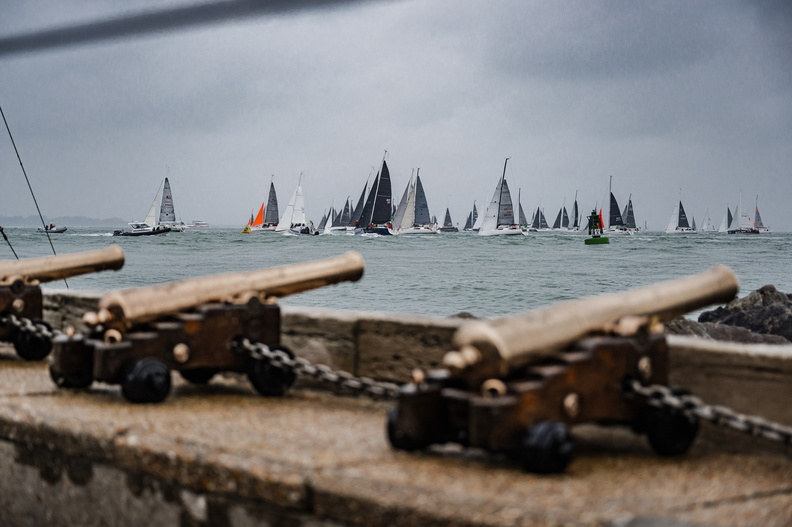
Rolex Fastnet Race 2023

©MartinAllen_pwppictures.com

The 2023 Rolex Fastnet Race proved to be a classic offshore sailing event that lived up to its reputation as being one of the toughest races both professional and amateur crews can enter. The giant fleet of 430 boats set off from the Solent into a southwesterly gale on Saturday 22 July. Over the 695 miles to the Fastnet Rock and back, for a second time, to the finish in Cherbourg-en-Cotentin, the slower boats had to deal over five or more days with weather they might normally expect in twice that time, including strong winds associated with three cold fronts.
2023 Rolex Fastnet Race


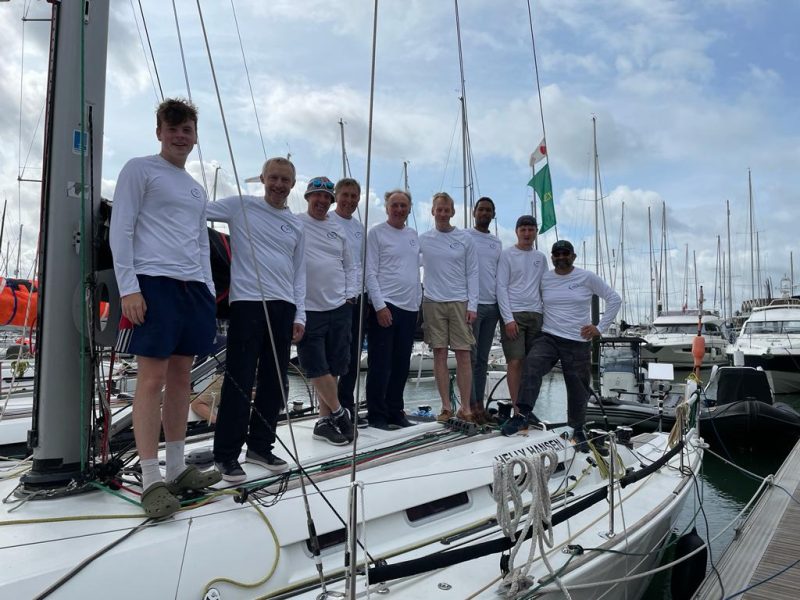
I was invited by my friend and neighbour Barnaby Wiener to join skipper John Gillard and six other crew members on Lancelot II, a Beneteau First 40 charter boat. Prior to the Fastnet, we took part in two RORC qualifier races, the Morgan Cup from Cowes to Dartmouth and the Cowes to St Malo race, which we successfully completed and enabled us to familiarise ourselves with the boat and prepare for the main event.

The Fastnet fleet was hugely diverse, from the 32x23m Ultim trimarans, the world’s fastest offshore yachts, to the 60ft flying IMOCAs of the Vendée Globe, Class40s and multihulls to the bulk of the fleet in the IRC classes – ranging from maxis, to purpose-built 50-footers, to substantial turn-outs of manufacturer classes, a record double-handed entry down to yacht club, association, family, sailing school and charter boat entries.

The start

Come start day on Saturday 22 July crowds congregated by the Royal Squadron Yacht and along Cowes Green while others braved the wind and rain elsewhere on the Solent shore to see off this historic gathering. As we waited for our start we watched the massive racing machines line up for their starts, a truly awesome spectacle. Given the severe weather forecast we decided to play safe at our start in IRC 1 and hoisted a storm jib and reefed the main, despite the fact that the winds at the start were only gusting 25 knots. This proved to be a very wise decision on our skipper’s part, because as we tacked our way down the western Solent the conditions rapidly deteriorated and we moved into a classic wind against tide scenario with steep waves and strengthening winds.

2023 Rolex Fastnet Race

©Martin Allen_pwppictures.com

As the bulk of the fleet negotiated Hurst Narrows, the Solent was in full ebb, the wind 30+ knots ahead of the front – combining to kick up a vicious wind-against-tide sea state. Over the course of the first night, conditions deteriorated with winds gusting to 40+ knots (F9/severe gale) and a sharp 5-6m sea.

Rolex Fastnet Race 2023

Rolex Fastnet Race 2023 22 July 2023 Race start from Cowes Isle of Wight. Challenger 1 @Rick-Tomlinson


This year more competitors erred on caution, including ourselves, choosing to exit the Solent via the calmer waters of the North Channel. Just south of the Needles at 17:00 the Sun Fast 3600 Vari, sailed by Yann Jestin and Romain Baggio, began sinking due to a severe leak in her engine compartment. The experienced double-handers issued a Mayday and took to their liferaft. Within 15 minutes of their discovery, Vari had sunk. As Ju Kyu stood by, after 10 minutes in their liferaft, they were recovered by the Yarmouth lifeboat and taken ashore.

2023 Rolex Fastnet Race

Four dismastings

In addition were four dismastings – Royal Naval Sailing Association’s Yoyo; Nick Martin’s Diablo, Bertrand Daniels’ Mirabelle and Tapio Lehtinen’s yawl Galiana, while others suffered steering and rigging issues and Richard Matthews’ Oystercatcher XXXV retired with structural deck issues.

There were also injuries. The Swanage all-weather lifeboat assisted a yacht where one crew had been knocked on the head and fallen overboard. Held on by their tether the crew had been recovered but was semi-unconscious. As the Coastguard helicopter was unable to lower a paramedic, instead the yacht headed for calmer waters where the casualty was transferred to the lifeboat and then to an ambulance in Poole Harbour.

Over the first night HM Coastguard answered 28 ‘incidents’ (albeit some involving the same boat) while in many other incidents HM Coastguard was not involved, including the mast foot breaking on race veteran Géry Trentesaux’s Long Courrier, which retired to Cowes.

Many crews showed excellent seamanship, choosing to seek shelter until conditions abated. Some continued, others did not. 24 hours into the race more than 100 yachts had retired. In the final tally 166 retired from this year’s race, roughly 39% of the fleet (compared to 45% in 2021 and 76% in 2007).

Rolex Fastnet Race 2023

The first 24 hours were brutal and witnessing these conditions and hearing the Maydays and PanPans over the VHF through the night was truly harrowing. It was thanks to our excellent skipper we held it together and we then prepared ourselves for the challenge ahead – the Fastnet Rock was still a very long way off and two more storms had been forecast.  To be continued in our next post!

Navigating Through Rough Waters: Tips for Handling Adverse Weather Conditions in a Sailboat

Navigating through rough waters in a sailboat requires skill, preparation, and a good understanding of both your vessel and the environment. Here are some tips for handling adverse weather conditions including Preparation, Techniques, Safety and much more..

Boat maintenance – what does it involve?

The maintenance of a boat involves things like cleaning, varnishing, painting, polishing, antifouling, servicing the engine, servicing the seacocks, and maintaining the gas and plumbing systems. It all amounts to a fairly considerable amount of work that can’t be ignored if you are to keep your boat in a safe and good condition.

Is Boating Good for Your Health and Happiness?

Absolutely! Boating offers a wealth of benefits for both your physical and mental well-being, making it a fantastic activity for overall health and...

Essential yacht tender safety for skippers and crew

Essential yacht tender safety - the dangers inherent in using a dinghy to get ashore from a moored or anchored yacht are all too easily...

Understanding your mast and rigging

The rig of a sailing boat is put under huge stresses and strains so it is important for inspections of a yacht's spars and rigging to be...

Sending distress signals

In an emergency situation at sea, it is a top priority is to know how to send and receive emergency radio calls and alert others of your predicament. Likewise, if you receive a distress signal, you must be ready to go to the help of others.

Essential Knots: Figure of eight

Essential Knots: Figure of eight Use: Stopper knot, prevents a rope from being pulled through a hole e.g. through a block or...

Rudders and steering systems – Part 2

One thing all rudders have in common is that they have three main parts that need to be checked: the rudder, or a steerable drive leg in the case of many power boats; the system that joins the rudder to the steering; the steering control itself.

Antifouling for leisure boats – Part 3

Antifouling is one of the least pleasant boat maintenance jobs to do, but it has to be done. The very worst job of all is removing the old antifouling as this can get seriously messy and is very hard work.

Cutless bearing replacement

Cutless bearings can last for many years but if the propeller shaft is out of alignment they will wear through more quickly. If you have noticed a clunking sound when motoring then it could be a worn cutless bearing that is causing the problem.

Estimating and plotting your position at sea

This post covers how we go about estimating and plotting our position using traditional methods, when out of sight of land – covering Dead Reckoning, Estimated Position, Tidal Streams, Leeway and more…

Electric motors and hybrid systems

In recent years there have been considerable advances with the development of electrically powered propulsion in the leisure marine sector. This includes developments with inboard and outboard electric motors, hybrid systems, lithium-ion battery technology as well as solar, wind and hydro powered generators.

Seacock maintenance

If seacocks are always left open and neglected they can eventually seize which will prove a serious threat to boat safety should a connecting hose fail and the seacock refuses to close. There are three main types of seacock – ball valves, cone valves and gate valves.

Diesel engine winterisation

An inactive boat engine needs to be protected from corrosion during the winter, caused by the rising humidity levels through the cold months and the salty coastal air. This applies whether the boat is left afloat or hauled out over the winter. Read here about the two important stages of winterisaton for a diesel boat engine.

Marine toilets – care and maintenance

There are a number of different types of marine toilet, or heads. They fall into one of three categories – manual, electric and vacuum, the most common being the manual, hand pumped type. These have double acting piston-pumps which both discharge the waste and flush the toilet with sea water.

How a propeller works

Have a look around any boatyard and you will notice quite a variety of propellers – some have two blades, some have three and others have four or more. While most propellers are completely rigid some have blades that fold.

Top five windvane self steering installation questions

Top five windvane self steering installation questions answered by Sarah Curry of Hydrovane International Marine, courtesy of Viki Moore from Island Cruising NZ

Antifouling for leisure boats – Part 4

Applying antifouling. Antifouling is best applied on a dry, calm day. It is best to apply the antifouling in the middle of the day to ensure the hull is dry and as warm as possible.

Jester Challenge 2022 – Sailing single handed from Plymouth UK to the Azores: Part 7 – Motivation

Jester Challenge – A modern experiment in old-fashioned self-reliance, self sufficiency, and personal responsibility. This is the seventh of a 10-part post where solo sailor, Bernie Branfield, shares his first-hand account of his single-handed, 2022 Jester Challenge, from Plymouth, UK to the Azores, in his 26′ Invicta Mk2, Louisa.

Jester Challenge 2022 – Sailing single handed from Plymouth UK to the Azores: Part 9 – Around the Azores

Jester Challenge – A modern experiment in old-fashioned self-reliance, self sufficiency, and personal responsibility. This is the ninth of a 10-part post where solo sailor, Bernie Branfield, shares his first-hand account of his single-handed, 2022 Jester Challenge, from Plymouth, UK to the Azores, in his 26′ Invicta Mk2, Louisa.

Feeling anxious at sea

  Some people feel anxious at sea. Will they be seasick? What if they get caught in a violent storm? Could the boat...

Jester Challenge 2022 – Sailing single handed from Plymouth UK to the Azores: Part 5 – Boat Management

Jester Challenge – A modern experiment in old-fashioned self-reliance, self sufficiency, and personal responsibility. This is the fifth of a 10-part post where solo sailor, Bernie Branfield, shares his first hand account of his single-handed, 2022 Jester Challenge, from Plymouth, UK to the Azores, in his 26′ Invicta Mk2, Louisa.

Boating Rules of the Road – International ColRegs

    International ColRegs Rule 7: Risk of Collision Anyone who is responsible for a vessel at sea, from the...

Tidal heights and the rule of twelfths

For those skippers who need to make a quick calculation or don’t have access to specific tidal curves for their location, it is possible to make an approximation using a system called the Rule of Twelfths. This is a simple method used to estimate the height of tide at any given time during the tidal cycle. It is based on the idea that the rise and fall of the tide is not constant, but follows a predictable pattern than can be divided into twelve parts.

Boat decks and superstructure

The deck of a boat is constantly exposed to the elements and should be inspected on an annual basis. Particular attention needs to be given to the overall condition of deck fittings such as the stanchions, cleats and chainplates.