Select Page

Skilled boat handling is needed when entering or leaving harbour. Crew tasks include preparing the mooring lines and fenders before docking and tying the boat safely alongside. The crew also prepare the boat for leaving harbour. In order to help avoid any mishap, they have to release the lines in the correct order, as instructed by the skipper.

Arriving at a berth

The skipper will ask for the crew to prepare for berthing when a yacht enters harbour. The engine will be started if the yacht is under sail, the sails will be dropped and stowed, and the control lines coiled. 

Before approaching a berth, the skipper will ask the crew to get the mooring lines and fenders ready. The skipper will also give instructions where the lines and fenders should be attached.

Preparing the mooring lines

Mooring lines are attached to cleats at the bow and stern. Normally there are two lines prepared at the bow and two at the stern. Each line is fed beneath and back over the guardrail, then made ready to be taken ashore and tied to the dock. 
Fenders

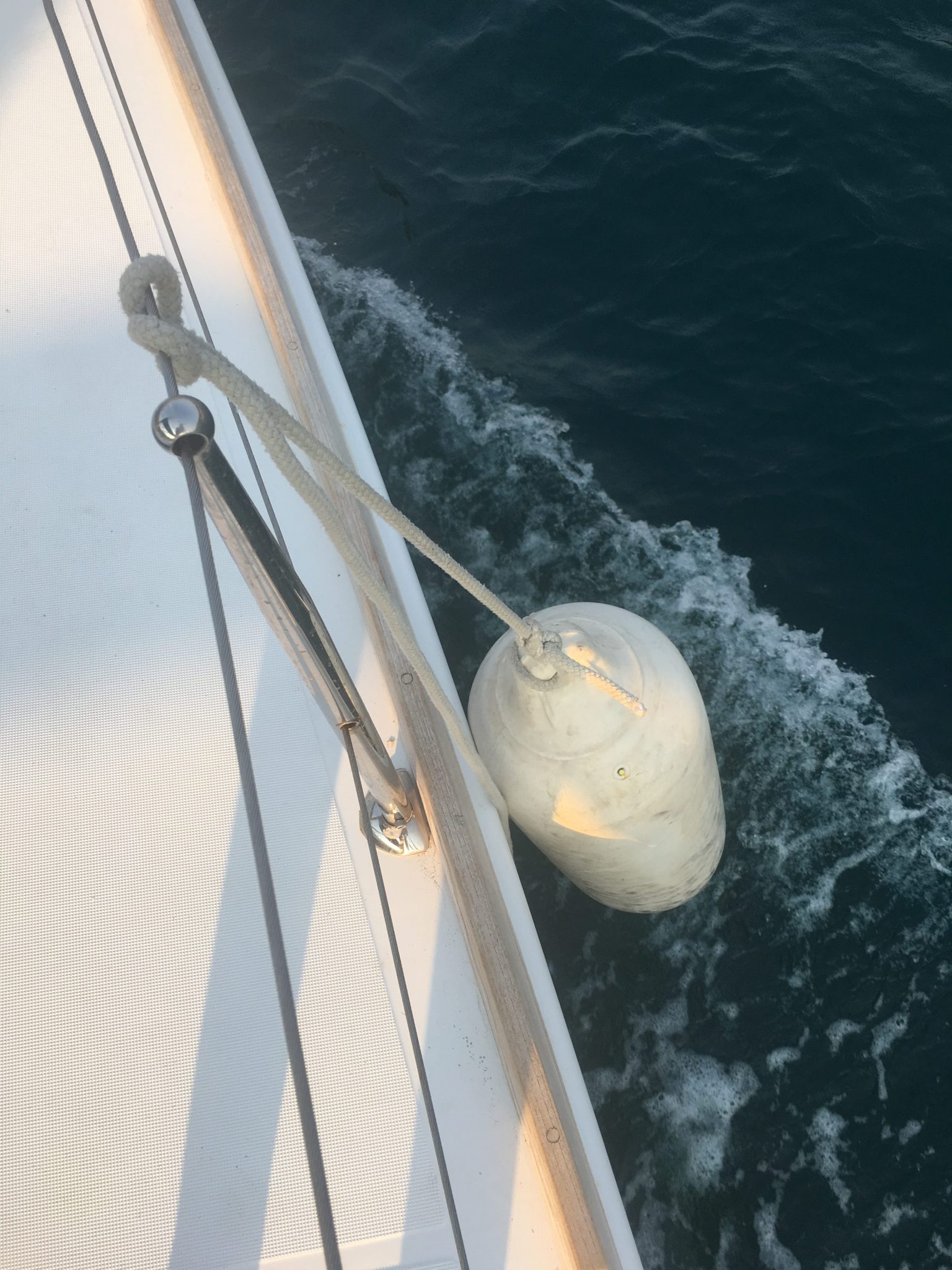
Fenders help prevent damage to a boat’s hull when it is alongside. A fender has a short rope which is attached to the guardrail using a clove hitch. A clove hitch is easily adjustable, therefore ideal for positioning the fender at the correct height to protect the hull. The fender needs to hang just above the water level so that it will protect the hull at its widest points when alongside.

Approaching the berth

When possible it is best for the boat to approach a berth into the wind, as this will help the boat to stop. If the wind is coming from behind, it will be more difficult to slow the boat down.

As well as taking the effects of the wind into account, in tidal waters the strength and direction of the tidal streams needs to be factored in. Given a choice, the skipper will most likely decide to approach the berth heading into the tide. If this is not possible, then bringing the boat to a stop becomes more difficult.

Stepping on to the pontoon

If you are responsible for a mooring line, hold it ready and move along the deck to the boat’s widest point before stepping ashore. Make sure the line remains outside the guardrail and side stays as you move along the deck to the centre position. Listen out for instructions from the skipper.

When the boat is alongside, step quickly ashore and secure the line to a cleat on the dock. If the line is a bow line, tie it to a cleat level or just forward of the bow. If the line is a stern line, then tie it level or just astern of the stern.

Tips for arrival:

  • Practice tying fenders to a guardrail using a clove hitch.
  • Practice tying a cleat hitch, round turn and two half hitches and bowline.
  • Make sure the mooring lines are not trailing through the water before docking.
  • Only step ashore when the skipper says it is safe to do so.

Leaving a berth

Before departure there is sometimes quite a bit of discussion about when it will be best to leave a berth, taking into consideration:

  • Tide – the direction of the tidal flow, whether it is rising or falling, is often critical for a safe departure from harbour.
  • Wind – is the wind blowing the boat towards the pontoon or away from it? This will affect the order in which the lines holding the boat alongside are cast off. 
  • Forecast – if a howling gale is forecast, it may be best to delay departure.

When it is time to leave, the crew will be asked to release the lines in the order the skipper asks. Under normal circumstances the spring lines will be released first. Then, either the bow or stern line are released, depending on the direction of the wind or tide.

Sometimes the direction of the wind and tide may make leaving difficult. In this case, extra lines and fenders may be needed to help manoeuvre away from the berth. The skipper will devise a plan and crew will be made responsible for various lines and await instructions.

Slipping a line

Before departure, some of the mooring lines may need to be re-tied, or set up, so they can be quickly released and pulled back on board immediately the skipper asks. This entails a crew member untying the line on the pontoon and arranging it in a long loop. Then, both ends of the line are fed back on board so that the line can be released from the boat. 

Tips for leaving:

  • Practice how to set up a line for slipping, making sure it doesn’t get caught as it is slipped.
  • Don’t untie or slip a line until the skipper has asked.
  • The first lines to be released will be those not taking any load.

2023 Rolex Fastnet Race

Safe Skipper’s Simon Jollands took part in the 2023 Rolex Fastnet Race – a classic offshore sailing event. This is the first of several articles on the race and focuses on the start.

Cutless bearing replacement

Cutless bearings can last for many years but if the propeller shaft is out of alignment they will wear through more quickly. If you have noticed a clunking sound when motoring then it could be a worn cutless bearing that is causing the problem.

Going aground – what to do if it happens to you

When a yacht runs aground, it can be a stressful situation, especially on a falling tide in an exposed position with a swell running. There are several steps you can take to address the situation in order to ensure the safety of your vessel and its occupants. Here are some tips should this happen to you.

Jester Challenge 2022 – Sailing single handed from Plymouth UK to the Azores: Part 9 – Around the Azores

Jester Challenge – A modern experiment in old-fashioned self-reliance, self sufficiency, and personal responsibility. This is the ninth of a 10-part post where solo sailor, Bernie Branfield, shares his first-hand account of his single-handed, 2022 Jester Challenge, from Plymouth, UK to the Azores, in his 26′ Invicta Mk2, Louisa.

Avoiding collisions at sea – how to stay safe on the water

Boats have many blind spots, including the headsails of sailing boats. Always keep a lookout, stay safe and remember that...

A simple guide to understanding tides when passage planning

Understanding tides when passage planning When planning a trip in tidal waters, check the tides before going afloat. Use...

Essential Knots: Figure of eight

Essential Knots: Figure of eight Use: Stopper knot, prevents a rope from being pulled through a hole e.g. through a block or...

How a propeller works

Have a look around any boatyard and you will notice quite a variety of propellers – some have two blades, some have three and others have four or more. While most propellers are completely rigid some have blades that fold.

Jester Challenge 2022 – Sailing single handed from Plymouth UK to the Azores: Getting to the Start

Jester Challenge – A modern experiment in old-fashioned self-reliance, self sufficiency, and personal responsibility. This is the start of a 10-part post where solo sailor, Bernie Branfield, shares his first hand account of his single-handed, 2022 Jester Challenge, from Plymouth, UK to the Azores, in his 26′ Invicta Mk2, Louisa.

Boat Handling – anchoring

Anchoring your yacht or motorboat Anchoring is one of the most important boat handling skills. If you can set an anchor...

Common marine electrical problems

Most problems with marine electrical systems arise from four possible sources, a lack of maintenance, a poor standard of initial installation, insufficient battery capacity, or ineffective charging systems.
Water ingress is a frequent issue – salt water can corrode contacts very quickly. If connections are not scrupulously clean – or are loose – resistance will be increased, resulting in progressively reduced power.

DIY boat upgrades: Budget-friendly projects to enhance your (older!) boat

DIY projects that can enhance both the functionality and aesthetics of your boat. In this article, we’ll explore a variety of DIY boat upgrades that won’t break the bank but will significantly enhance your boating experience.

Tidal terms and definitions

Getting to grips with tidal terms and definitions can seem a little daunting, even to the most experienced sailors! Here we look at some of the key terms and definitions associated with the language of tides.

Pre-start engine checks

According to the Royal National Lifeboat Institution (RNLI) almost one third of emergency call outs at sea are caused by mechanical failure. Many engine breakdowns are avoidable. The best way to avoid a breakdown is to carry out pre-start checks before heading out to sea.

Anchoring – getting it right

If you can set an anchor correctly with confidence and know your boat will be safe in a secure anchorage, then you can rest in comfort and will not...

Jester Challenge 2022 – Sailing single handed from Plymouth UK to the Azores: Part 5 – Boat Management

Jester Challenge – A modern experiment in old-fashioned self-reliance, self sufficiency, and personal responsibility. This is the fifth of a 10-part post where solo sailor, Bernie Branfield, shares his first hand account of his single-handed, 2022 Jester Challenge, from Plymouth, UK to the Azores, in his 26′ Invicta Mk2, Louisa.

Safety Briefings – leave nothing to chance

Before giving your crew a safety briefing, it is worth considering the specific circumstances of the planned trip, the...

Sending distress signals

In an emergency situation at sea, it is a top priority is to know how to send and receive emergency radio calls and alert others of your predicament. Likewise, if you receive a distress signal, you must be ready to go to the help of others.

Engine failure at sea – keeping the boat safe

If the engine stops when you are underway, or your have to shut it down when a warning buzzer sounds, you also need to make sure the boat remains safe. It’s important therefore to recognise situations in which the boat would be immediately put in danger if the engine were to fail.

Cleaning & polishing gelcoat topsides

The gelcoat topsides of a GRP boat can be pampered and restored to their former glory relatively easily when it is ashore. Gelcoat is only a very thin outer layer of the hull, often less than 1mm thick, so you should avoid cleaning it with highly abrasive cleaners, or an-ything that could potentially damage its surface.

Tips and advice for staying safe on a sailboat at sea

Here we focus on how to stay safe on a sailboat at sea. We cover key things to ensure you have on board before you set sail as well as covering the most common cause of incidents on sailboats and how to deal with them.

Understanding tide tables and tidal curves

There are many factors that influence local tidal patterns and it’s essential for every sailor to have a good understanding of tide tables and tidal charts to ensure they can calculate the level of tide at any given time.

Points of Sailing

The course on which a boat is sailing can be described by its angle to the wind, not to be confused with its compass...

Boat electrics

All boat owners should have a basic knowledge of electrics, both to avoid encountering electrical problems at sea and to stand a chance of solving them should they occur.

Essential Boat Safety Briefing

Skippers Responsibilities Skippers are obliged to give a safety briefing to the crew even if they are a regular crew. At...