Select Page

Whatever their size or type, all skippers have a responsibility to avoid collisions with other boats at sea.  It is important for all boat skippers to know the give-way hierarchy at sea to help avoid accidents. But how similar are the rules of the road on land and at sea?

On land, road users have signs to show them the way and warn them of hazards they are approaching.  They avoid collisions with others by following the road rules.  They use light and sound signals to indicate what their intentions are. 

Broadly speaking, all this happens at sea too.  There are navigation marks which act like road signs; there are road rules to prevent collisions and there are sound and light signals to tell others of a vessel’s intentions.  In addition there are some extra factors to get to grips with:

  • As there are no roads on the water, boats tend to move around in all directions. 
  • There are more diverse shapes and sizes of vessels on the water than there are vehicles on land.
  • There is a give way hierarchy between the types of vessel, which needs to be followed by all boat users.
  • Vessels display lights at night to tell others which direction they are moving in and what type and size of vessel they are.
  • Vessels display shapes during the day to tell others what type of vessel they are and certain activities which they may be involved in. 
  • There are navigation marks which identify safe water channels and hazards to be avoided.
  • There are light beacons which guide vessels safely towards land and into harbour at night.

Learn all of the nautical ColRegs Rules of the Road for power boating and sailing, in our comprehensive reference app, which includes a quiz to test yourself!

The give way hierarchy

If you are in charge of a boat you need to know what to do in a potentially dangerous close quarters situation and act accordingly.  It is important to know the ‘who gives way to whom’ hierarchy and this should be learnt by all boat operators.

Sailing boat hierarchy

Port tack gives way to starboard tack.

If on the same tack, the windward boat gives way.

If it is unclear to a sailing boat on port tack which tack another sailing boat to windward is on, then the boat on port tack must give way.

Power boat hierarchy
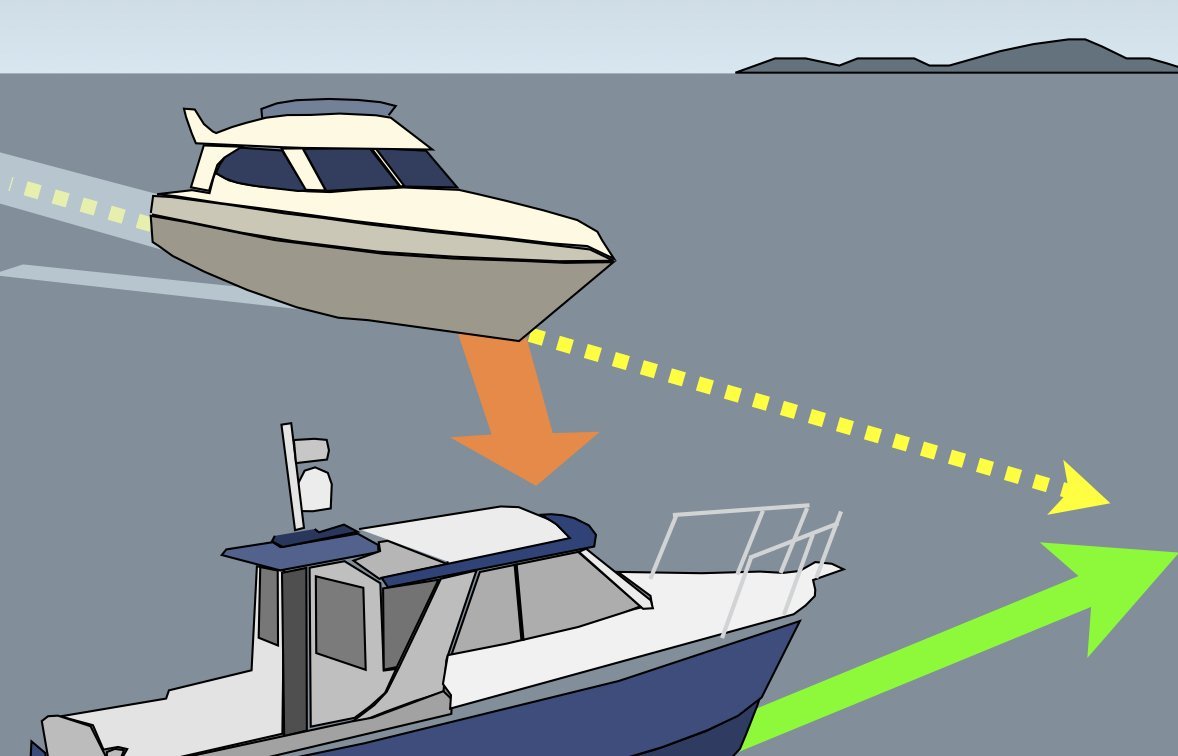
If two power boats are heading towards each other, both boats should alter course to starboard, so their port sides will pass each other.

If two power boats are crossing paths and there is a risk of collision, then the vessel which has the other on its starboard side must give way.  It must also avoid crossing ahead of the stand-on boat.

Narrow channels

All boats should keep to the right of narrow channels. Vessels of less than 20 metres in length and sailing vessels must stay clear of larger vessels who can only navigate within the channel.  It is often the case that smaller craft can operate safely outside a buoyed channel.

Give-way vessel

When two similar vessels are crossing, the one that has the other to its starboard side is the give-way vessel.

The ‘give-way’ boat is responsible for keeping clear and altering course where necessary to avoid a collision. The give-way boat should make an obvious course direction in plenty of time, so the stand-on vessel is in no doubt it has taken avoiding action.

Stand-on vessel

If you have the right of way you are the stand-on boat, keep to your course and speed to make it easier for the give-way boat to manoeuvre out of your way. If the give-way vessel does not take avoiding action, the stand-on vessel must be ready to turn quickly out of the way or stop as a last resort.

Overtaking

All vessels, whatever their size and type, must keep well clear of others when overtaking.

A vessel is said to be overtaking another if it is approaching more than 22.5º behind the other vessel’s beam.  This overtaking sector covers an arc of 135º, which is the same as the arc of a stern light.  At night, it is easy to tell if you are overtaking a vessel because you can see its stern light as you approach it. 

During the day, it is not always as easy to be sure you are in the overtaking sector.  Are you overtaking or alternatively are you crossing the other vessel’s path, in which case you could have right of way? If in doubt, it is always best to proceed with caution and keep well clear of the other vessel. 

Learn all of the nautical ColRegs Rules of the Road for power boating and sailing, in our comprehensive reference app, which includes a quiz to test yourself!

Tidal terms and definitions

Getting to grips with tidal terms and definitions can seem a little daunting, even to the most experienced sailors! Here we look at some of the key terms and definitions associated with the language of tides.

Safe Skipper – crew management tips

Effective crew briefings are a vital part of the good on-board communication that helps everything to run smoothly on a sailing vessel at sea, whether it is cruising or racing.

Hourly Checks when sailing or motoring

  Hourly Checks Get into the habit of carrying out these checks and both yourself, your crew and your boat will be...

Boat electrics inspection checklist

With the boat ashore, here are some recommendations for carrying out a boat owner electrics inspection. Safety is always paramount so remember to do the checks with the batteries off. Wearing a head torch helps, make notes as you go and only tackle a repair if you are 100% sure you know what you are doing:

Boat electrics

All boat owners should have a basic knowledge of electrics, both to avoid encountering electrical problems at sea and to stand a chance of solving them should they occur.

Boat Engine Safety Checks

  Boat Engine Safety Checks Every skipper needs to make regular essential boat engine safety checks. Below you will...

Tacking a sailing boat

Tacking is the sailing manoeuvre used to change a boat's direction through an oncoming wind. Tacking a sailing boat calls for the crew to work as a...

Boat ownership – some fundamentals

Owning a boat is a big commitment that should bring no end of satisfaction, but the costs of maintaining and keeping a boat are significant and should never be underestimated.

Learning about diesel engine maintenance

Marine diesel engines are internal combustion engines that are designed specifically for use in maritime applications. These engines are commonly used in a variety of watercraft, ranging from small boats and yachts to large ships and vessels. Learn about marine diesel engine maintenance courses.

Jester Challenge 2022 – Sailing single handed from Plymouth UK to the Azores: Part 7 – Motivation

Jester Challenge – A modern experiment in old-fashioned self-reliance, self sufficiency, and personal responsibility. This is the seventh of a 10-part post where solo sailor, Bernie Branfield, shares his first-hand account of his single-handed, 2022 Jester Challenge, from Plymouth, UK to the Azores, in his 26′ Invicta Mk2, Louisa.

Sail trimming for cruisers

Sail trimming tips for cruisers. Whether racing or cruising, a well tuned boat will sail faster and tend to heel less than a boat with badly adjusted sails.

Avoiding collisions at sea – how to stay safe on the water

Boats have many blind spots, including the headsails of sailing boats. Always keep a lookout, stay safe and remember that...

Tidal heights and the rule of twelfths

For those skippers who need to make a quick calculation or don’t have access to specific tidal curves for their location, it is possible to make an approximation using a system called the Rule of Twelfths. This is a simple method used to estimate the height of tide at any given time during the tidal cycle. It is based on the idea that the rise and fall of the tide is not constant, but follows a predictable pattern than can be divided into twelve parts.

Antifouling for leisure boats – Part 1

Boats that are kept afloat can very quickly become a home for small marine organisms such as barnacles, weed and slime. Applying an antifouling paint to your hull is necessary to protect it from these micro-organisms, as a fouled hull can cause problems and will slow down a boat’s maximum speed considerably if left unchecked.

Avoiding personal dangers at sea

In order to stay safe at sea, we need to know the risks we are facing and to be aware of any personal dangers we could possibly encounter. Here are six of the most common potential dangers individual crew members should be aware of.

Wooden Hull Repairs

While wooden boat hull maintenance is mostly straightforward, it is always a good idea to take expert advice on any repair job needed doing to a wooden boat, unless you have done the job before and know what you are doing.

DIY boat upgrades: Budget-friendly projects to enhance your (older!) boat

DIY projects that can enhance both the functionality and aesthetics of your boat. In this article, we’ll explore a variety of DIY boat upgrades that won’t break the bank but will significantly enhance your boating experience.

You Need To Understand The IRPCS ColRegs To Pass Your Yachtmaster, Master of Yachts and Coxswain Certificate of Competence

IRPCS ColRegs Rules of the Road at Sea and Yachtmaster Learning, understanding and remembering the International Regulations...

Feeling anxious at sea

  Some people feel anxious at sea. Will they be seasick? What if they get caught in a violent storm? Could the boat...

Weather forecasting resources and tips

All competent sailors need to have a good basic understanding of how to interpret a weather forecast. They also need to be able to interpret the actual conditions they are experiencing.

The VHF DSC Radio jargon buster

AIS - Automatic Identification System This system is used by shipping. It allows another vessel or coast station to use...

Anchoring – getting it right

If you can set an anchor correctly with confidence and know your boat will be safe in a secure anchorage, then you can rest in comfort and will not...

How to use tides and currents to your advantage

If you are contemplating a cruise through tidal waters and strong currents, then planning your trip carefully in advance is essential to enable you to take advantage of favourable tides rather than constantly fighting against them.

Understanding boat engines

Irrespective of what kind of engine a boat is equipped with and who does the work, the regular care and maintenance of a marine engine is essential. The most common cause of marine engine failure is widely known to be lack of maintenance.

Navigation safety: a quick-reference mobile app to learn the ColRegs NavLights and Shapes

 Safety at SeaSafety at sea will always remains a topical and important subject that will no doubt dominate the syllabuses of nautical...