ColRegs Rule 14 – Head-on Situation
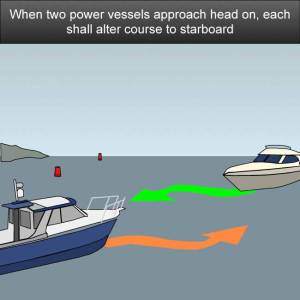
ColRegs Rule 14: Head-on Situation
(a) When two power-driven vessels are meeting on reciprocal or nearly reciprocal courses so as to involve risk of collision each shall alter her course to starboard so that each shall pass on the port side of the other. (b) Such a situation shall be deemed to exist when a vessel sees the other ahead or nearly ahead and by night she would see the mast head lights of the other in a line or nearly in a line and or both sidelights and by day she observes the corresponding aspect of the other vessel. (c) When a vessel is in any doubt as to whether such a situation exists she shall assume that it does exist and act accordingly.
(From Nautical Rules of the Road – ColRegs for power boating and sailing – a Safe-Skipper App)

You Need To Understand The IRPCS ColRegs To Pass Your Yachtmaster, Master of Yachts and Coxswain Certificate of Competence
Cleaning & polishing painted topsides
The gelcoat topsides of a GRP boat can be pampered and restored to their former glory relatively easily when it is ashore. Gelcoat is only a very thin outer layer of the hull, often less than 1mm thick, so you should avoid cleaning it with highly abrasive cleaners, or an-ything that could potentially damage its surface.
Nautical paper charts – a reminder of the basics
The nautical chart is an indispensable tool for navigation. A chart is a graphic representation of an area of the sea which might also include coastlines, estuaries and islands. All cruising leisure boats should carry up-to-date paper charts.
Understanding tide tables and tidal curves
There are many factors that influence local tidal patterns and it’s essential for every sailor to have a good understanding of tide tables and tidal charts to ensure they can calculate the level of tide at any given time.
Sailing Safely at Night – Best Practice
Sailing at night can be a magical experience – the peaceful solitude, starry skies, and gentle lapping of waves create an unforgettable atmosphere. However, nighttime sailing also presents unique challenges and risks that require careful preparation and vigilance. This comprehensive guide will cover essential safety practices to ensure your nocturnal nautical adventures are both enjoyable and secure.
Galvanic and electrolytic corrosion
Galvanic corrosion is an electrochemical reaction between two or more different metals, in the presence of an electrolyte (note salt water is a good electrolyte).
Fire prevention on boats
Right boat vs Wrong boat – Over 30 Ways to Cut the Cost of Your Sailing and Cruising
Sailing and cruising offer unparalleled freedom and adventure, but they can quickly become costly. Fortunately, there are numerous strategies to help you enjoy the open water without breaking the bank. Here are over 30 practical ways to cut your sailing and cruising costs.
The give-way hierarchy at sea – who gives way to whom?
Diesel engine winterisation
An inactive boat engine needs to be protected from corrosion during the winter, caused by the rising humidity levels through the cold months and the salty coastal air. This applies whether the boat is left afloat or hauled out over the winter. Read here about the two important stages of winterisaton for a diesel boat engine.
Passage Planning Advice & Safety for skippers
Boating emergency – how to broadcast a MAYDAY emergency call
Sailing to windward – how to take advantage of wind shifts
For most sailors, sailing upwind is the most exhilarating point of sail as you tack your way to your destination. Sailing to windward is a bit like zig-zagging your way up a mountain road through a series of hairpin bends – great fun but also calling for concentration and hard work.
Boat engine basics
Boat gas system maintenance
There are correct types of hose for marine plumbing, sewerage, exhaust, cooling and gas and all hoses should be checked regularly for wear and deterioration.
Boat ownership
Hull inspection – the annual checks
Navigating narrow channels
Navigating narrow channels can present challenges for boat operators due to limited space, restricted manoeuvrability, and potential hazards such as shallows, rocks, or other vessels. To ensure safe passage through narrow channels, it’s essential to follow specific strategies and techniques.
Top five windvane self steering installation questions
Top five windvane self steering installation questions answered by Sarah Curry of Hydrovane International Marine, courtesy of Viki Moore from Island Cruising NZ
Boat electrics
All boat owners should have a basic knowledge of electrics, both to avoid encountering electrical problems at sea and to stand a chance of solving them should they occur.
Essential Knots: Sheet bend
Understanding your boat’s compass
How to use tides and currents to your advantage
If you are contemplating a cruise through tidal waters and strong currents, then planning your trip carefully in advance is essential to enable you to take advantage of favourable tides rather than constantly fighting against them.