Select Page

The rig of a sailing boat is put under huge stresses and strains so it is important for inspections of a yacht’s spars and rigging to be carried out at regular intervals.

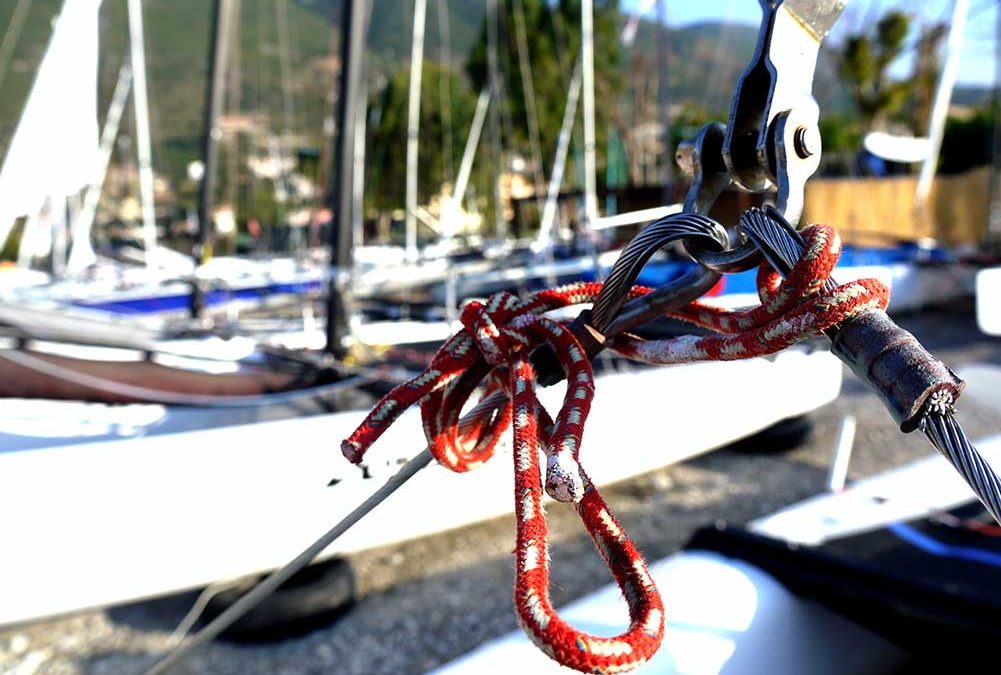
All the elements of a sailing rig – the mast, spreaders, boom, kicker, stays and the fittings that hold everything together – are subjected to considerable forces when at sea.

Less obvious perhaps is that the process of cyclic loading, the cause of metal fatigue, continues unabated even when a boat is rocking gently on a sheltered mooring. The rig components continue to push and pull against each other, day in and day out. Added to the all stresses and strains imposed on the rig components are their susceptibility to different kinds of corrosion, caused in the case of aluminium masts both by exposure to the marine environment on the one hand and also by galvanic corrosion. This occurs when stainless steel or bronze fittings are fitted to aluminium masts and not adequately insulated from each other, which causes the aluminium to corrode. While wooden masts do not suffer from galvanic corrosion, they are susceptible to rot and de-lamination.

Rig care

As with many other kinds of boat care, regular checks, preventative maintenance and the correct set up of mast and rigging are key to ensuring longevity and preventing failure. With sailing boat rigs in particular, the integrity of all their parts is vital. The mast and rigging is a lightweight structure designed to be rigid and strong, a bit like a house of cards – if one of the components fails then the whole house comes tumbling down. Even if one part becomes loose this can increase loads on other parts, causing them to fail.

While doing regular checks of your rig throughout the sailing season is good practice, so too is a more detailed inspection when the boat comes ashore and if needs be the mast can be taken down. Even if the rig remains unstepped ashore it still needs to be checked by a trained eye.

Understanding your rig

There are many kinds of mast and rig configurations for sailing boats and it is important for boat owners to fully understand the rig set up of their particular boat. This understanding will help them know what to look out for when doing their regular checks. Here are a few questions that owners should be able to answer:

Standing rigging

  • What are the main causes of rig failure?
  • When was the mast last unstepped? Once every two or three years is generally recommended.
  • When was the standing rigging last inspected? Annual inspections are usually recommended.
  • When was the standing rigging last replaced? Once every ten years or so is usually recommended for wire rigging and about fifteen years for rod rigging.
  • Where are the main stress points on your rig?
  • How do you check the rig alignment?

Running rigging

  • When was the running rigging last inspected?
  • When should it be replaced?
  • What maintenance needs to be done?

Causes of rig failure

While many sailors live in fear of rogue waves and capsize, most dismastings happen either because of equipment failure or operator error. Leaving aside operator error, the main reasons include the failure of chainplates, spreaders, turnbuckles and tangs caused by either metal fatigue, corrosion or a combination of the two.

Chainplate failure is one of the most common causes of dismasting. Chainplates are not easy to inspect as they are hidden from view beneath the deck. Corrosion happens out of sight where the metal cannot be inspected without the plates first being removed.

Other causes are the failure of terminal fittings, clevis pins, cotter pins and all the parts that hold a rig together.

Surprisingly perhaps, the mast and stays are rarely the components that break first and cause a dismasting.           

Stresses and loads

The components of a rig are designed to withstand certain stress levels and loads caused by a boat under sail in varying conditions. The correct adjustment of the rig is important to maintain the rig’s strength and longevity for a number of reasons – not just the boat’s performance and ability to point to windward. These include:

  • If the rigging is slack problems can develop as it moves about, causing fatigue.
  • Rig components can become weakened by vibrations caused for example as sails flog in strong winds, or by shock loading caused for example by accidental gybes.
  • The misalignment of part of a rig can cause other parts to be overloaded resulting in metal fatigue and eventual failure.
  • Stress coupled with corrosion will accelerate the potential for rig failure.

Crevice corrosion

Some surface rust on stainless steel rigging is normal and usually polishes off very easily. While stainless steel does not rust in the way that regular steel does, it does suffer from crevice corrosion.

Crevice corrosion occurs because the stainless steel has been deprived of oxygen. As a result its protective oxide film breaks down, allowing chlorides to infiltrate and corrode the metal. This happens around joints and under fastener heads and where pieces of metal are in close contact. Chainplates often suffer from this type of corrosion where they pass through the deck and sea water has saturated the deck core.

Crevice corrosion also takes place where cyclic loading has caused stainless steel to develop hairline cracks on the metal’s surface. Sea water then gets into the cracks and the corrosion slowly takes hold.

 Galvanic corrosion

Aluminium masts with stainless steel fittings are at risk from galvanic corrosion. Galvanic corrosion is the transfer of electrons from one metal (the anode) to another (the cathode). In this case the anode is the aluminium and the cathode is the stainless steel. Positively charged electrons flow from the the anode to the negatively charged cathode. Galvanic corrosion also requires an electrolyte, a liquid that enables the electron flow to take place. In this case salt water is the electrolyte and a very efficient one.

Note: All stainless steel fittings should be insulated from aluminium masts by washers or sealant

Repairing chips and dings in gelcoat

The gelcoat topsides of a GRP boat can be pampered and restored to their former glory relatively easily when it is ashore. Gelcoat is only a very thin outer layer of the hull, often less than 1mm thick, so you should avoid cleaning it with highly abrasive cleaners, or an-ything that could potentially damage its surface.

Fixing position at sea using traditional methods

This post looks at some traditional methods used for fixing a vessel’s position at sea, within sight of land. Electronic fixes using chart plotters are very straightforward to record, but if for some reason a vessel’s electronics are faulty it is essential that a skipper knows how to use traditional methods.

Jester Challenge 2022 – Sailing single handed from Plymouth UK to the Azores: Part 5 – Boat Management

Jester Challenge – A modern experiment in old-fashioned self-reliance, self sufficiency, and personal responsibility. This is the fifth of a 10-part post where solo sailor, Bernie Branfield, shares his first hand account of his single-handed, 2022 Jester Challenge, from Plymouth, UK to the Azores, in his 26′ Invicta Mk2, Louisa.

Boat maintenance below decks

While most interior maintenance work can be done when a boat is afloat, some jobs such as servicing the seacocks have to be done ashore. It makes sense to do any major interior repairs and improvements with the boat hauled out in the boatyard.

Jester Challenge 2022 – Sailing single handed from Plymouth UK to the Azores: Part 9 – Around the Azores

Jester Challenge – A modern experiment in old-fashioned self-reliance, self sufficiency, and personal responsibility. This is the ninth of a 10-part post where solo sailor, Bernie Branfield, shares his first-hand account of his single-handed, 2022 Jester Challenge, from Plymouth, UK to the Azores, in his 26′ Invicta Mk2, Louisa.

Distress flares – which flare, how & when to use?

How to use distress flares at sea To effectively use distress flares at sea, you need to understand the different types, their purpose, and the...

Anchoring – getting it right

If you can set an anchor correctly with confidence and know your boat will be safe in a secure anchorage, then you can rest in comfort and will not...

Sail care and maintenance – Part 2

At the end of the sailing season sails should be washed and inspected carefully for damage, including small tears, stitching failure, ultraviolet damage, stains and mildew.

Stern gear maintenance

The stern gear of a boat needs to be checked carefully when the boat is ashore as this is something that can only be done when it is out of the water. The same applies for any maintenance and repairs that may need doing, so it is best to check it all over as soon after an end of season lift out as possible.

Seized fixings and fastenings

Maintaining a boat can be a rewarding experience but at times it can also be frustrating. A prime example of this is when you come across a seized fixing or fastening that refuses to budge. Read our tips on how to release and fix them:

How a propeller works

Have a look around any boatyard and you will notice quite a variety of propellers – some have two blades, some have three and others have four or more. While most propellers are completely rigid some have blades that fold.

Electric motors and hybrid systems

In recent years there have been considerable advances with the development of electrically powered propulsion in the leisure marine sector. This includes developments with inboard and outboard electric motors, hybrid systems, lithium-ion battery technology as well as solar, wind and hydro powered generators.

First Aid Afloat – Jellyfish Stings

Jellyfish stings are a common occurrence when boating or swimming in many parts of the world. While most stings are not serious, some can cause...

Boat batteries

Under-sized battery banks are one of the key factors behind power failure at sea, as well as the premature failure of batteries, so make sure that your boat battery measures up to the use you want to put it to.

Preparing for sailboat cruising

Preparing for a sailing trip entails a lot of planning. In this blog, we take a look at some of the many safety aspects that a skipper needs to consider before heading off on a cruise.

Boating Rules of the Road – International ColRegs

    International ColRegs Rule 7: Risk of Collision Anyone who is responsible for a vessel at sea, from the...

An explanation of the IALA maritime buoyage systems – IALA A and IALA B

What are the differences between the two IALA buoyage systems, IALA Region A and IALA Region B, and where are they used?   As recently as the 1970s...

Boat interior varnishing

Most boat interiors have a combination of varnished and painted surfaces including solid wooden joinery, plywood laminates with thin hardwood veneers and glass reinforced plastic. When making your assessment of what you are going to do, bear in mind that the varnishing process consumes a lot of time, especially if the existing surfaces are in poor shape.

How to read nautical charts

Whilst most sailors today rely on GPS to find their way at sea, nautical charts are a crucial tool for any sailor to navigate safely and effectively. Here is a reminder of some of the basic steps involved in reading a nautical chart:

Antifouling for leisure boats – Part 3

Antifouling is one of the least pleasant boat maintenance jobs to do, but it has to be done. The very worst job of all is removing the old antifouling as this can get seriously messy and is very hard work.

Steel and Aluminium Hulls

The two metals used for hull construction are steel and aluminium. These are both very strong materials and will last a long time as long as they are cared for, which primarily means protecting steel boats from rust and aluminium boats from electrolytic action.

Jester Challenge 2022 – Sailing single handed from Plymouth UK to the Azores: Part 2 – Weather

Jester Challenge – A modern experiment in old-fashioned self-reliance, self sufficiency, and personal responsibility. This is the second of a 10-part post where solo sailor, Bernie Branfield, shares his first hand account of his single-handed, 2022 Jester Challenge, from Plymouth, UK to the Azores, in his 26′ Invicta Mk2, Louisa.

Pleasure craft safety equipment recommendations

Safety equipment is an important part of boat preparation and it is advisable for all pleasure craft skippers to check their vessel is...

Fire prevention on boats

  Fire prevention on boats - common causes of fire: • Smoking below decks • Galley cookers • Build-up of butane or...

Finding your way at sea: waypoints

Any sea voyage needs a certain amount of planning before it is undertaken. It makes sense to think about where you are going, how you will get there and what factors might influence your plan. Planning the route itself is also critical. One of the essential parts of modern navigation is the use of waypoints.