Select Page

Boats that are kept afloat can very quickly become a home for small marine organisms such as barnacles, weed and slime. Applying an antifouling paint to your hull is necessary to protect it from these micro-organisms, as a fouled hull can cause problems and will slow down a boat’s maximum speed considerably if left unchecked.

There has been much controversy over the years about antifouling products due to their detrimental effects on marine life, especially in marinas and crowded anchorages in estuaries. The big challenge for the paint manufacturers is to develop products that will keep hulls free of foul without harming the environment.

There are two main types of antifouling paint used for leisure boats, normally referred to as hard and eroding. Both contain biocides that kill and deter fouling organisms but they work in different ways and are designed for different types of boat. The basis of most biocides found in antifouling are copper (Cu) and cuprous oxide (CuO). These are effective at deterring the growth of molluscs, larvae and some types of weed but there needs to be high concentrations of copper in the paint for them to work. To be completely effective, some antifouling also contains zinc based biocides or organic algaecides.

When choosing antifouling for your boat, it is advisable to talk to your local chandleries as they should be able to tell you what antifouling is best for your type of boat, its location and the environment. It is important to know the type of antifouling currently on your boat, as not all types of antifouling are compatible with each other.

Hard antifouling

Hard antifouling slowly releases biocide which prevents foul from settling on the hull. The biocide can last a whole year and if several layers are applied, even longer. However, the leaching rate reduces over time and the paint loses its efficiency. This type of paint has a hard finish, which enables it to be scrubbed or wet sanded through the season to keep the bottom in good condition.

Hard antifouling is popular with boats where maximum performance is required – racing yachts and fast powerboats for example. It is also used for boats kept in fresh water as the alternative, eroding antifouling, is designed to be used in salt water and does not perform as well in fresh water.

There are some types of hard antifouling with a very high copper content, where tiny particles of copper are suspended in epoxy resin. Several layers of this copper resin have to be applied very carefully to a pristine hull. This process is normally done by a small professional team under controlled conditions. The final coat is sanded, leaving a layer of copper oxide that is effective, very hard wearing and can last up to 10 years or so. Copper resins are expensive to buy and apply in the first place, but after a few years they become a viable option as there is very little maintenance required.
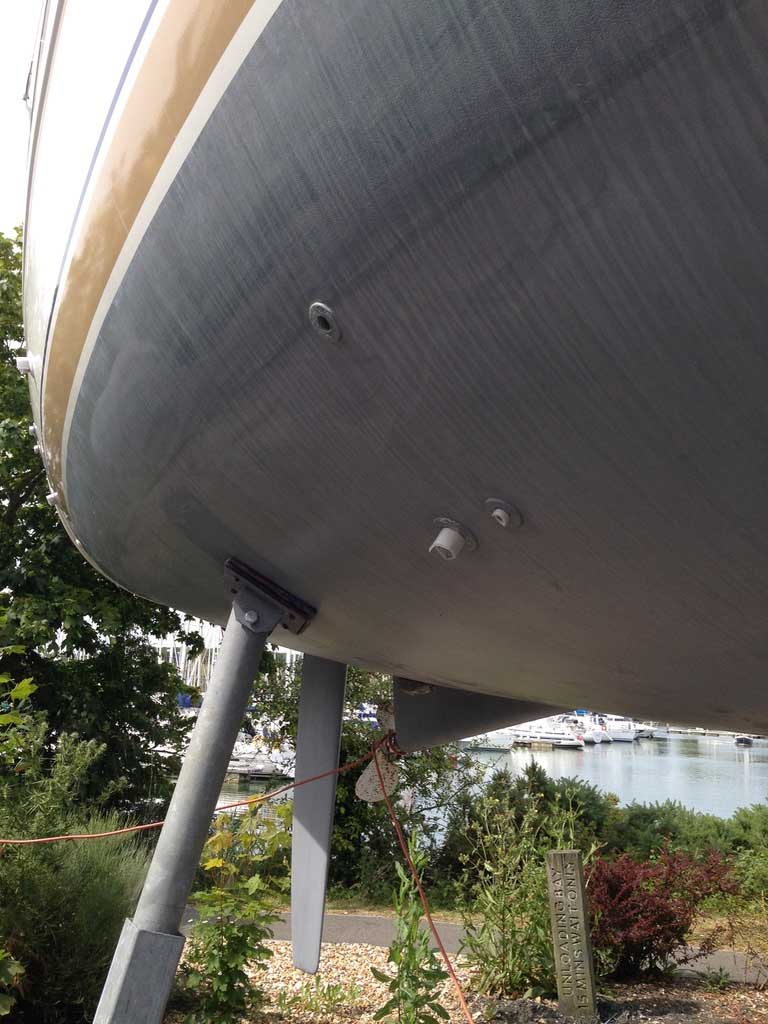
Eroding antifouling

Eroding antifouling is also known as soft antifouling and like hard antifouling slowly releases biocide. The big difference between the two is that the paint itself erodes into salt water, leaving very little residue on the hull itself. This is ideal in many ways for the cruising boat owner as it reduces the build up of successive layers of antifouling and makes maintenance much easier. However, this is not so ideal for those who want to keep their boat’s bottom in pristine condition through the boating season as scrubbing or sanding it smooth takes off the paint.

Therefore, eroding antifouling is more widely used for cruising yachts and displacement motorboats where speed is not the absolute priority.

Non-toxic antifouling

Recent developments in antifouling technology have concentrated on finding non-toxic solutions which are environmentally safe. There have been some significant breakthroughs in recent times.    

There are several silicon based products available that form a very slippery surface which prevents micro-organisms from gripping onto the hull. While these developments have generally been well received by the leisure marine community, they perform best on hulls that regularly move through the water at speeds of 10 knots or more. A great idea for powerboats but not so excellent for most sailing yachts that rarely, if ever, exceed 10 knots through the water.

Another option to consider is electronic antifouling, which uses ultrasound technology to deter fouling organisms. These systems are easy to install and can be undertaken by competent DIY boat owners. You do have to swallow hard when it comes to the price but perhaps in the future these will become common place and more affordable – I hope so.

Anchoring – getting it right

If you can set an anchor correctly with confidence and know your boat will be safe in a secure anchorage, then you can rest in comfort and will not...

Essential boat engine checklist

Boat engine checklist Engine oil level check Even if you have checked it previously, confirming the engine oil level is up...

Engine failure at sea – common causes and how to avoid them

Many engine failures are caused by lack of maintenance, resulting in fuel filter blockages, water pump failures, overheating and other breakdowns. Indeed, one of the most common reasons for marine rescue service call outs is for one of the most basic reasons possible – boats that have run out of fuel.

Engine failure at sea – keeping the boat safe

If the engine stops when you are underway, or your have to shut it down when a warning buzzer sounds, you also need to make sure the boat remains safe. It’s important therefore to recognise situations in which the boat would be immediately put in danger if the engine were to fail.

How a propeller works

Have a look around any boatyard and you will notice quite a variety of propellers – some have two blades, some have three and others have four or more. While most propellers are completely rigid some have blades that fold.

Tools and spares for your boat

Tools and Spares to take to sea!

You won’t regret taking a look at our essential tips and checklist to make sure you’re prepared for routine maintenance and those unexpected jobs that come up whilst you’re afloat!

Estimating and plotting your position at sea

This post covers how we go about estimating and plotting our position using traditional methods, when out of sight of land – covering Dead Reckoning, Estimated Position, Tidal Streams, Leeway and more…

How to read nautical charts

Whilst most sailors today rely on GPS to find their way at sea, nautical charts are a crucial tool for any sailor to navigate safely and effectively. Here is a reminder of some of the basic steps involved in reading a nautical chart:

Finding your way at sea: waypoints

Any sea voyage needs a certain amount of planning before it is undertaken. It makes sense to think about where you are going, how you will get there and what factors might influence your plan. Planning the route itself is also critical. One of the essential parts of modern navigation is the use of waypoints.

A five day sailing cruise of the Solent, UK

Welcome to our virtual Solent sailing cruise – a five day sail in the south of England from Bosham Quay in Chichester...

Hourly Checks when sailing or motoring

  Hourly Checks Get into the habit of carrying out these checks and both yourself, your crew and your boat will be...

Antifouling for leisure boats – Part 3

Antifouling is one of the least pleasant boat maintenance jobs to do, but it has to be done. The very worst job of all is removing the old antifouling as this can get seriously messy and is very hard work.

ColRegs – avoiding collisions at sea

ColRegs - avoiding collisions at sea ColRegs Rule 8: Action to avoid collision (a) Any action taken to avoid collision shall...

Essential Knots: Round turn and two half hitches

Essential Knots: Round turn and two half hitches Use: Tying a rope to a pole or a ring. Step 1. Pass the end around the object. Step 2....

Sail trimming for cruisers

Sail trimming tips for cruisers. Whether racing or cruising, a well tuned boat will sail faster and tend to heel less than a boat with badly adjusted sails.

Keel maintenance and repair – Part 1

Keels are designed to act as underwater foils that generate lift as the boat moves through the water, counteracting the leeward force of the wind and enabling the boat to sail closer to the wind. Keel maintenance and repair is essential for the performance of your boat.

How diesel engines work

The basic principle of a diesel engine is less complex than that of a petrol engine. No spark plug or ignition system is needed, making the basic diesel engine a comparatively straightforward system that results in fewer faults and has lower maintenance costs than a petrol engine.

Stern gear maintenance

The stern gear of a boat needs to be checked carefully when the boat is ashore as this is something that can only be done when it is out of the water. The same applies for any maintenance and repairs that may need doing, so it is best to check it all over as soon after an end of season lift out as possible.

Boat electrics

All boat owners should have a basic knowledge of electrics, both to avoid encountering electrical problems at sea and to stand a chance of solving them should they occur.

Boat surveys

A full boat survey assesses the condition of the hull, mechanical gear and means of propulsion. The survey is carried out with the boat...

Leaking decks

Leaking decks are perceived as a nuisance by some boat owners, but if leaks are ignored a much more serious situation may well be developing, especially in the case of boats with balsa or plywood deck cores. So deck leaks do need to be investigated and dealt with.

Boat interior inspection and checks

While a boat is ashore, the most critical interior checks to carry out are those that concern the safety of the boat. This entails the integrity of all through-hull fittings and seacocks, the gas system and the electrical system.

A simple guide to understanding tides when passage planning

Understanding tides when passage planning When planning a trip in tidal waters, check the tides before going afloat. Use...

Crew Overboard Drill – Updated

How to respond to crew overboard A Man Overboard (MOB) drill is a crucial safety procedure that every boater should practice regularly. It simulates...

Fractures, sprains and dislocations at sea

Moving about a boat at sea often results in a few knocks and bruises, but if a crew member has a fall or major bump and is in serious pain, they should be examined and treated accordingly.