Select Page

It is important for all boat skippers to have a basic knowledge of boat electrics and this includes understanding how batteries work. Under-sized battery banks are one of the key factors behind power failure at sea, as well as the premature failure of batteries. It’s therefore worth analysing the set up on your boat when it’s ashore in the boatyard to see whether it measures up to the use you put it to.
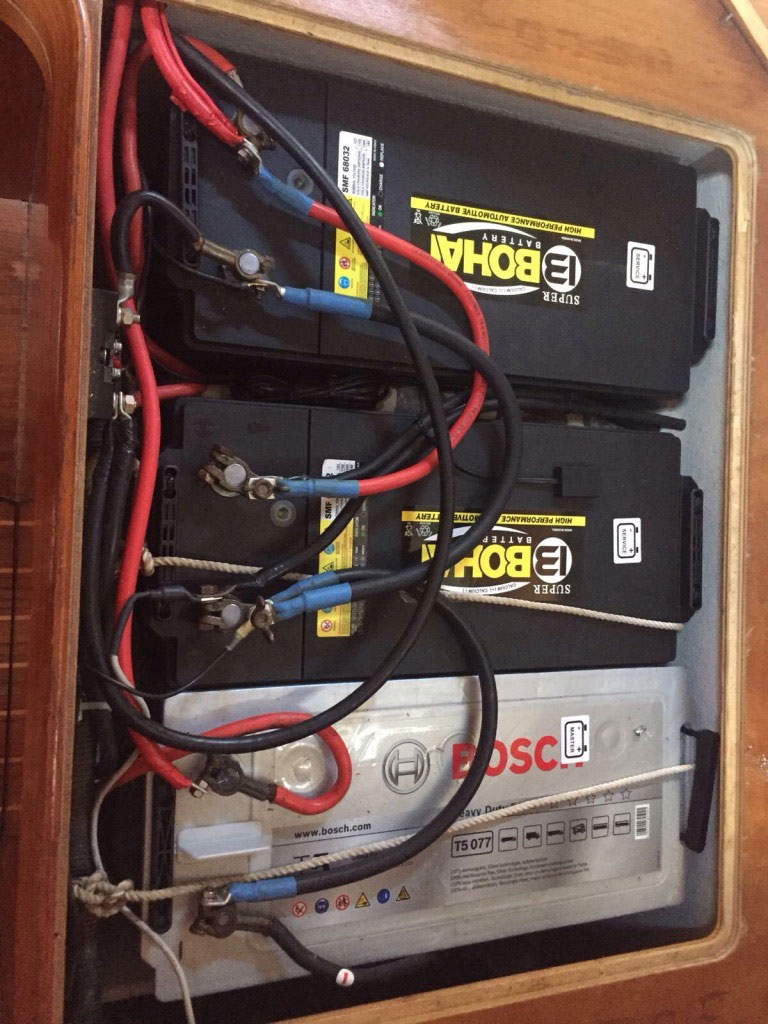
boat battery bank

An automotive-type battery, of a similar specification to those used in cars, can be used to supply the starter motor with the very high loads for the few seconds it takes to start the engine. This type of battery, however, is not suitable for powering the boat’s other systems, which will typically draw a relatively small amount of power for many hours, or even days, at a stretch.

Deep-discharge (or traction) batteries are designed for slow discharge over a period of time, before being recharged when the engine is running or via shore power chargers, or solar or wind generators. This type of use would quickly destroy an automotive battery, but a good leisure battery will withstand several hundred such cycles. However, discharging even the best deep discharge batteries below 50 per cent of their rated capacity will dramatically shorten their life.

There are various grades of such battery – the cheaper ones are not sealed and will need topping up with distilled water from time to time and are likely to have a shorter life span than more expensive models. Gel and AGM type batteries cannot spill battery acid and don’t produce potentially explosive hydrogen gas when charging. They can withstand many more charge-discharge cycles than conventional deep discharge batteries and so have many advantages for use on boats, despite their higher initial purchase price. Some are also capable of being used for both starting and deep cycling applications.

All batteries loose some of their charge over time. When storing them over the winter, ensure they are fully charged at the start of the storage period and, if possible, charge once a month to maintain the charge level. Modern three-stage and four-stage mains powered chargers may be left connected permanently.

Determining battery capacity

Deep discharge batteries are rated in Amp-hours – a fully-charged 100Ah battery, for instance, will deliver 5A for 20 hours before becoming completely discharged. However, discharging even the best deep discharge batteries below 50 per cent of their rated capacity will dramatically shorten their life.

boat battery connection

Calculating your estimated daily power usage, by multiplying the current in Amps of each device by the length of time for which you expect to use each it, will help determine the size of the batteries needed for the boat. If you aim to charge once a day and don’t plan to discharge the batteries to more than 50 per cent of their total capacity, your battery bank should in theory be at least twice the size of your estimated daily power usage.

However, even with good battery charging technologies it becomes increasingly difficult to cram the last 20 per cent of charge into a battery. It’s therefore best to size battery banks at around three times the expected daily power usage. Even then, this gives little scope for adding new power hungry devices such as a fridge or electric autopilot and even with correctly sized batteries it’s important to maintain a watch over the battery state throughout a voyage.


Examples of power usage  
Navigation light 1A (boats up to 12m)
Navigation light 2.5A (boats over 12m)
Interior lights (each) 1A
LED lights (each) 0.2A
Laptop 3-6A
Instruments 1A
Chart plotter 1-2A
Stereo 1-3A
Auto pilot 3-6A
Fridge 4A
   

Tip:

  • Some boat owners always keep a fully charged reserve battery for engine starting.

Boating Rules of the Road – International ColRegs

    International ColRegs Rule 7: Risk of Collision Anyone who is responsible for a vessel at sea, from the...

Essential Boat Spares for Safety

  Boats Spares Tool kit What you carry in the boats tool kit will be useful for many boat repairs, but you might want...

Antifouling for leisure boats – Part 1

Boats that are kept afloat can very quickly become a home for small marine organisms such as barnacles, weed and slime. Applying an antifouling paint to your hull is necessary to protect it from these micro-organisms, as a fouled hull can cause problems and will slow down a boat’s maximum speed considerably if left unchecked.

Tips and advice for staying safe on a sailboat at sea

Here we focus on how to stay safe on a sailboat at sea. We cover key things to ensure you have on board before you set sail as well as covering the most common cause of incidents on sailboats and how to deal with them.

Peer to Peer yacht charter – How can you monetize your boat?

There is a growing trend in peer to peer yacht charter. How does it work? People already rent rooms, cars and bikes from one...

First aid at sea basics

At least one person on board should be trained in first aid and know how to administer the contents of the first aid kit, ensuring there are adequate supplies for the planned duration of the trip.

Sailing to windward – how to take advantage of wind shifts

For most sailors, sailing upwind is the most exhilarating point of sail as you tack your way to your destination. Sailing to windward is a bit like zig-zagging your way up a mountain road through a series of hairpin bends – great fun but also calling for concentration and hard work.

2023 Rolex Fastnet Race – Part 2

Simon Jollands took part in the 2023 Rolex Fastnet Race. This is the second of his articles on the race aboard Lancelot II, a Beneteau First 40.

Jester Challenge 2022 – Sailing single handed from Plymouth UK to the Azores: Part 10 – The Return Trip

Jester Challenge – A modern experiment in old-fashioned self-reliance, self sufficiency, and personal responsibility. This is the final instalment of a 10-part post where solo sailor, Bernie Branfield, shares his first-hand account of his single-handed, 2022 Jester Challenge, from Plymouth, UK to the Azores, in his 26′ Invicta Mk2, Louisa.

Rudders and steering systems – Part 2

One thing all rudders have in common is that they have three main parts that need to be checked: the rudder, or a steerable drive leg in the case of many power boats; the system that joins the rudder to the steering; the steering control itself.

How to read nautical charts

Whilst most sailors today rely on GPS to find their way at sea, nautical charts are a crucial tool for any sailor to navigate safely and effectively. Here is a reminder of some of the basic steps involved in reading a nautical chart:

Essential Knots: Reef knot

Essential Knots: Reef knot Use: Tying two ends of rope together, often used for tying up a bundle of loose sail around the boom. Step...

Jester Challenge 2022 – Sailing single handed from Plymouth UK to the Azores: Getting to the Start

Jester Challenge – A modern experiment in old-fashioned self-reliance, self sufficiency, and personal responsibility. This is the start of a 10-part post where solo sailor, Bernie Branfield, shares his first hand account of his single-handed, 2022 Jester Challenge, from Plymouth, UK to the Azores, in his 26′ Invicta Mk2, Louisa.

Understanding boat engines

Irrespective of what kind of engine a boat is equipped with and who does the work, the regular care and maintenance of a marine engine is essential. The most common cause of marine engine failure is widely known to be lack of maintenance.

Boat engine basics

Boat engines come in all shapes and sizes and include inboards, outboards, petrol, diesel, electric and hybrid systems. Some engines are...

ColRegs Nav Lights & Shapes, Rules Of The Road and IALA Buoys Apps

ColRegs Nav Lights & Shapes, Rules Of The Road and IALA Buoys Apps Make Learning Rules on iPhone, iPad, iPod and Android...

Feeling anxious at sea

  Some people feel anxious at sea. Will they be seasick? What if they get caught in a violent storm? Could the boat...

Essential boat engine checklist

Boat engine checklist Engine oil level check Even if you have checked it previously, confirming the engine oil level is up...

Weather forecasting resources and tips

All competent sailors need to have a good basic understanding of how to interpret a weather forecast. They also need to be able to interpret the actual conditions they are experiencing.

Sailboat rig checks – Part 2

In part two of Sail boat rig checks we run through some useful rig maintenance tips and then finish with a brief look at what a professional rig check involves.

Man Overboard Drill

How to respond to crew overboard under sail • Keep the MOB in sight • Tack into the heave-to position, do not adjust the...

Hourly Checks when sailing or motoring

  Hourly Checks Get into the habit of carrying out these checks and both yourself, your crew and your boat will be...

Navigation safety: a quick-reference mobile app to learn the ColRegs NavLights and Shapes

 Safety at SeaSafety at sea will always remains a topical and important subject that will no doubt dominate the syllabuses of nautical...

Leaking decks

Leaking decks are perceived as a nuisance by some boat owners, but if leaks are ignored a much more serious situation may well be developing, especially in the case of boats with balsa or plywood deck cores. So deck leaks do need to be investigated and dealt with.

Jester Challenge 2022 – Sailing single handed from Plymouth UK to the Azores: Part 3 – Preparations

Jester Challenge – A modern experiment in old-fashioned self-reliance, self sufficiency, and personal responsibility. This is the third of a 10-part post where solo sailor, Bernie Branfield, shares his first hand account of his single-handed, 2022 Jester Challenge, from Plymouth, UK to the Azores, in his 26′ Invicta Mk2, Louisa.