Select Page

In our series of Safe Skipper blogs on first aid at sea, here are four common emergencies skippers should be prepared for at sea. Knowing how to cope with them could well save a life, while not knowing could result in an avoidable tragedy. In this blog we look at what to do in the event of a crew member choking, drowning, or suffering from hypothermia or fatigue.


Choking

If the larynx is blocked and the victim cannot breathe, give several strong blows between the shoulder blades while supporting their chest. If this fails to relieve the obstruction, try abdominal thrusts by standing behind the casualty, clasping your hands together, positioning them on their abdomen and pulling inwards and upwards four or five times. If the casualty becomes unconscious, begin CPR.

Drowning

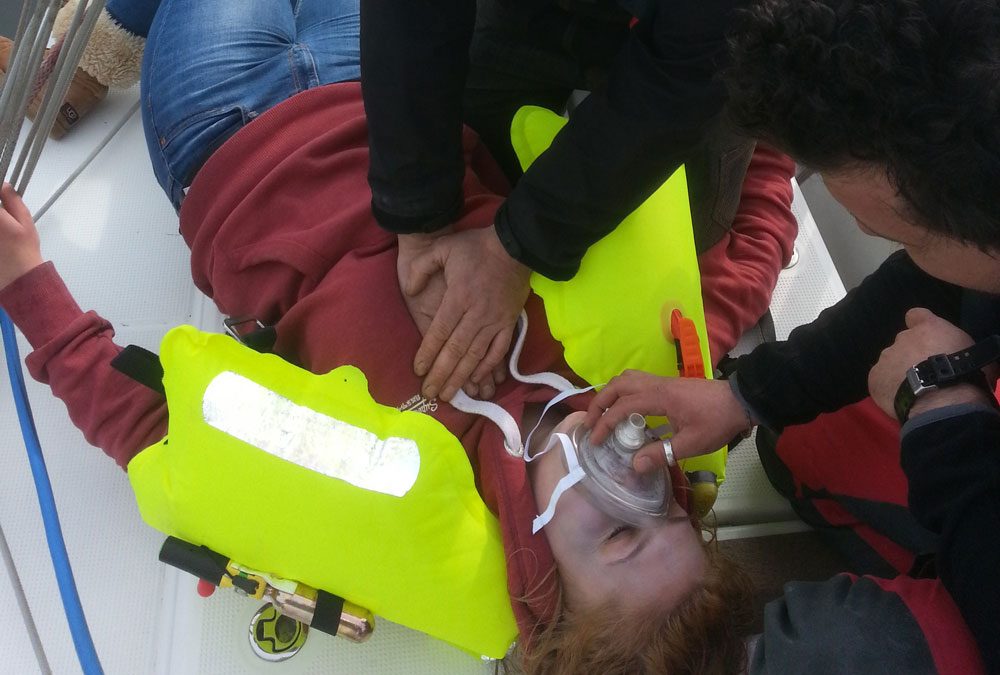
Someone who has been recovered from the water and is unconscious should be treated for drowning as follows:

  • Check for a blocked airway and signs of breathing.
  • Begin CPR if there are no signs of breathing.
  • When the casualty begins breathing, place them in the recovery position.
  • Treat for hypothermia and shock.
  • Remove wet clothes if possible and keep warm with blankets or warm clothing.

Monitor the casualty closely and when they regain consciousness be aware of the risks of secondary drowning, where the lungs are damaged after inhaling water. This can occur up to 3 days after the accident, so a casualty who has recovered from near drowning should always go to hospital for a check up.

Hypothermia

Normal body temperature is 37ºC.  A person becomes hypothermic if their body temperature drops below 35ºC. The same applies to those suffering from hypothermia as to those suffering from seasickness and fatigue. That is, you should be alert for the early signs and take what action you can to remedy the condition as soon as possible.  At sea, hypothermia can occur gradually after prolonged exposure to cold, wet and windy conditions on deck, or more suddenly after immersion in the sea.

Early signs of hypothermia include: shivering, slurred speech, clumsiness, irritability and memory loss. The sufferer develops pale skin, slow breathing and a slow pulse. The next stage, severe hypothermia, is complete collapse and unconsciousness and if unchecked, the heart eventually stops.

Treatment of hypothermia:

  • If the casualty is breathing, put them in the recovery position, ideally below deck.
  • Keep the casualty horizontal and commence warming. Be gentle, as a hypothermic person’s internal organs are sensitive to physical shocks.
  • Replace wet clothing with dry warm clothing, sleeping bags or a space blanket.
  • You can warm the casualty by applying warm towels to their head, or by lying another crew member alongside them to share body heat.
  • Applying hot water bottles is also recommended but keep the temperature below 46ºC / 115ºF.
  • Give the casualty warm, sweetened non-caffeinated drinks.
  • Keep monitoring the casualty’s temperature, if it drops below 32ºC then severe hypothermia develops and you have a major emergency to deal with.

Signs of severe hypothermia are as follows:

  • Casualty stops shivering.
  • Skin appears blue or grey, partly swollen.
  • Pulse is slow or weak.
  • Casualty loses consciousness.
  • Little or no breathing.
  • Pupils may be dilated.

Treatment of severe hypothermia:

  • Send MAYDAY. The casualty needs urgent hospital care.
  • Handle with extreme care. The casualty is at risk from cardiac arrest.
  • Check for signs of breathing. If the casualty is not breathing, commence basic life support starting with rescue breaths and then chest compressions and the CPR cycle.
  • Re-warm slowly. Take care not to burn the casualty.
  • Monitor pulse and breathing constantly.
  • Do not rub the casualty’s skin or give them alcohol.

Fatigue

Fatigue can be a major problem at sea, as people begin to make mistakes when they are tired, whether incorrectly plotting a position, slipping on deck or becoming short tempered with others.  On a long cruise, it is a good idea to agree a watch system which everyone on board keeps to.

See also: Common medical emergencies at seaFirst aid at sea basics.

Care of boat batteries

Boat batteries need to be kept properly charged, which means never allowing the batteries to discharge below 50 per cent of their total charge. As well as the batteries themselves, keeping a boat’s charging systems in good shape will also help to keep batteries topped up to a higher level of charge.

2023 Rolex Fastnet Race

Safe Skipper’s Simon Jollands took part in the 2023 Rolex Fastnet Race – a classic offshore sailing event. This is the first of several articles on the race and focuses on the start.

Boat maintenance log

Keeping a boat maintenance log is an ideal way of reminding owners what needs to be done to a boat and when. Read on for some tips,...

Five dangers a vessel may encounter at sea

What are the main dangers a vessel may face at sea and what should skippers do to reduce the risk of these happening?

Estimating your position at sea

Navigators use a combination of techniques to estimate their position at sea. The primary method used today is GPS (Global Positioning System), a network of 24 satellites that became fully operational in the 1990s and was originally restricted for use by the United States military.

Feeling anxious at sea

  Some people feel anxious at sea. Will they be seasick? What if they get caught in a violent storm? Could the boat...

Safety Briefings – leave nothing to chance

Before giving your crew a safety briefing, it is worth considering the specific circumstances of the planned trip, the...

How to predict wind direction and strength by reading a weather chart

Weather charts, also known as surface pressure or synoptic charts, contain a lot of information that helps weather...

Liferafts

Liferafts should be stowed where they are ready for immediate launching. All crew should know the location of the liferaft and know how to launch, inflate and board it. They should also know what equipment it contains.

Repairing a leaking hull-to-deck joint

If you suspect a hull-to-deck joint has failed, then being absolutely sure where the actual leak is occurring is of prime...

VHF DSC radio – how best to communicate at sea

There are many ways to communicate with others at sea. What makes the VHF DSC radio the best form of short range...

Jester Challenge 2022 – Sailing single handed from Plymouth UK to the Azores: Part 6 – Communications

Jester Challenge – A modern experiment in old-fashioned self-reliance, self sufficiency, and personal responsibility. This is the sixth of a 10-part post where solo sailor, Bernie Branfield, shares his first-hand account of his single-handed, 2022 Jester Challenge, from Plymouth, UK to the Azores, in his 26′ Invicta Mk2, Louisa.

Tidal heights and the rule of twelfths

For those skippers who need to make a quick calculation or don’t have access to specific tidal curves for their location, it is possible to make an approximation using a system called the Rule of Twelfths. This is a simple method used to estimate the height of tide at any given time during the tidal cycle. It is based on the idea that the rise and fall of the tide is not constant, but follows a predictable pattern than can be divided into twelve parts.

Learning about diesel engine maintenance

Marine diesel engines are internal combustion engines that are designed specifically for use in maritime applications. These engines are commonly used in a variety of watercraft, ranging from small boats and yachts to large ships and vessels. Learn about marine diesel engine maintenance courses.

Sail care and maintenance – Part 2

At the end of the sailing season sails should be washed and inspected carefully for damage, including small tears, stitching failure, ultraviolet damage, stains and mildew.

How to improve a yacht’s upwind performance

There are several ways to improve the upwind performance of a sailing yacht. Read on for some useful tips including headsail reefing, heavy weather jibs and motor sailing.

Essential Knots: Round turn and two half hitches

Essential Knots: Round turn and two half hitches Use: Tying a rope to a pole or a ring. Step 1. Pass the end around the object. Step 2....

First Aid Afloat – Jellyfish Stings

Jellyfish stings are a common occurrence when boating or swimming in many parts of the world. While most stings are not serious, some can cause...

Dag Pike’s Boat Survey

We're really pleased to be working with Dag Pike on some great new apps for iPhone & Android. Here'a a bit more about the first app: Dag Pike's...

Safety Equipment Checklist for Boats

Safety Equipment Checklist for Boats   Liferaft line attached The liferaft will not work unless the trigger line is...

Steel and Aluminium Hulls

The two metals used for hull construction are steel and aluminium. These are both very strong materials and will last a long time as long as they are cared for, which primarily means protecting steel boats from rust and aluminium boats from electrolytic action.

Understanding tides

If you are used to sailing in tidal waters, you will know that tides can be both a benefit and a hindrance to the sailor. In many ways,...

2023 Rolex Fastnet Race – Part 2

Simon Jollands took part in the 2023 Rolex Fastnet Race. This is the second of his articles on the race aboard Lancelot II, a Beneteau First 40.

Pleasure craft safety equipment recommendations

Safety equipment is an important part of boat preparation and it is advisable for all pleasure craft skippers to check their vessel is...

Rudders and steering systems – Part 3

In the third of our three blog articles on rudders and steering systems, we look at how to replace rudder bearings and repair a water-saturated core.