Select Page

What are the differences between the two IALA buoyage systems, IALA Region A and IALA Region B, and where are they used?
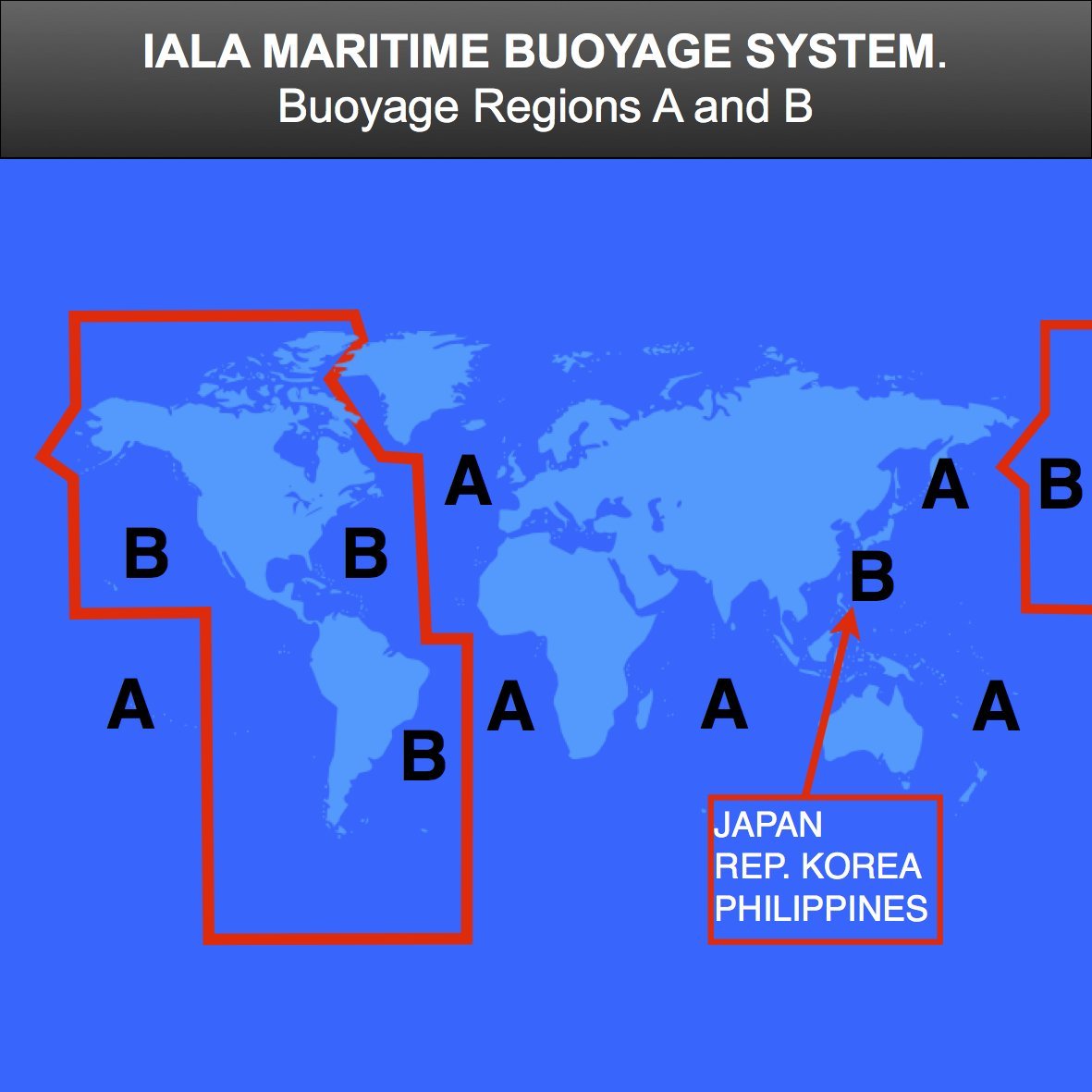
 IALA buoyage map

As recently as the 1970s there were more than 30 buoyage systems in use around the world. This caused confusion and accidents and it was after two fatal incidents in the Dover Straits in 1971 that the IALA (International Association of Marine Aids to Navigation and Lighthouse Authorities) was established.  There followed a worldwide effort to develop a safe, unified maritime buoyage system that could be followed by all vessels at sea.

This resulted in the IALA Maritime Buoyage System and by 1980 there were just 2 systems in use, IALA A and IALA B. Although there is not as yet one unified system for the whole world, this was a major achievement nonetheless and the differences between IALA A and IALA B are only minor. The IALA chose the two systems in order to keep the number of changes to existing systems to a minimum and to avoid major conflict.

IALA REGION A

IALA A is used by countries in Africa, most of Asia, Australia, Europe and India.

IALA REGION B

IALA B is used by countries in North, Central and South America, Japan, Korea and the Philippines.

IALA A buoyage

IALA B buoyage

Take our IALA Buoys & Lights Quiz right now to see how much you know! Just click here.

The differences – lateral marks

The difference between the two systems is the colour and light characteristics used for lateral marks, as follows:

•  IALA REGION A port lateral marks and lights are coloured red.  IALA  A starboard lateral marks and lights are coloured green.

•  IALA REGION B port lateral marks and lights are coloured green.  IALA B starboard lateral marks and lights are coloured red.

Lateral marks indicate the port and starboard sides of navigable channels. These are used in accordance with the direction of buoyage for the region or specific location, as indicated on marine charts. Where a channel divides a modified or “preferred” channel mark may be used to indicate the preferred route to take.  In IALA Region A the lateral marks on the starboard side of the channel are coloured green and should be passed on the starboard side of the vessel. Those on the port side of the channel should be passed on the port side of the vessel.  In IALA Region B the lateral marks on the starboard side of a channel are coloured red and on the port side are coloured green.

The similarities – all other types of buoy

Aside from the different lateral marks, both systems use identical cardinal, isolated danger, safe water and special marks. In 2006 new danger marks were introduced, see details below.

Cardinal Marks

Cardinal marks warn of hazards to be avoided such as shallows or rocks. Their markings and shape indicate which side of a buoy a vessel should pass and are placed either to the north, south, east or west of a hazard. Therefore a vessel should pass to the west of a west cardinal mark, or to the east of a east cardinal mark and so on.  They are painted in combinations of yellow and black and have two distinct cone shapes on top, arranged in different combinations to help identify them.

Isolated Danger Marks

Isolated danger marks are used to indicate a single hazard, such as a wreck, which has navigable water all around it.  Vessels should keep well clear of the mark on all sides. They are coloured black with red bands and have two black balls above each other on the top of the mark.

Safe Water Marks

Safe water marks indicate there is safe water all around the mark. They are used at the start of a buoyed channel when approaching a harbour from the sea. They coloured with red and white vertical stripes.

Special Marks

Special marks are not intended primarily as navigation marks.  They are used to mark the boundaries of areas used for recreation eg water skiing or bathing, as racing marks and also for naval activities such as gunnery ranges.  Special marks are coloured yellow and can be a variety of shapes.

New Danger Marks

New danger marks were introduced in 2006 and are used as emergency marks for recent wrecks or new hazards which do not appear on nautical charts.  They are coloured with blue and yellow vertical stripes.

___________________

Safe Skipper apps have recently updated our Buoys and Lights app, which includes a full illustrated guide and a very useful test yourself section – see here.

Or – take our IALA Buoys & Lights Quiz right now to see how much you know! Just click here.

Essential Knots: Round turn and two half hitches

Essential Knots: Round turn and two half hitches Use: Tying a rope to a pole or a ring. Step 1. Pass the end around the object. Step 2....

Estimating your position at sea

Navigators use a combination of techniques to estimate their position at sea. The primary method used today is GPS (Global Positioning System), a network of 24 satellites that became fully operational in the 1990s and was originally restricted for use by the United States military.

Diesel engine winterisation

An inactive boat engine needs to be protected from corrosion during the winter, caused by the rising humidity levels through the cold months and the salty coastal air. This applies whether the boat is left afloat or hauled out over the winter. Read here about the two important stages of winterisaton for a diesel boat engine.

Tips and advice for staying safe on a sailboat at sea

Here we focus on how to stay safe on a sailboat at sea. We cover key things to ensure you have on board before you set sail as well as covering the most common cause of incidents on sailboats and how to deal with them.

Keeping boat records and doing checks

A boat’s records should provide information about maintenance schedules, when major work was done and when equipment was replaced or added to the boat. Without this information you are left guessing when things are likely to need replacing in the future and also what the costs are likely to be.

ColRegs Nav Lights & Shapes, Rules Of The Road and IALA Buoys Apps

ColRegs Nav Lights & Shapes, Rules Of The Road and IALA Buoys Apps Make Learning Rules on iPhone, iPad, iPod and Android...

How to improve a yacht’s upwind performance

There are several ways to improve the upwind performance of a sailing yacht. Read on for some useful tips including headsail reefing, heavy weather jibs and motor sailing.

Points of Sailing

The course on which a boat is sailing can be described by its angle to the wind, not to be confused with its compass...

Sailing Safely at Night – Best Practice

Sailing at night can be a magical experience – the peaceful solitude, starry skies, and gentle lapping of waves create an unforgettable atmosphere. However, nighttime sailing also presents unique challenges and risks that require careful preparation and vigilance. This comprehensive guide will cover essential safety practices to ensure your nocturnal nautical adventures are both enjoyable and secure.

Boat electrics

All boat owners should have a basic knowledge of electrics, both to avoid encountering electrical problems at sea and to stand a chance of solving them should they occur.

Competent crew skills: mooring lines

Mooring lines are used when arriving or leaving a berth. One of the most important competent crew skills is to know how to...

Boat decks and superstructure

The deck of a boat is constantly exposed to the elements and should be inspected on an annual basis. Particular attention needs to be given to the overall condition of deck fittings such as the stanchions, cleats and chainplates.

First aid at sea – four common emergencies

In this blog we look at what to do in the event of a crew member choking, drowning, or suffering from hypothermia or fatigue. Knowing how to cope with them could well save a life, while not knowing could result in an avoidable tragedy.

Gybing a sailing boat

Gybing is the sailing manoeuvre used to change a boat's direction through a following wind. As with the tacking manoeuvre,...

2023 Rolex Fastnet Race – Part 2

Simon Jollands took part in the 2023 Rolex Fastnet Race. This is the second of his articles on the race aboard Lancelot II, a Beneteau First 40.

Boat Security: Protecting your vessel from theft & vandalism

Boats are susceptible to theft and vandalism. Protecting your vessel from these risks requires a proactive approach to boat security. In this comprehensive guide, we’ll explore the various threats to boat security and provide practical strategies and technologies to safeguard your investment and enjoy peace of mind on the water.

Antifouling for leisure boats – Part 3

Antifouling is one of the least pleasant boat maintenance jobs to do, but it has to be done. The very worst job of all is removing the old antifouling as this can get seriously messy and is very hard work.

A five day sailing cruise of the Solent, UK

Welcome to our virtual Solent sailing cruise – a five day sail in the south of England from Bosham Quay in Chichester...

Boat batteries

Under-sized battery banks are one of the key factors behind power failure at sea, as well as the premature failure of batteries, so make sure that your boat battery measures up to the use you want to put it to.

Navigating Through Rough Waters: Tips for Handling Adverse Weather Conditions in a Sailboat

Navigating through rough waters in a sailboat requires skill, preparation, and a good understanding of both your vessel and the environment. Here are some tips for handling adverse weather conditions including Preparation, Techniques, Safety and much more..

Tidal terms and definitions

Getting to grips with tidal terms and definitions can seem a little daunting, even to the most experienced sailors! Here we look at some of the key terms and definitions associated with the language of tides.

Going aground – what to do if it happens to you

When a yacht runs aground, it can be a stressful situation, especially on a falling tide in an exposed position with a swell running. There are several steps you can take to address the situation in order to ensure the safety of your vessel and its occupants. Here are some tips should this happen to you.

Keel maintenance and Repair – Part 2

If you have ever witnessed a boat colliding with a rock or other submerged obstacle you will know that there is an almighty thump and the whole boat shakes and judders. While such hard groundings seldom result in catastrophic keel failure, something has to give and even the sturdiest keels can easily be damaged by such an impact.

Rig check – how to prevent failure at sea

Regular rig checks prevent the risk of mast and rigging failure at sea. This includes regular rig inspections of the spars, ...

First aid at sea basics

At least one person on board should be trained in first aid and know how to administer the contents of the first aid kit, ensuring there are adequate supplies for the planned duration of the trip.