Select Page

Boats have many blind spots, including the headsails of sailing boats. Always keep a lookout, stay safe and remember that whatever their size or type, all boats have a responsibility to avoid collisions with others at sea.

If you are heading out on the water for the first time after many months, it would be wise to remind yourself about some of the collision rules, just to be on the safe side. Anyone in charge of a boat needs to know what to do in a potentially dangerous close quarters situation and how to act accordingly. It is important to know the ‘who gives way to whom’ hierarchy and this should be learnt by all boat operators. As well as this:

  • Always be alert for other vessels which could be out of control or at risk of going aground.
  • If another vessel of any size is out of control it is up to you to get out of its way, even if you have right of way.
  • Always be prepared to take avoiding action before it is too late.

Learn all of the nautical ColRegs Rules of the Road for power boating and sailing, in our comprehensive reference app, which includes a quiz to test yourself!

Keeping a lookout

Keep a proper lookout at all times, whether inside a harbour or out at sea. Keeping a lookout includes monitoring radar – AIS and GPS chart plotters should also be checked regularly. Look out for lobster pots and other floating obstacles.

  • Check all around you, not just ahead. 
  • Monitor all vessels in your vicinity. 
  • Check the bearings of boats that could be on a collision course with you.
  • Use sight, hearing and instruments.
  • Listen for sound signals and engine noise, especially in poor visibility. 
  • Checks for lobster pots, channel markers and natural obstacles.

Safe speed

Keeping to a safe speed will help reduce the risk of colliding with others, but what exactly is meant by a safe speed? Remember that fast boats should respect other water users and check their wash is not disturbing others.

With so many types and sizes of vessel out on the water, a safe speed will vary according to the design and capabilities of a particular boat and the specific conditions and circumstances it finds itself in.

Here are some reminders about what keeping to a safe speed means in practice:

  • State of visibility – slow down in fog, rain, mist or excessive glare from the sun.
  • Traffic density – take particular note of fishing vessels and when navigating in narrow channels.
  • Manoeuvrability – travel at a speed that will allow you to either manoeuvre out of the way or stop in order to avoid a potential collision.
  • At night – slow down if background light from the shore or from your own lights interferes with your night vision.
  • Sea state – reduce speed in rough conditions, especially those caused by wind against tide.
  • Remember that a safe speed can often be less than a harbour speed limit.
  • A yacht entering a crowded harbour under full sail is most likely sailing too fast.
  • Slow down in poor visibility, even if you have radar on.
Risk of collision

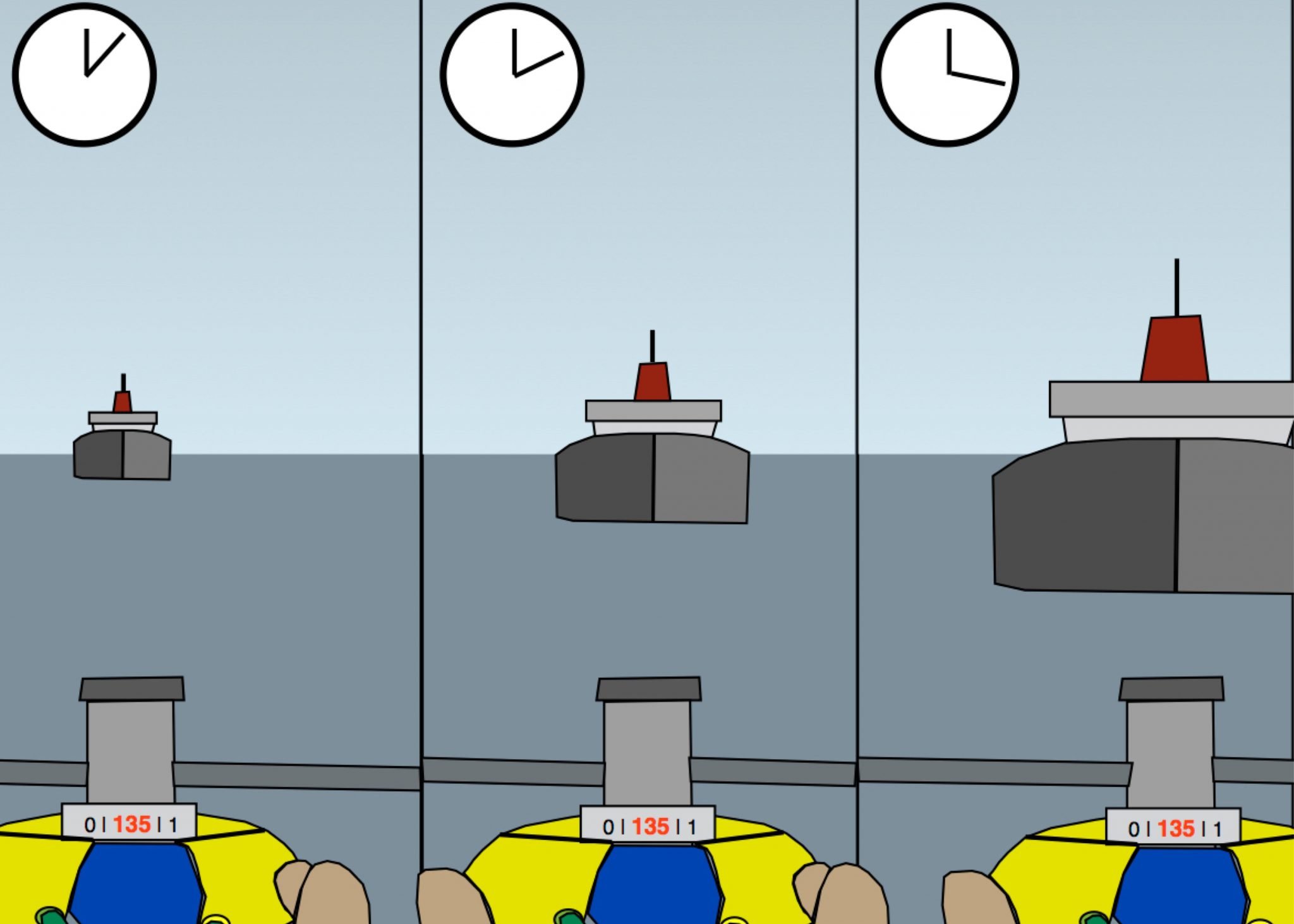
The risk of collision can be determined by taking a series of compass bearings of an approaching vessel. If the bearing of the approaching vessel does not change then the two vessels are on a collision course.

Narrow channels

Here are some reminders about narrow channels:

  • The term narrow channel is relative to the size and draught of vessels using it.
  • Fishing vessels are not allowed to impede the passage of others using a channel.
  • Vessels crossing a channel must stay clear of other vessels who can only safely navigate within it.
  • Remember your heading is the course you are steering. A bearing is the compass direction between you and another object.
  • Take bearings every minute or so and make a note of them.
  • When at close range risk of collision can still exist with a very large vessel, even if the bearing is changing.

Learn all of the nautical ColRegs Rules of the Road for power boating and sailing, in our comprehensive reference app, which includes a quiz to test yourself!

Happy boating and stay safe on the water!

ColRegs Rule 14 – Head-on Situation

  ColRegs Rule 14: Head-on Situation (a) When two power-driven vessels are meeting on reciprocal or nearly reciprocal...

How to ensure your boat is in proper working condition

In this article Eva Tucker from Volvo Penta presents a handy check list of all the things that you need to check regularly in order to make sure that your boat is in a seaworthy condition. Including maintenance, safety gear and electrical checks.

Essential yacht tender safety for skippers and crew

Essential yacht tender safety - the dangers inherent in using a dinghy to get ashore from a moored or anchored yacht are all too easily...

How to cope with an emergency at sea

A safe skipper will be mentally prepared for all kinds of potential emergencies happening at sea, including medical emergencies, engine failure, fire, a holed hull, capsize and dismasting.

Keeping boat records and doing checks

A boat’s records should provide information about maintenance schedules, when major work was done and when equipment was replaced or added to the boat. Without this information you are left guessing when things are likely to need replacing in the future and also what the costs are likely to be.

Jester Challenge 2022 – Sailing single handed from Plymouth UK to the Azores: Part 8 – Arriving at the Azores

Jester Challenge – A modern experiment in old-fashioned self-reliance, self sufficiency, and personal responsibility. This is the eighth of a 10-part post where solo sailor, Bernie Branfield, shares his first-hand account of his single-handed, 2022 Jester Challenge, from Plymouth, UK to the Azores, in his 26′ Invicta Mk2, Louisa.

How to operate a winch

Winches are drum shaped mechanical devices used to handle halyards, sheets and control lines. One of the important crew...

Rudders and steering systems – Part 1

Rudders and steering systems. A rudder is one of the most critical parts of a boat. Rudder failure is a common occurrence on neglected or overworked boats and a very unpleasant and potentially dangerous thing to happen when you are out at sea.

Galvanic and electrolytic corrosion

Galvanic corrosion is an electrochemical reaction between two or more different metals, in the presence of an electrolyte (note salt water is a good electrolyte).

Jester Challenge 2022 – Sailing single handed from Plymouth UK to the Azores: Part 7 – Motivation

Jester Challenge – A modern experiment in old-fashioned self-reliance, self sufficiency, and personal responsibility. This is the seventh of a 10-part post where solo sailor, Bernie Branfield, shares his first-hand account of his single-handed, 2022 Jester Challenge, from Plymouth, UK to the Azores, in his 26′ Invicta Mk2, Louisa.

Boatyard Health and Safety

Boat storage facilities are potentially hazardous environments and it is the responsibility of both boat owners and boatyards to ensure that the...

Fractures, sprains and dislocations at sea

Moving about a boat at sea often results in a few knocks and bruises, but if a crew member has a fall or major bump and is in serious pain, they should be examined and treated accordingly.

First Aid Afloat – Jellyfish Stings

Jellyfish stings are a common occurrence when boating or swimming in many parts of the world. While most stings are not serious, some can cause...

Rudders and steering systems – Part 3

In the third of our three blog articles on rudders and steering systems, we look at how to replace rudder bearings and repair a water-saturated core.

Understanding tides

If you are used to sailing in tidal waters, you will know that tides can be both a benefit and a hindrance to the sailor. In many ways,...

Light characteristics – how do navigators identify lights at night?

How do navigators identify the different types of light around our coasts at night and what are their characteristics?Navigating at...

Sailing into fog – being prepared and staying safe

Most skippers will sensibly delay their departure, if fog is forecast. However, if fog begins to form when you are at sea it is important to be prepared, and know what precautions to take, to help make your vessel detectable or visible in fog and keep the crew safe.

Liferafts

Liferafts should be stowed where they are ready for immediate launching. All crew should know the location of the liferaft and know how to launch, inflate and board it. They should also know what equipment it contains.

Man Overboard Drill

How to respond to crew overboard under sail • Keep the MOB in sight • Tack into the heave-to position, do not adjust the...

Competent crew skills: mooring lines

Mooring lines are used when arriving or leaving a berth. One of the most important competent crew skills is to know how to...

Gybing a sailing boat

Gybing is the sailing manoeuvre used to change a boat's direction through a following wind. As with the tacking manoeuvre,...

The dangers of running aground in a motor boat

The peril of grounding a motor boat is not only an inconvenience; it can lead to substantial risks for both the vessel and its passengers. . In this article, we’ll explore the potential dangers of running aground and highlight the importance of proper navigation and preparedness to avoid these hazards!

An explanation of the IALA maritime buoyage systems – IALA A and IALA B

What are the differences between the two IALA buoyage systems, IALA Region A and IALA Region B, and where are they used?   As recently as the 1970s...

Dripless shaft seals

Dripless shaft seals are designed to completely stop water from entering a boat’s hull via the stern tube. There are two main types of dripless seals known as face seals and lip seals which many boat manufacturers now fit to production boats.

Essential Knots: Sheet bend

Essential Knots: Sheet bend Use: Joining two ropes together. A sheet bend is particularly useful for joining two ropes of different...