Select Page

If sacrificial anodes are disappearing very quickly this can indicate there is a galvanic or electrolytic problem caused by electrical currents, which means an electrical circuit is being made for some reason. In order to understand what could be going on, it is worth trying to get to grips with the differences between these two forms of corrosion.

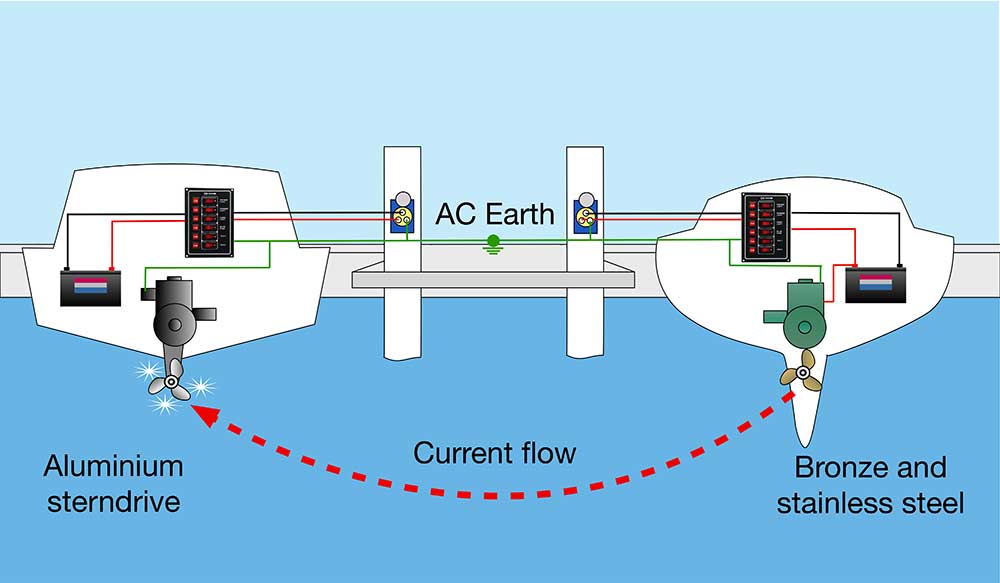
Galvanic corrosion is an electrochemical reaction between two or more different metals, in the presence of an electrolyte (note salt water is a good electrolyte). In other words, one piece of metal will be corroded, known as the anode, and the other piece of metal will be unaffected, known as the cathode. Common examples of galvanic corrosion are where an aluminium outdrive comes into contact with a stainless steel propeller, causing the aluminium to corrode, or where aluminium comes into contact with copper or bronze fittings. The first signs of galvanic corrosion is blistering of paint below the waterline and the formation of a white powdery substance on exposed metal. The exposed metal areas become deeply pitted as the metal is eaten away by the corrosion.

Electrolytic corrosion, also known as stray current corrosion, is an electrochemical process where a metallic surface is corroded by another metal it is in contact with, due to an electrolyte and the flow of an electrical current between the two metals, caused from an external source of electromotive force (EMF). In other words, electrolytic corrosion is caused by a current such as a boat’s battery or a shore supply. Metal hull boats are particularly at risk because their hulls are good conductors and stray wires or connections use the hull as a ground.

Preventing electrolytic corrosion requires good electrical installation where marine grade wiring should be insulated return with two wires rather than earth return. Metal hulls must never be used as the earth return.

Risks from electrolytic and galvanic corrosion

Aluminium boats are at risk from electrolytic and galvanic corrosion. Aluminium boat owners need to take precautions that would not be of concern to owners of GRP boats. For example, it is wise not to stay too long berthed next to a steel-hulled boat in a marina, where both vessels are connected to shore power. The reason for this is an electric circuit can form between the two vessels with the aluminium hull acting as an anode and the steel hull acting as a cathode, resulting in galvanic corrosion of the aluminium hull.

Owners also need to make sure that the shore power polarity is correctly wired in marinas as this can lead to corrosion too. They also pay particular attention to the condition of their wiring and electrical systems, to protect the boat from electrolytic corrosion.

Some aluminium boats are equipped with current leakage meters which display real time corrosion potential that warns of problems with electrolytic and galvanic corrosion.

Protecting an aluminium hull

  • Electrolytic action – all stray currents must be removed from the boat’s electrical system.
  • Anodes – zinc anodes should should be positioned on the outside of the hull and replaced when 80% consumed.
  • Stern gear – to protect the stern gear, the propeller shaft should be fitted with an electro-eliminator brush and earthed to the hull.
  • Insulation – insert plastic seals between aluminium and other metals. For example, ensure gaskets are fitted between aluminium and the flange of a stainless steel or brass valve. The same applies to lead or iron keels, where insulating washers and gaskets between the hull and keel.
  • Painting – while aluminium topsides do not need to be painted, antifouling coating beneath the waterline does need to be applied. Only use coatings that are designed for use with aluminium.


Understanding boat engines

Irrespective of what kind of engine a boat is equipped with and who does the work, the regular care and maintenance of a marine engine is essential. The most common cause of marine engine failure is widely known to be lack of maintenance.

Antifouling for leisure boats – Part 2

To prepare for antifouling, as soon as your boat has been lifted out and pressure washed, you need to check all the surfaces of the hull below the waterline, remove any remaining barnacles and check for blisters.

Understanding marine sealants & adhesives

Sealants, adhesives and adhesive sealantsThere is a bewildering variety of sealants, adhesives and even adhesive sealants available for...

DIY boat upgrades: Budget-friendly projects to enhance your (older!) boat

DIY projects that can enhance both the functionality and aesthetics of your boat. In this article, we’ll explore a variety of DIY boat upgrades that won’t break the bank but will significantly enhance your boating experience.

Hourly Checks when sailing or motoring

  Hourly Checks Get into the habit of carrying out these checks and both yourself, your crew and your boat will be...

ColRegs – avoiding collisions at sea

ColRegs - avoiding collisions at sea ColRegs Rule 8: Action to avoid collision (a) Any action taken to avoid collision shall...

Understanding tide tables and tidal curves

There are many factors that influence local tidal patterns and it’s essential for every sailor to have a good understanding of tide tables and tidal charts to ensure they can calculate the level of tide at any given time.

Sail care and maintenance – Part 2

At the end of the sailing season sails should be washed and inspected carefully for damage, including small tears, stitching failure, ultraviolet damage, stains and mildew.

2023 Rolex Fastnet Race – Part 2

Simon Jollands took part in the 2023 Rolex Fastnet Race. This is the second of his articles on the race aboard Lancelot II, a Beneteau First 40.

How to read nautical charts

Whilst most sailors today rely on GPS to find their way at sea, nautical charts are a crucial tool for any sailor to navigate safely and effectively. Here is a reminder of some of the basic steps involved in reading a nautical chart:

Distress flares – which flare, how & when to use?

How to use distress flares at sea To effectively use distress flares at sea, you need to understand the different types, their purpose, and the...

Common medical emergencies at sea

A medical emergency aboard a boat at sea requires immediate attention to ensure the safety of the casualty and the crew in general. The skipper needs to know which crew members, if any, have had medical training or have a first aid qualification. All boats should carry first aid handbooks to help an untrained crew cope with a medical emergency.

Winch Servicing

It is not essential to service the winches when a boat is ashore, but if time allows I prefer to do this maintenance job when the boat...

Understanding your mast and rigging

The rig of a sailing boat is put under huge stresses and strains so it is important for inspections of a yacht's spars and rigging to be...

Boat electrics

All boat owners should have a basic knowledge of electrics, both to avoid encountering electrical problems at sea and to stand a chance of solving them should they occur.

How to improve a yacht’s upwind performance

There are several ways to improve the upwind performance of a sailing yacht. Read on for some useful tips including headsail reefing, heavy weather jibs and motor sailing.

Jester Challenge 2022 – Sailing single handed from Plymouth UK to the Azores: Part 8 – Arriving at the Azores

Jester Challenge – A modern experiment in old-fashioned self-reliance, self sufficiency, and personal responsibility. This is the eighth of a 10-part post where solo sailor, Bernie Branfield, shares his first-hand account of his single-handed, 2022 Jester Challenge, from Plymouth, UK to the Azores, in his 26′ Invicta Mk2, Louisa.

What boating skills should you have before you buy a yacht?

Many people dream of owning a yacht and sailing off into the blue yonder. What boating skills should you have before you buy...

Liferafts

Liferafts should be stowed where they are ready for immediate launching. All crew should know the location of the liferaft and know how to launch, inflate and board it. They should also know what equipment it contains.

Passage planning and pilotage

Passage planning and pilotage help skippers navigate safely from one port to another. A passage plan takes into account all...

Antifouling for leisure boats – Part 3

Antifouling is one of the least pleasant boat maintenance jobs to do, but it has to be done. The very worst job of all is removing the old antifouling as this can get seriously messy and is very hard work.

You Need To Understand The IRPCS ColRegs To Pass Your Yachtmaster, Master of Yachts and Coxswain Certificate of Competence

IRPCS ColRegs Rules of the Road at Sea and Yachtmaster Learning, understanding and remembering the International Regulations...

Boating Rules of the Road – International ColRegs

    International ColRegs Rule 7: Risk of Collision Anyone who is responsible for a vessel at sea, from the...

Boat engine fuel system

If engines are installed and serviced correctly then most marine engines are very reliable, but one of the most important parts of the engine to check and service is the fuel system.

Steel hull maintenance

A steel boat owner’s biggest enemy is corrosion. You don’t have to worry about osmosis or rotting timbers, instead rust is the number one issue that will keep you awake at night.