Select Page

The regular maintenance of a marine diesel is key to preventing engine failure at sea. This means doing regular checks of the fuel, cooling, electrical and oil systems. The oil system needs daily checks of the engine oil level and additional checks for oil leaks.  It is also important to follow the manufacturer’s recommendations for changing the oil and replacing the engine oil filter.

Why is oil so important?

Most of us know that checking the oil regularly is a good idea and that oil reduces friction and wear of an engine’s moving parts, but engine oil does more than this. As it circulates, it helps cool the engine, it reduces corrosion and it also cleans the engine by removing carbon deposits and tiny metal particles. Failure to change the oil results in increased engine wear as all the carbon and metal particles build up, making the oil dirtier and dirtier.

While all that may make obvious sense, why is it necessary to change the oil when the boat is brought ashore for the winter? After all, the engine is not going to be used for several months. The reason for doing this is that old engine oil gets contaminated from the harmful by-products of combustion, making it very acidic. This corrodes the engine and shortens its life. Replacing the old oil with clean new oil will help to protect the engine.

Follow the manufacturer’s advice

It is also important to buy the grade of oil that is recommended by your engine manufacturer, so once again this is a case of consulting the manual for the correct type to use. This may prove to be more expensive than the average car engine oil, but when it comes to boat engines it is best to follow the manufacturer’s advice. This can be a particular problem for older engines where the specified oil is not widely available.

The recommended grade of oil for your engine will be given as an SAE (American Society of Automotive Engineers) grade. The SAE grade system refers to the viscosity or thickness of the oil where the higher the number the greater the viscosity, for example a SAE40 is thicker than a SAE30. A low viscosity oil such as 10W (“W” stands for winter) will flow better in low temperatures as it is thinner, meaning the engine will be easier to start and better protected in colder temperatures.
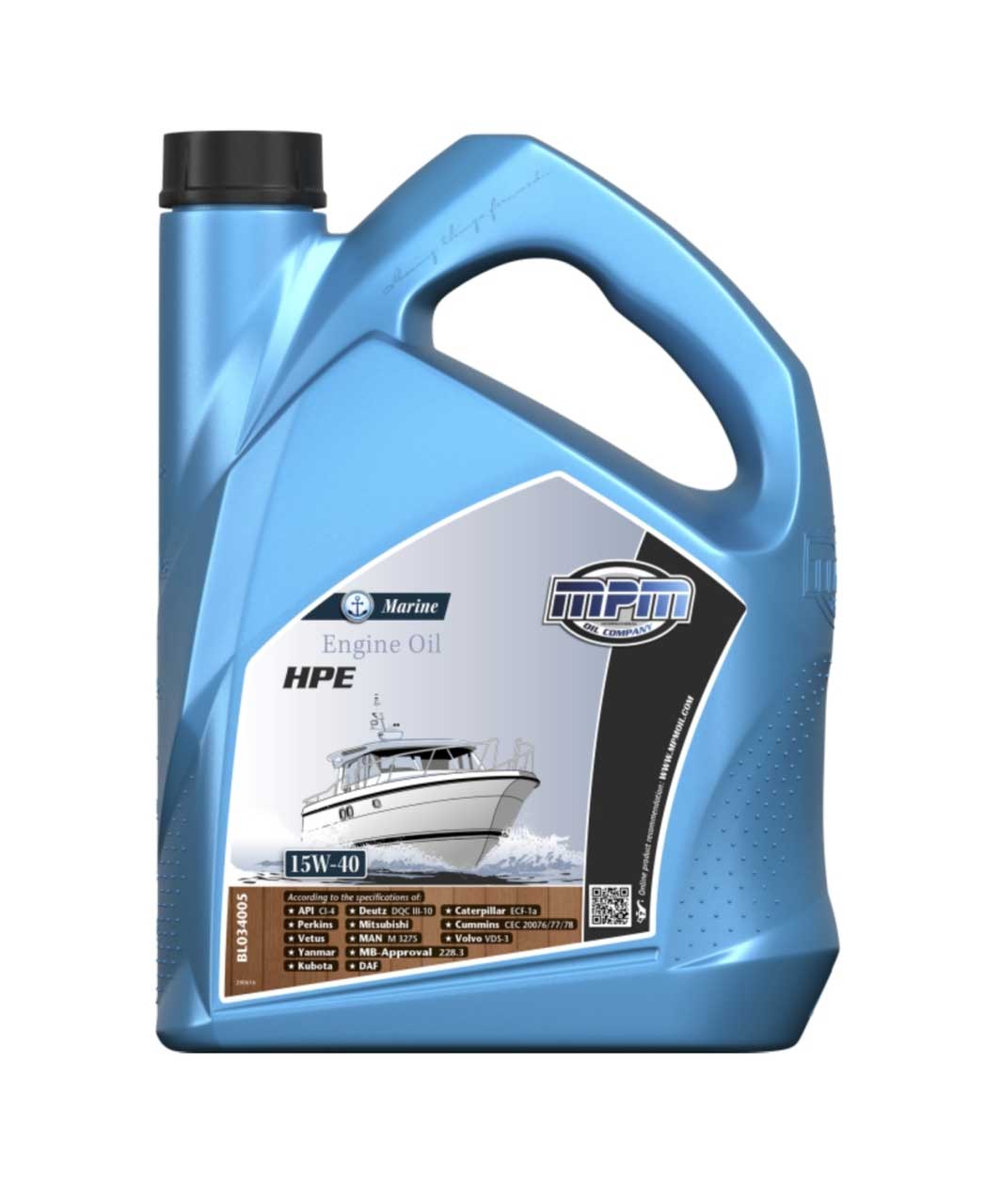
  

Today we have multigrade oils which are designed to work efficiently in winter and summer. For example a SAE15W/40 means that the oil is a multigrade oil with a viscosity of 15W when cold and a viscosity of SAE40 when hot. Multigrade oils have chemical additives which are mixed with the oil to change its characteristics at different temperatures.

It helps to check and learn the specific requirements for your engine and to keep a record of when you change the oil and filter. It also helps to keep a log of the engine hours and the manufacturer’s recommendations for oil changes – usually every 200 or 250 hours or so.

Oil leaks

If your engine has been leaking oil then it would be wise to check out what is causing the leak – either a failed gasket, a failed seal or worn piston rings. Some leaks are easier to deal with than others, so you will need to decide whether this calls for a professional repair or if it is something that you can do yourself. This very much depends on your engineering skills and experience.

The first thing to do is to wipe the engine and bilges clean and try to pinpoint where the leak is coming from, which is easier said than done in a cramped engine bay but rather easier when all round access to the engine is possible. Then check:

  • Head gasket – this is the biggest gasket and subject to very high pressure and temperatures. To replace this entails removing the cylinder head which can be done in situ.
  • Sump gasket – not as critical as the head gasket but this will require the engine to be removed for the repair.
  • Camshaft seals – the camshaft cover and pulley will need to be removed but the engine should not need lifting.
  • Crankshaft seals – the front crankshaft seal can be repaired fairly easily while the rear seal is more challenging as you have to remove the flywheel and gaining access is normally an issue.
  • Valve seals – replacing valves seals normally requires removing the camshaft.
  • Worn piston rings – oil leaking into the combustion chamber is caused by worn piston rings. The telltale sign of this is blue smoke coming out of the exhaust. This a major job which could entail a complete engine rebuild.

Dry friction

After a long period of disuse (over the winter for example), all the oil makes its way down into the sump. When the engine is started, the moving parts including the cams and bearings may have become completely dry and will be subject to dry friction, causing harmful metal abrasion. To overcome this problem at the beginning of the season, you can spray a small amount of oil into the air inlet and then turn the engine over without starting it. This will provide a coating of oil in the cylinders and reduce the friction.

Crew Overboard Drill – Updated

How to respond to crew overboard A Man Overboard (MOB) drill is a crucial safety procedure that every boater should practice regularly. It simulates...

Preparing for sailboat cruising

Preparing for a sailing trip entails a lot of planning. In this blog, we take a look at some of the many safety aspects that a skipper needs to consider before heading off on a cruise.

Jester Challenge 2022 – Sailing single handed from Plymouth UK to the Azores: Part 4 – Navigation

Jester Challenge – A modern experiment in old-fashioned self-reliance, self sufficiency, and personal responsibility. This is the fourth of a 10-part post where solo sailor, Bernie Branfield, shares his first hand account of his single-handed, 2022 Jester Challenge, from Plymouth, UK to the Azores, in his 26′ Invicta Mk2, Louisa.

Marine toilets – care and maintenance

There are a number of different types of marine toilet, or heads. They fall into one of three categories – manual, electric and vacuum, the most common being the manual, hand pumped type. These have double acting piston-pumps which both discharge the waste and flush the toilet with sea water.

Navigating narrow channels

Navigating narrow channels can present challenges for boat operators due to limited space, restricted manoeuvrability, and potential hazards such as shallows, rocks, or other vessels. To ensure safe passage through narrow channels, it’s essential to follow specific strategies and techniques.

Capsize – understanding the risks

A skipper should know how their boat will cope with rough seas. By working within known limits and understanding the risks,...

Estimating your position at sea

Navigators use a combination of techniques to estimate their position at sea. The primary method used today is GPS (Global Positioning System), a network of 24 satellites that became fully operational in the 1990s and was originally restricted for use by the United States military.

Sailing at the touch of a button

Easier and more controlled sail handling can also be achieved by powering up a furling mast. I came across some interesting solutions at the Southampton Boat Show this week on the Selden Mast stand, where they were running demos of their E40i electric winch and SMF furling system.

First Aid Afloat – fish spine injury

First Aid Afloat - Here is what to do if somebody stands on a fish spine: • Check for dangers. Is it safe for you to enter...

Sending distress signals

In an emergency situation at sea, it is a top priority is to know how to send and receive emergency radio calls and alert others of your predicament. Likewise, if you receive a distress signal, you must be ready to go to the help of others.

Competent crew skills: mooring lines

Mooring lines are used when arriving or leaving a berth. One of the most important competent crew skills is to know how to...

Going aground – what to do if it happens to you

When a yacht runs aground, it can be a stressful situation, especially on a falling tide in an exposed position with a swell running. There are several steps you can take to address the situation in order to ensure the safety of your vessel and its occupants. Here are some tips should this happen to you.

Sailing to windward – how to take advantage of wind shifts

For most sailors, sailing upwind is the most exhilarating point of sail as you tack your way to your destination. Sailing to windward is a bit like zig-zagging your way up a mountain road through a series of hairpin bends – great fun but also calling for concentration and hard work.

Boat ownership

Owning a boat is a big commitment that should bring no end of satisfaction for the owner as well as the owner's family and friends. In...

2023 Rolex Fastnet Race

Safe Skipper’s Simon Jollands took part in the 2023 Rolex Fastnet Race – a classic offshore sailing event. This is the first of several articles on the race and focuses on the start.

The give-way hierarchy – sail boats and power boats

Who gives way to who at sea? Even seasoned sailors sometimes get this wrong and in a crowded harbour this can easily lead to a collision or at best considerable embarrassment for a boat that mistakenly thinks it has right of way over another.

Common medical emergencies at sea

A medical emergency aboard a boat at sea requires immediate attention to ensure the safety of the casualty and the crew in general. The skipper needs to know which crew members, if any, have had medical training or have a first aid qualification. All boats should carry first aid handbooks to help an untrained crew cope with a medical emergency.

Diesel engine winterisation

An inactive boat engine needs to be protected from corrosion during the winter, caused by the rising humidity levels through the cold months and the salty coastal air. This applies whether the boat is left afloat or hauled out over the winter. Read here about the two important stages of winterisaton for a diesel boat engine.

First aid at sea basics

At least one person on board should be trained in first aid and know how to administer the contents of the first aid kit, ensuring there are adequate supplies for the planned duration of the trip.

Boat electrics

All boat owners should have a basic knowledge of electrics, both to avoid encountering electrical problems at sea and to stand a chance of solving them should they occur.

Estimating and plotting your position at sea

This post covers how we go about estimating and plotting our position using traditional methods, when out of sight of land – covering Dead Reckoning, Estimated Position, Tidal Streams, Leeway and more…

Essential boat engine checklist

Boat engine checklist Engine oil level check Even if you have checked it previously, confirming the engine oil level is up...

Essential Knots: Clove hitch

Essential Knots: Clove hitch Use: Tying a rope to posts, bollards, rings or a guardrail. Step 1. Make a turn around the object and lay...

A five day sailing cruise of the Solent, UK

Welcome to our virtual Solent sailing cruise – a five day sail in the south of England from Bosham Quay in Chichester...

Essential Knots: Round turn and two half hitches

Essential Knots: Round turn and two half hitches Use: Tying a rope to a pole or a ring. Step 1. Pass the end around the object. Step 2....