Select Page

In our series of Safe Skipper blogs on first aid at sea, here are four common emergencies skippers should be prepared for at sea. Knowing how to cope with them could well save a life, while not knowing could result in an avoidable tragedy. In this blog we look at what to do in the event of a crew member choking, drowning, or suffering from hypothermia or fatigue.


Choking

If the larynx is blocked and the victim cannot breathe, give several strong blows between the shoulder blades while supporting their chest. If this fails to relieve the obstruction, try abdominal thrusts by standing behind the casualty, clasping your hands together, positioning them on their abdomen and pulling inwards and upwards four or five times. If the casualty becomes unconscious, begin CPR.

Drowning

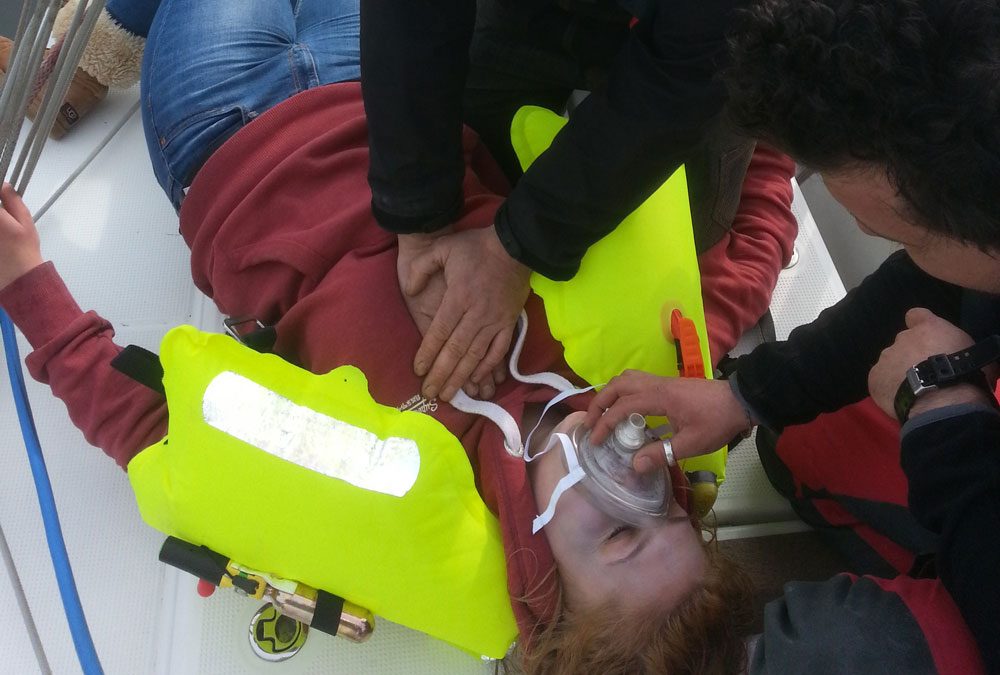
Someone who has been recovered from the water and is unconscious should be treated for drowning as follows:

  • Check for a blocked airway and signs of breathing.
  • Begin CPR if there are no signs of breathing.
  • When the casualty begins breathing, place them in the recovery position.
  • Treat for hypothermia and shock.
  • Remove wet clothes if possible and keep warm with blankets or warm clothing.

Monitor the casualty closely and when they regain consciousness be aware of the risks of secondary drowning, where the lungs are damaged after inhaling water. This can occur up to 3 days after the accident, so a casualty who has recovered from near drowning should always go to hospital for a check up.

Hypothermia

Normal body temperature is 37ºC.  A person becomes hypothermic if their body temperature drops below 35ºC. The same applies to those suffering from hypothermia as to those suffering from seasickness and fatigue. That is, you should be alert for the early signs and take what action you can to remedy the condition as soon as possible.  At sea, hypothermia can occur gradually after prolonged exposure to cold, wet and windy conditions on deck, or more suddenly after immersion in the sea.

Early signs of hypothermia include: shivering, slurred speech, clumsiness, irritability and memory loss. The sufferer develops pale skin, slow breathing and a slow pulse. The next stage, severe hypothermia, is complete collapse and unconsciousness and if unchecked, the heart eventually stops.

Treatment of hypothermia:

  • If the casualty is breathing, put them in the recovery position, ideally below deck.
  • Keep the casualty horizontal and commence warming. Be gentle, as a hypothermic person’s internal organs are sensitive to physical shocks.
  • Replace wet clothing with dry warm clothing, sleeping bags or a space blanket.
  • You can warm the casualty by applying warm towels to their head, or by lying another crew member alongside them to share body heat.
  • Applying hot water bottles is also recommended but keep the temperature below 46ºC / 115ºF.
  • Give the casualty warm, sweetened non-caffeinated drinks.
  • Keep monitoring the casualty’s temperature, if it drops below 32ºC then severe hypothermia develops and you have a major emergency to deal with.

Signs of severe hypothermia are as follows:

  • Casualty stops shivering.
  • Skin appears blue or grey, partly swollen.
  • Pulse is slow or weak.
  • Casualty loses consciousness.
  • Little or no breathing.
  • Pupils may be dilated.

Treatment of severe hypothermia:

  • Send MAYDAY. The casualty needs urgent hospital care.
  • Handle with extreme care. The casualty is at risk from cardiac arrest.
  • Check for signs of breathing. If the casualty is not breathing, commence basic life support starting with rescue breaths and then chest compressions and the CPR cycle.
  • Re-warm slowly. Take care not to burn the casualty.
  • Monitor pulse and breathing constantly.
  • Do not rub the casualty’s skin or give them alcohol.

Fatigue

Fatigue can be a major problem at sea, as people begin to make mistakes when they are tired, whether incorrectly plotting a position, slipping on deck or becoming short tempered with others.  On a long cruise, it is a good idea to agree a watch system which everyone on board keeps to.

See also: Common medical emergencies at seaFirst aid at sea basics.

Always have an emergency ditch bag ready to go…

An emergency ditch bag (also known as a grab bag, abandon ship bag, or go-bag) is a crucial piece of safety equipment for any vessel venturing out...

First Aid Afloat – fish spine injury

First Aid Afloat - Here is what to do if somebody stands on a fish spine: • Check for dangers. Is it safe for you to enter...

Essential Yachting + Power Boat Safety Briefing

Yachting Safety Briefing   Down below Lifejackets and harnesses - fitting, when to wear, clipping on Gas - risks, precautions, gas bottles and...

Cleaning & polishing gelcoat topsides

The gelcoat topsides of a GRP boat can be pampered and restored to their former glory relatively easily when it is ashore. Gelcoat is only a very thin outer layer of the hull, often less than 1mm thick, so you should avoid cleaning it with highly abrasive cleaners, or an-ything that could potentially damage its surface.

How to Avoid Collisions At Sea With The ColRegs

      Every Skipper Needs Accurate Knowledge of the IRPCS ColRegs As a responsible skipper it is every skipper’s duty to learn and apply the IRPCS...

Getting a tow for your sail or power boat at sea or on inland waterways

FREE tips from the Safe Skipper App for iPhone/iPad/Android: Getting a tow for your sail or power boat Plan how to secure a...

Boat electrics inspection checklist

With the boat ashore, here are some recommendations for carrying out a boat owner electrics inspection. Safety is always paramount so remember to do the checks with the batteries off. Wearing a head torch helps, make notes as you go and only tackle a repair if you are 100% sure you know what you are doing:

Essential Knots: Reef knot

Essential Knots: Reef knot Use: Tying two ends of rope together, often used for tying up a bundle of loose sail around the boom. Step...

Essential Knots: Bowline

Essential Knots: Bowline Use: Making a secure eye or loop in the end of a rope. Bowlines have many uses on a boat, for example to make a...

Boat maintenance below decks

While most interior maintenance work can be done when a boat is afloat, some jobs such as servicing the seacocks have to be done ashore. It makes sense to do any major interior repairs and improvements with the boat hauled out in the boatyard.

Antifouling for leisure boats – Part 1

Boats that are kept afloat can very quickly become a home for small marine organisms such as barnacles, weed and slime. Applying an antifouling paint to your hull is necessary to protect it from these micro-organisms, as a fouled hull can cause problems and will slow down a boat’s maximum speed considerably if left unchecked.

How to operate a winch

Winches are drum shaped mechanical devices used to handle halyards, sheets and control lines. One of the important crew...

Winch Servicing

It is not essential to service the winches when a boat is ashore, but if time allows I prefer to do this maintenance job when the boat...

Essential Knots: Clove hitch

Essential Knots: Clove hitch Use: Tying a rope to posts, bollards, rings or a guardrail. Step 1. Make a turn around the object and lay...

Safety Equipment Checklist for Boats

Safety Equipment Checklist for Boats   Liferaft line attached The liferaft will not work unless the trigger line is...

Pre-start engine checks

According to the Royal National Lifeboat Institution (RNLI) almost one third of emergency call outs at sea are caused by mechanical failure. Many engine breakdowns are avoidable. The best way to avoid a breakdown is to carry out pre-start checks before heading out to sea.

Sailing Boat Rig Care

The rig of a sailing boat is put under huge stresses and strains so it is important for inspections of a yacht’s spars and rigging to be carried out at regular intervals.

Sailing at the touch of a button

Easier and more controlled sail handling can also be achieved by powering up a furling mast. I came across some interesting solutions at the Southampton Boat Show this week on the Selden Mast stand, where they were running demos of their E40i electric winch and SMF furling system.

Dag Pike’s Boat Survey

We're really pleased to be working with Dag Pike on some great new apps for iPhone & Android. Here'a a bit more about the first app: Dag Pike's...

ColRegs Nav Lights & Shapes, Rules Of The Road and IALA Buoys Apps

ColRegs Nav Lights & Shapes, Rules Of The Road and IALA Buoys Apps Make Learning Rules on iPhone, iPad, iPod and Android...

Cutless bearing replacement

Cutless bearings can last for many years but if the propeller shaft is out of alignment they will wear through more quickly. If you have noticed a clunking sound when motoring then it could be a worn cutless bearing that is causing the problem.

Feeling anxious at sea

  Some people feel anxious at sea. Will they be seasick? What if they get caught in a violent storm? Could the boat...

Nautical paper charts – a reminder of the basics

The nautical chart is an indispensable tool for navigation. A chart is a graphic representation of an area of the sea which might also include coastlines, estuaries and islands. All cruising leisure boats should carry up-to-date paper charts.

Peer to Peer yacht charter – How can you monetize your boat?

There is a growing trend in peer to peer yacht charter. How does it work? People already rent rooms, cars and bikes from one...

Jester Challenge 2022 – Sailing single handed from Plymouth UK to the Azores: Part 3 – Preparations

Jester Challenge – A modern experiment in old-fashioned self-reliance, self sufficiency, and personal responsibility. This is the third of a 10-part post where solo sailor, Bernie Branfield, shares his first hand account of his single-handed, 2022 Jester Challenge, from Plymouth, UK to the Azores, in his 26′ Invicta Mk2, Louisa.