Select Page

Boats that are kept afloat can very quickly become a home for small marine organisms such as barnacles, weed and slime. Applying an antifouling paint to your hull is necessary to protect it from these micro-organisms, as a fouled hull can cause problems and will slow down a boat’s maximum speed considerably if left unchecked.

There has been much controversy over the years about antifouling products due to their detrimental effects on marine life, especially in marinas and crowded anchorages in estuaries. The big challenge for the paint manufacturers is to develop products that will keep hulls free of foul without harming the environment.

There are two main types of antifouling paint used for leisure boats, normally referred to as hard and eroding. Both contain biocides that kill and deter fouling organisms but they work in different ways and are designed for different types of boat. The basis of most biocides found in antifouling are copper (Cu) and cuprous oxide (CuO). These are effective at deterring the growth of molluscs, larvae and some types of weed but there needs to be high concentrations of copper in the paint for them to work. To be completely effective, some antifouling also contains zinc based biocides or organic algaecides.

When choosing antifouling for your boat, it is advisable to talk to your local chandleries as they should be able to tell you what antifouling is best for your type of boat, its location and the environment. It is important to know the type of antifouling currently on your boat, as not all types of antifouling are compatible with each other.

Hard antifouling

Hard antifouling slowly releases biocide which prevents foul from settling on the hull. The biocide can last a whole year and if several layers are applied, even longer. However, the leaching rate reduces over time and the paint loses its efficiency. This type of paint has a hard finish, which enables it to be scrubbed or wet sanded through the season to keep the bottom in good condition.

Hard antifouling is popular with boats where maximum performance is required – racing yachts and fast powerboats for example. It is also used for boats kept in fresh water as the alternative, eroding antifouling, is designed to be used in salt water and does not perform as well in fresh water.

There are some types of hard antifouling with a very high copper content, where tiny particles of copper are suspended in epoxy resin. Several layers of this copper resin have to be applied very carefully to a pristine hull. This process is normally done by a small professional team under controlled conditions. The final coat is sanded, leaving a layer of copper oxide that is effective, very hard wearing and can last up to 10 years or so. Copper resins are expensive to buy and apply in the first place, but after a few years they become a viable option as there is very little maintenance required.
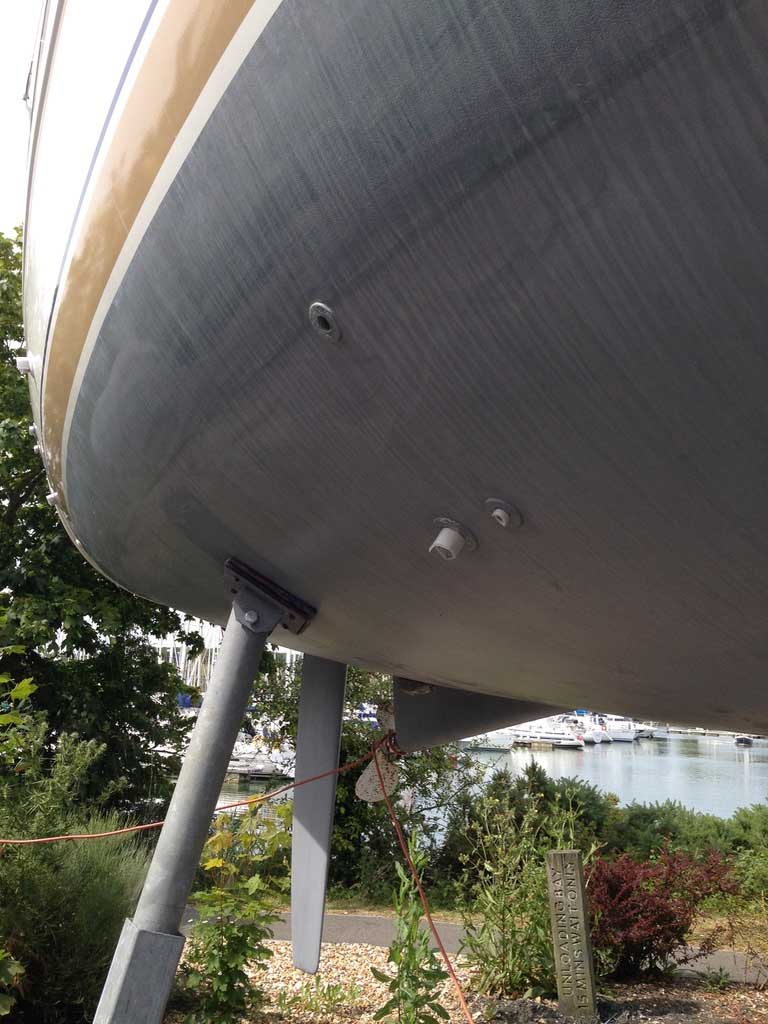
Eroding antifouling

Eroding antifouling is also known as soft antifouling and like hard antifouling slowly releases biocide. The big difference between the two is that the paint itself erodes into salt water, leaving very little residue on the hull itself. This is ideal in many ways for the cruising boat owner as it reduces the build up of successive layers of antifouling and makes maintenance much easier. However, this is not so ideal for those who want to keep their boat’s bottom in pristine condition through the boating season as scrubbing or sanding it smooth takes off the paint.

Therefore, eroding antifouling is more widely used for cruising yachts and displacement motorboats where speed is not the absolute priority.

Non-toxic antifouling

Recent developments in antifouling technology have concentrated on finding non-toxic solutions which are environmentally safe. There have been some significant breakthroughs in recent times.    

There are several silicon based products available that form a very slippery surface which prevents micro-organisms from gripping onto the hull. While these developments have generally been well received by the leisure marine community, they perform best on hulls that regularly move through the water at speeds of 10 knots or more. A great idea for powerboats but not so excellent for most sailing yachts that rarely, if ever, exceed 10 knots through the water.

Another option to consider is electronic antifouling, which uses ultrasound technology to deter fouling organisms. These systems are easy to install and can be undertaken by competent DIY boat owners. You do have to swallow hard when it comes to the price but perhaps in the future these will become common place and more affordable – I hope so.

Pleasure craft safety equipment recommendations

Safety equipment is an important part of boat preparation and it is advisable for all pleasure craft skippers to check their vessel is...

Essential Knots: Bowline

Essential Knots: Bowline Use: Making a secure eye or loop in the end of a rope. Bowlines have many uses on a boat, for example to make a...

Jester Challenge 2022 – Sailing single handed from Plymouth UK to the Azores: Part 2 – Weather

Jester Challenge – A modern experiment in old-fashioned self-reliance, self sufficiency, and personal responsibility. This is the second of a 10-part post where solo sailor, Bernie Branfield, shares his first hand account of his single-handed, 2022 Jester Challenge, from Plymouth, UK to the Azores, in his 26′ Invicta Mk2, Louisa.

Essential Knots: Reef knot

Essential Knots: Reef knot Use: Tying two ends of rope together, often used for tying up a bundle of loose sail around the boom. Step...

Navigating Through Rough Waters: Tips for Handling Adverse Weather Conditions in a Sailboat

Navigating through rough waters in a sailboat requires skill, preparation, and a good understanding of both your vessel and the environment. Here are some tips for handling adverse weather conditions including Preparation, Techniques, Safety and much more..

Essential Knots: Sheet bend

Essential Knots: Sheet bend Use: Joining two ropes together. A sheet bend is particularly useful for joining two ropes of different...

Wooden Hulls – Part 2

It is important to ensure the essential hull maintenance of a wooden boat is done, even if you are paying others to look after your boat for you. The priority is to prevent rot from taking hold. The protective layers of paint and varnish over wood are far more critical than on GRP boats, where the topsides are painted more for cosmetic reasons.

Nautical paper charts – a reminder of the basics

The nautical chart is an indispensable tool for navigation. A chart is a graphic representation of an area of the sea which might also include coastlines, estuaries and islands. All cruising leisure boats should carry up-to-date paper charts.

First Aid Afloat – fish spine injury

First Aid Afloat - Here is what to do if somebody stands on a fish spine: • Check for dangers. Is it safe for you to enter...

Navigating narrow channels

Navigating narrow channels can present challenges for boat operators due to limited space, restricted manoeuvrability, and potential hazards such as shallows, rocks, or other vessels. To ensure safe passage through narrow channels, it’s essential to follow specific strategies and techniques.

Understanding your boat’s compass

Article submitted by Mike Rossiter, Certificated Compass Adjuster. Since the magnetic compass was first used by the Chinese...

Repairing chips and dings in gelcoat

The gelcoat topsides of a GRP boat can be pampered and restored to their former glory relatively easily when it is ashore. Gelcoat is only a very thin outer layer of the hull, often less than 1mm thick, so you should avoid cleaning it with highly abrasive cleaners, or an-ything that could potentially damage its surface.

Know your Navlights & Shapes – essential for all skippers

Know your Navlights & Shapes International Regulations for Preventing Collisions at Sea (ColRegs) Anyone who is...

Navigation safety: a quick-reference mobile app to learn the ColRegs NavLights and Shapes

 Safety at SeaSafety at sea will always remains a topical and important subject that will no doubt dominate the syllabuses of nautical...

Understanding tide tables and tidal curves

There are many factors that influence local tidal patterns and it’s essential for every sailor to have a good understanding of tide tables and tidal charts to ensure they can calculate the level of tide at any given time.

Keeping boat records and doing checks

A boat’s records should provide information about maintenance schedules, when major work was done and when equipment was replaced or added to the boat. Without this information you are left guessing when things are likely to need replacing in the future and also what the costs are likely to be.

Jester Challenge 2022 – Sailing single handed from Plymouth UK to the Azores: Part 9 – Around the Azores

Jester Challenge – A modern experiment in old-fashioned self-reliance, self sufficiency, and personal responsibility. This is the ninth of a 10-part post where solo sailor, Bernie Branfield, shares his first-hand account of his single-handed, 2022 Jester Challenge, from Plymouth, UK to the Azores, in his 26′ Invicta Mk2, Louisa.

How a propeller works

Have a look around any boatyard and you will notice quite a variety of propellers – some have two blades, some have three and others have four or more. While most propellers are completely rigid some have blades that fold.

Tips and advice for staying safe on a sailboat at sea

Here we focus on how to stay safe on a sailboat at sea. We cover key things to ensure you have on board before you set sail as well as covering the most common cause of incidents on sailboats and how to deal with them.

Sending distress signals

In an emergency situation at sea, it is a top priority is to know how to send and receive emergency radio calls and alert others of your predicament. Likewise, if you receive a distress signal, you must be ready to go to the help of others.

Learning about diesel engine maintenance

Marine diesel engines are internal combustion engines that are designed specifically for use in maritime applications. These engines are commonly used in a variety of watercraft, ranging from small boats and yachts to large ships and vessels. Learn about marine diesel engine maintenance courses.

Understanding boat engines

Irrespective of what kind of engine a boat is equipped with and who does the work, the regular care and maintenance of a marine engine is essential. The most common cause of marine engine failure is widely known to be lack of maintenance.

Preparing for sailboat cruising

Preparing for a sailing trip entails a lot of planning. In this blog, we take a look at some of the many safety aspects that a skipper needs to consider before heading off on a cruise.

The dangers of running aground in a motor boat

The peril of grounding a motor boat is not only an inconvenience; it can lead to substantial risks for both the vessel and its passengers. . In this article, we’ll explore the potential dangers of running aground and highlight the importance of proper navigation and preparedness to avoid these hazards!

Estimating and plotting your position at sea

This post covers how we go about estimating and plotting our position using traditional methods, when out of sight of land – covering Dead Reckoning, Estimated Position, Tidal Streams, Leeway and more…