Select Page

Skilled boat handling is needed when entering or leaving harbour. Crew tasks include preparing the mooring lines and fenders before docking and tying the boat safely alongside. The crew also prepare the boat for leaving harbour. In order to help avoid any mishap, they have to release the lines in the correct order, as instructed by the skipper.

Arriving at a berth

The skipper will ask for the crew to prepare for berthing when a yacht enters harbour. The engine will be started if the yacht is under sail, the sails will be dropped and stowed, and the control lines coiled. 

Before approaching a berth, the skipper will ask the crew to get the mooring lines and fenders ready. The skipper will also give instructions where the lines and fenders should be attached.

Preparing the mooring lines

Mooring lines are attached to cleats at the bow and stern. Normally there are two lines prepared at the bow and two at the stern. Each line is fed beneath and back over the guardrail, then made ready to be taken ashore and tied to the dock. 
Fenders

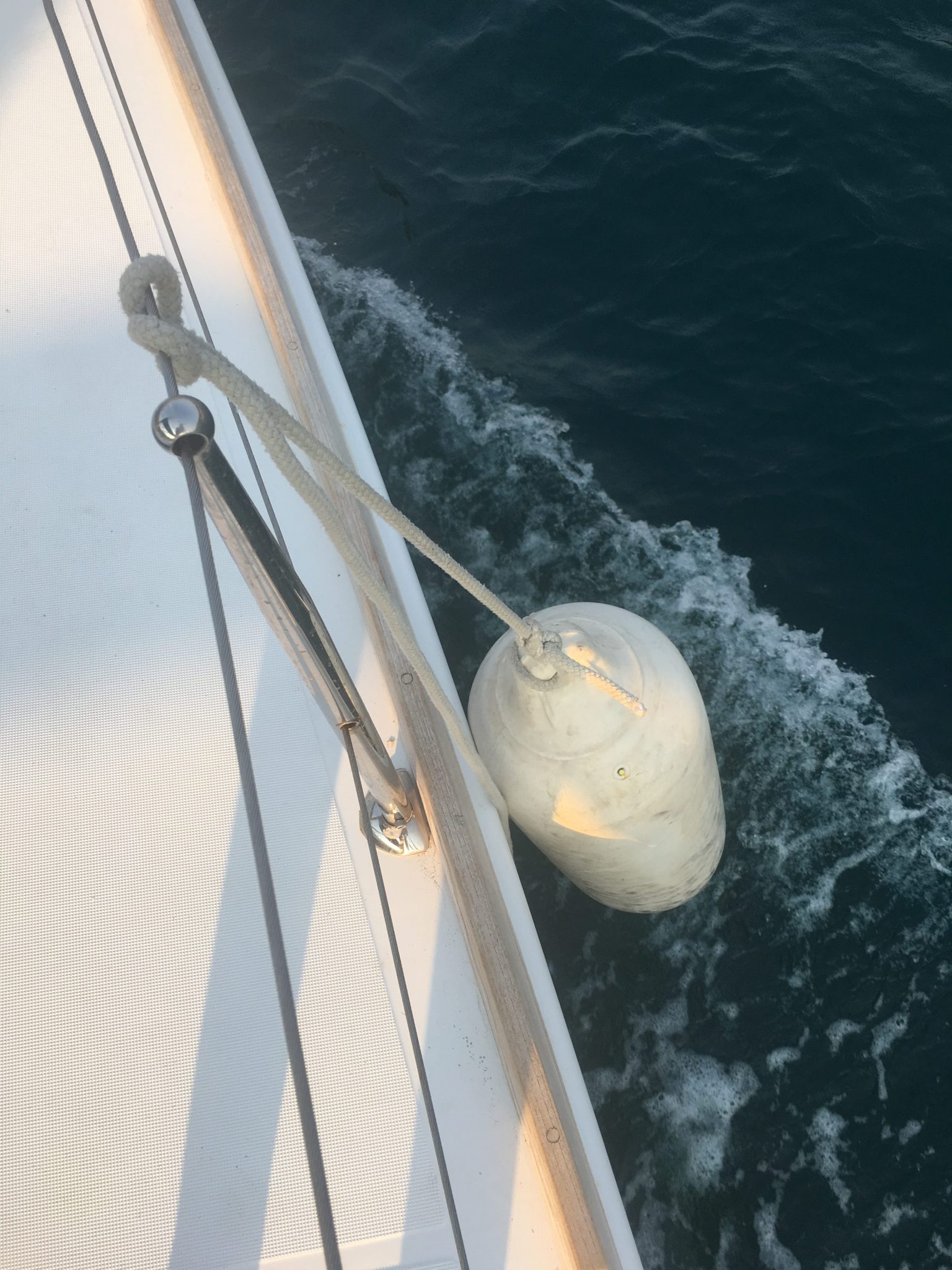
Fenders help prevent damage to a boat’s hull when it is alongside. A fender has a short rope which is attached to the guardrail using a clove hitch. A clove hitch is easily adjustable, therefore ideal for positioning the fender at the correct height to protect the hull. The fender needs to hang just above the water level so that it will protect the hull at its widest points when alongside.

Approaching the berth

When possible it is best for the boat to approach a berth into the wind, as this will help the boat to stop. If the wind is coming from behind, it will be more difficult to slow the boat down.

As well as taking the effects of the wind into account, in tidal waters the strength and direction of the tidal streams needs to be factored in. Given a choice, the skipper will most likely decide to approach the berth heading into the tide. If this is not possible, then bringing the boat to a stop becomes more difficult.

Stepping on to the pontoon

If you are responsible for a mooring line, hold it ready and move along the deck to the boat’s widest point before stepping ashore. Make sure the line remains outside the guardrail and side stays as you move along the deck to the centre position. Listen out for instructions from the skipper.

When the boat is alongside, step quickly ashore and secure the line to a cleat on the dock. If the line is a bow line, tie it to a cleat level or just forward of the bow. If the line is a stern line, then tie it level or just astern of the stern.

Tips for arrival:

  • Practice tying fenders to a guardrail using a clove hitch.
  • Practice tying a cleat hitch, round turn and two half hitches and bowline.
  • Make sure the mooring lines are not trailing through the water before docking.
  • Only step ashore when the skipper says it is safe to do so.

Leaving a berth

Before departure there is sometimes quite a bit of discussion about when it will be best to leave a berth, taking into consideration:

  • Tide – the direction of the tidal flow, whether it is rising or falling, is often critical for a safe departure from harbour.
  • Wind – is the wind blowing the boat towards the pontoon or away from it? This will affect the order in which the lines holding the boat alongside are cast off. 
  • Forecast – if a howling gale is forecast, it may be best to delay departure.

When it is time to leave, the crew will be asked to release the lines in the order the skipper asks. Under normal circumstances the spring lines will be released first. Then, either the bow or stern line are released, depending on the direction of the wind or tide.

Sometimes the direction of the wind and tide may make leaving difficult. In this case, extra lines and fenders may be needed to help manoeuvre away from the berth. The skipper will devise a plan and crew will be made responsible for various lines and await instructions.

Slipping a line

Before departure, some of the mooring lines may need to be re-tied, or set up, so they can be quickly released and pulled back on board immediately the skipper asks. This entails a crew member untying the line on the pontoon and arranging it in a long loop. Then, both ends of the line are fed back on board so that the line can be released from the boat. 

Tips for leaving:

  • Practice how to set up a line for slipping, making sure it doesn’t get caught as it is slipped.
  • Don’t untie or slip a line until the skipper has asked.
  • The first lines to be released will be those not taking any load.

DIY boat upgrades: Budget-friendly projects to enhance your (older!) boat

DIY projects that can enhance both the functionality and aesthetics of your boat. In this article, we’ll explore a variety of DIY boat upgrades that won’t break the bank but will significantly enhance your boating experience.

A simple guide to understanding tides when passage planning

Understanding tides when passage planning When planning a trip in tidal waters, check the tides before going afloat. Use...

Jester Challenge 2022 – Sailing single handed from Plymouth UK to the Azores: Part 3 – Preparations

Jester Challenge – A modern experiment in old-fashioned self-reliance, self sufficiency, and personal responsibility. This is the third of a 10-part post where solo sailor, Bernie Branfield, shares his first hand account of his single-handed, 2022 Jester Challenge, from Plymouth, UK to the Azores, in his 26′ Invicta Mk2, Louisa.

Essential Knots: Sheet bend

Essential Knots: Sheet bend Use: Joining two ropes together. A sheet bend is particularly useful for joining two ropes of different...

Essential Knots: Reef knot

Essential Knots: Reef knot Use: Tying two ends of rope together, often used for tying up a bundle of loose sail around the boom. Step...

Pre-start engine checks

According to the Royal National Lifeboat Institution (RNLI) almost one third of emergency call outs at sea are caused by mechanical failure. Many engine breakdowns are avoidable. The best way to avoid a breakdown is to carry out pre-start checks before heading out to sea.

How to ensure your boat is in proper working condition

In this article Eva Tucker from Volvo Penta presents a handy check list of all the things that you need to check regularly in order to make sure that your boat is in a seaworthy condition. Including maintenance, safety gear and electrical checks.

Estimating your position at sea

Navigators use a combination of techniques to estimate their position at sea. The primary method used today is GPS (Global Positioning System), a network of 24 satellites that became fully operational in the 1990s and was originally restricted for use by the United States military.

Boat Improvements

My Boat - practical improvements Author - Mike Rossiter Most boat owners who have had their craft for any length of time will have made what they...

Sail care and maintenance – Part 2

At the end of the sailing season sails should be washed and inspected carefully for damage, including small tears, stitching failure, ultraviolet damage, stains and mildew.

Essential Knots: Figure of eight

Essential Knots: Figure of eight Use: Stopper knot, prevents a rope from being pulled through a hole e.g. through a block or...

Fire prevention on boats

  Fire prevention on boats - common causes of fire: • Smoking below decks • Galley cookers • Build-up of butane or...

Understanding tide tables and tidal curves

There are many factors that influence local tidal patterns and it’s essential for every sailor to have a good understanding of tide tables and tidal charts to ensure they can calculate the level of tide at any given time.

How to cope with an emergency at sea

A safe skipper will be mentally prepared for all kinds of potential emergencies happening at sea, including medical emergencies, engine failure, fire, a holed hull, capsize and dismasting.

Understanding your boat’s compass

Article submitted by Mike Rossiter, Certificated Compass Adjuster. Since the magnetic compass was first used by the Chinese...

Keel design – options to consider when choosing a yacht

Keel design is constantly evolving and nowhere is this more apparent than in modern racing yachts such as the Imoca Open 60...

Marine engine electrical system

The typical basic electrical system associated with a marine engine includes a dedicated engine starting battery, a starter motor, a charger in the form of an alternator, a solenoid and some engine sensors and instruments.

Marine engine oil system maintenance

The regular maintenance of a marine diesel is key to preventing engine failure at sea. This means doing regular checks of the fuel, cooling, electrical and oil systems.

Fixing position at sea using traditional methods

This post looks at some traditional methods used for fixing a vessel’s position at sea, within sight of land. Electronic fixes using chart plotters are very straightforward to record, but if for some reason a vessel’s electronics are faulty it is essential that a skipper knows how to use traditional methods.

What boating skills should you have before you buy a yacht?

Many people dream of owning a yacht and sailing off into the blue yonder. What boating skills should you have before you buy...

Dripless shaft seals

Dripless shaft seals are designed to completely stop water from entering a boat’s hull via the stern tube. There are two main types of dripless seals known as face seals and lip seals which many boat manufacturers now fit to production boats.

Safety at sea principles

Safety at sea is not as simple as just spending money adding shiny new emergency equipment such as liferafts, danbuoys, distress flares, EPIRBs and so on.

Essential boat engine checklist

Boat engine checklist Engine oil level check Even if you have checked it previously, confirming the engine oil level is up...

Understanding tides

If you are used to sailing in tidal waters, you will know that tides can be both a benefit and a hindrance to the sailor. In many ways,...

2023 Rolex Fastnet Race – Part 2

Simon Jollands took part in the 2023 Rolex Fastnet Race. This is the second of his articles on the race aboard Lancelot II, a Beneteau First 40.