Select Page

A recently cancelled sailing event I was due to take part in left us with a free weekend in the diary. Given that my wife and I were celebrating a bumper wedding anniversary and the weather forecast was for fine weather, we decided to hunt around for a last minute canal holiday.

There is a network of more than 2,000 miles of historic canals and rivers across England and Wales.  Most of the canals were built in the 18th century during the industrial revolution, well before the railways were developed. The network has a long history used primarily for the transport of heavy goods though most have now been adapted for recreational use.

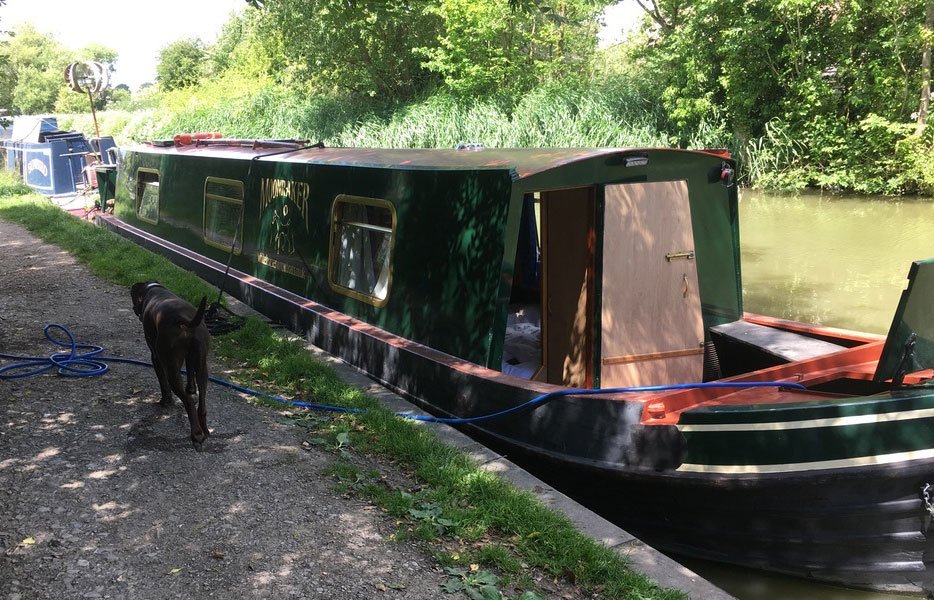
Our search led us to Devizes in southern England where there was a 47 foot narrowboat named Moonraker available for three day’s hire from www.whitehorsenarrowboats.co.uk on the Kennet & Avon canal.

The Kennet & Avon canal has an overall length of 140 km and was constructed between 1794 and 1810 to form a waterway that links Bristol with London via the Rivers Avon, Kennet and Thames. Although originally the canal was designed to carry heavy goods such as coal and stone in horse drawn barges, today it is used solely for recreation after falling into decline during the early 20th century, following the introduction of railways in the 19th century.


A 47 foot boat might sound excessive for two people, but narrowboats are as their name implies very narrow, with the accommodation in a long pencil shaped line.

Moonraker was beautifully maintained with shiny new paintwork, varnished wood work and polished brass fittings. Down below it was very comfortable with an excellent galley complete with gas cooker, pressurised hot and cold water, fridge, plus crockery, cutlery, glassware, pots and pans. There was a good sized heads with shower, basin and WC. USB ports and a 240 volt inverter for laptops and phone chargers were also provided.

The brand new diesel engine conforms to the latest emissions standards and was very fuel efficient, using a meagre 20 litres of fuel over the three days. This impressive fuel economy is achievable by keeping the revs low and proceeding at walking speed, which prevents wash from damaging the canal banks and also prevents disturbing moored boats. One of the many joys of canal boating is that it slows you down, literally, and it doesn’t take long to feel completely relaxed. UK canals have a 4 mph speed limit so this needs to be factored in when route planning.

Rules of the road

For those used to boating in crowded harbours and inshore waters, where strict observation of collision regulations is essential, navigating on a canal is much more straightforward.  The basic rules of the road are:

  • Keep on the right of the canal when passing other boats.
  • Make sure you give on-coming boats room to pass.
  • Look out for fishermen and slow down to give them time to pull in their lines. Keep to the middle of the canal as you pass them.
  • Sound your horn when approaching a blind bend.
  • Slow down to tick over when passing moored boats.

Mooring

There are plenty of places to moor along the towpath side of a canal, for short stays or overnight. Restricted areas are clearly signed and the non towpath side of the canal is normally restricted also. You should also avoid mooring near bridges, sharp bends or angling spots.

Popular places to stop include alongside pubs and cafes. Here you will find mooring rings and bollards and a maximum stay usually of up to 24 hours.

We prefer to aim for the quieter stretches, where you simply choose a spot, slow down and head for the canal bank at a 30º angle. When you are a couple of metres away from the bank, simply straighten up and put the engine in reverse for a few seconds and you should come to a stop alongside. Once you have practised this manoeuvre a couple of times you soon get the hang of it.

Moonraker was supplied with a boarding ladder, three steel mooring pins, a lump hammer and mooring lines. To moor the boat, you step ashore using the boarding ladder and then hammer in the pins at a 45º angle and tie up with the mooring lines. Doing all this is again straightforward, but for obvious reasons you should not hammer the pins into the towpath to prevent tripping up passers by.

Turning around

On a weekend break it is likely that you will need to turn the boat around and head back to where you came from. Given that most canal boats are longer than the width of a canal, turning around is done in specially designated turning points known as winding holes. These are usually miles apart, so you need to plan ahead and keep an eye on the map. In our case we used an app called Open Canal Map which tells you where you are.

To turn around, steer the boat slowly into the widest part of the winding hole until the bow touches the bank. You then engage forward gear and the boat will slowly pivot against the bank, while keeping the tiller pointing towards the bank. Once the boat has turned sufficiently, you then engage reverse gear and head back to the opposite side. You then move back into forward gear and you should be able to steer clear. I took a couple of attempts at this but we got round in the end.

I would thoroughly recommend a narrowboat holiday on the Kennet & Avon canal for those looking for a relaxing break in the UK. We did not encounter any locks which would have added to the fun but there were a few swing bridges to contend with. We also enjoyed some fabulous walks in the Wiltshire countryside.

Understanding tides

If you are used to sailing in tidal waters, you will know that tides can be both a benefit and a hindrance to the sailor. In many ways,...

Galvanic and electrolytic corrosion

Galvanic corrosion is an electrochemical reaction between two or more different metals, in the presence of an electrolyte (note salt water is a good electrolyte).

Safe Skipper – crew management tips

Effective crew briefings are a vital part of the good on-board communication that helps everything to run smoothly on a sailing vessel at sea, whether it is cruising or racing.

ColRegs – avoiding collisions at sea

ColRegs - avoiding collisions at sea ColRegs Rule 8: Action to avoid collision (a) Any action taken to avoid collision shall...

ColRegs Nav Lights & Shapes, Rules Of The Road and IALA Buoys Apps

ColRegs Nav Lights & Shapes, Rules Of The Road and IALA Buoys Apps Make Learning Rules on iPhone, iPad, iPod and Android...

How to trim a genoa sail

I recently had two new sails made by Sanders Sails, based in Lymington UK. The first to arrive was the new genoa and it took me a little while to get to know it and learn how to adjust it correctly. Here is an aide memoire for getting to know how to trim a genoa so that it will deliver the best performance.

Jester Challenge 2022 – Sailing single handed from Plymouth UK to the Azores: Getting to the Start

Jester Challenge – A modern experiment in old-fashioned self-reliance, self sufficiency, and personal responsibility. This is the start of a 10-part post where solo sailor, Bernie Branfield, shares his first hand account of his single-handed, 2022 Jester Challenge, from Plymouth, UK to the Azores, in his 26′ Invicta Mk2, Louisa.

Tools and spares for your boat

Tools and Spares to take to sea!

You won’t regret taking a look at our essential tips and checklist to make sure you’re prepared for routine maintenance and those unexpected jobs that come up whilst you’re afloat!

Seacock maintenance

If seacocks are always left open and neglected they can eventually seize which will prove a serious threat to boat safety should a connecting hose fail and the seacock refuses to close. There are three main types of seacock – ball valves, cone valves and gate valves.

Peer to Peer yacht charter – How can you monetize your boat?

There is a growing trend in peer to peer yacht charter. How does it work? People already rent rooms, cars and bikes from one...

Wooden Hull Repairs

While wooden boat hull maintenance is mostly straightforward, it is always a good idea to take expert advice on any repair job needed doing to a wooden boat, unless you have done the job before and know what you are doing.

Stress cracks on GRP boats

It is quite common to find cracks in the gelcoat when inspecting the deck and superstructure of a GRP boat. It is important to differentiate between a gelcoat crack and a scratch.

Fire safety advice at sea from the Marine & Coastguard Agency

Fire safety advice for boaters Top fire safety advice at sea: 1. Fit smoke alarms, carbon monoxide and gas detectors 2. Turn...

Seasickness – how can you prevent it?

Seasickness is a common problem at sea and affects both seasoned sailors and novices. What are the causes and symptoms of seasickness?...

Essential Boat Safety Briefing

Skippers Responsibilities Skippers are obliged to give a safety briefing to the crew even if they are a regular crew. At...

Essential Knots: Figure of eight

Essential Knots: Figure of eight Use: Stopper knot, prevents a rope from being pulled through a hole e.g. through a block or...

Sailing to windward – how to take advantage of wind shifts

For most sailors, sailing upwind is the most exhilarating point of sail as you tack your way to your destination. Sailing to windward is a bit like zig-zagging your way up a mountain road through a series of hairpin bends – great fun but also calling for concentration and hard work.

Dag Pike’s Boat Survey

We're really pleased to be working with Dag Pike on some great new apps for iPhone & Android. Here'a a bit more about the first app: Dag Pike's...

Boat surveys

A full boat survey assesses the condition of the hull, mechanical gear and means of propulsion. The survey is carried out with the boat...

Marine diesel exhaust checks

You should inspect the exhaust system for corrosion damage regularly, especially around the injection bend. If you have noticed the engine exhaust smoking a lot during the sailing season this can also indicate a number of potential problems.

Estimating your position at sea

Navigators use a combination of techniques to estimate their position at sea. The primary method used today is GPS (Global Positioning System), a network of 24 satellites that became fully operational in the 1990s and was originally restricted for use by the United States military.

Boat batteries

Under-sized battery banks are one of the key factors behind power failure at sea, as well as the premature failure of batteries, so make sure that your boat battery measures up to the use you want to put it to.

How a propeller works

Have a look around any boatyard and you will notice quite a variety of propellers – some have two blades, some have three and others have four or more. While most propellers are completely rigid some have blades that fold.

Boat engine basics

Boat engines come in all shapes and sizes and include inboards, outboards, petrol, diesel, electric and hybrid systems. Some engines are...

Jester Challenge 2022 – Sailing single handed from Plymouth UK to the Azores: Part 7 – Motivation

Jester Challenge – A modern experiment in old-fashioned self-reliance, self sufficiency, and personal responsibility. This is the seventh of a 10-part post where solo sailor, Bernie Branfield, shares his first-hand account of his single-handed, 2022 Jester Challenge, from Plymouth, UK to the Azores, in his 26′ Invicta Mk2, Louisa.