Select Page

Boating emergency - how to broadcast a MAYDAY emergency call

How to broadcast a MAYDAY emergency call


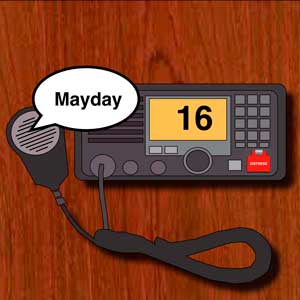
How to broadcast a MAYDAY emergency call if a vessel or person is in grave and imminent danger and immediate assistance is required:

• Check that your VHF radio is on and high power setting is selected 
Select Channel 16 (or 2182kHz for MF) 

• Press the transmit button and say slowly and clearly: 
“MAYDAY, MAYDAY, MAYDAY”

“THIS IS… ” 
(say the name of your vessel 3 times. Say your MMSI number and call sign) 

“MAYDAY, THIS IS…” 
(say name of vessel) 

“MY POSITION IS…” 
(latitude and longitude, true bearing and distance from a known point, or general direction) 

“I AM…” 
(say nature of distress eg SINKING, ON FIRE) 

“I REQUIRE IMMEDIATE ASSISTANCE”

“I HAVE…” 
(say number of persons on board PLUS any other useful information – such as sinking, flares fired, abandoning to liferaft) 

“OVER”

• Now release transmit button and listen for reply 

• Keep listening to Channel 16 for instructions 

• If you hear nothing then repeat the distress call 

Vessels with GMDSS equipment should make aMAYDAY call by voice on Ch 16 or MF 2182 kHz after sending a DSC Distress alert on VHF Ch 70 or MF 2187.5 kHz 

DSC Radio Emergency Procedure

• In an emergency, press the DSC radio’s red button for 15 seconds and then transmit a voice message on Channel 16. 

• Prepare for sending/receiving subsequent distress traffic on the distress traffic frequency (2182 kHz on MF, Ch16 on VHF) 

• NOTE: The nature of distress can be selected from the DSC radio receiver’s menu.

Information from our Safe Skipper App

“A well written and detailed app for yachts & inland craft also quite useful for ocean going vessels – well done.”

Boating Etiquette: Do’s and Don’ts on the Water

Boating etiquette is essential for ensuring the safety, enjoyment, and harmony of everyone on the water. Whether you’re a seasoned boater or new to the boating community, it’s important to be aware of the do’s and don’ts of boating etiquette. Take a look at our guidelines:

Top five windvane self steering installation questions

Top five windvane self steering installation questions answered by Sarah Curry of Hydrovane International Marine, courtesy of Viki Moore from Island Cruising NZ

Avoiding collisions at sea – how to stay safe on the water

Boats have many blind spots, including the headsails of sailing boats. Always keep a lookout, stay safe and remember that...

How to use tides and currents to your advantage

If you are contemplating a cruise through tidal waters and strong currents, then planning your trip carefully in advance is essential to enable you to take advantage of favourable tides rather than constantly fighting against them.

First Aid Afloat – fish spine injury

First Aid Afloat - Here is what to do if somebody stands on a fish spine: • Check for dangers. Is it safe for you to enter...

Sailing into a storm

Weather forecasting has become increasingly accurate, but despite this, I was caught out recently by a forecast that considerably underestimated the wind strengths and consequently was sailing single handed in to a Force 8 gale, which proved to be challenging!

Rig check – how to prevent failure at sea

Regular rig checks prevent the risk of mast and rigging failure at sea. This includes regular rig inspections of the spars, ...

Stress cracks on GRP boats

It is quite common to find cracks in the gelcoat when inspecting the deck and superstructure of a GRP boat. It is important to differentiate between a gelcoat crack and a scratch.

Jester Challenge 2022 – Sailing single handed from Plymouth UK to the Azores: Part 5 – Boat Management

Jester Challenge – A modern experiment in old-fashioned self-reliance, self sufficiency, and personal responsibility. This is the fifth of a 10-part post where solo sailor, Bernie Branfield, shares his first hand account of his single-handed, 2022 Jester Challenge, from Plymouth, UK to the Azores, in his 26′ Invicta Mk2, Louisa.

Fire prevention on boats

  Fire prevention on boats - common causes of fire: • Smoking below decks • Galley cookers • Build-up of butane or...

Sailing at the touch of a button

Easier and more controlled sail handling can also be achieved by powering up a furling mast. I came across some interesting solutions at the Southampton Boat Show this week on the Selden Mast stand, where they were running demos of their E40i electric winch and SMF furling system.

Keel design – options to consider when choosing a yacht

Keel design is constantly evolving and nowhere is this more apparent than in modern racing yachts such as the Imoca Open 60...

Learning about diesel engine maintenance

Marine diesel engines are internal combustion engines that are designed specifically for use in maritime applications. These engines are commonly used in a variety of watercraft, ranging from small boats and yachts to large ships and vessels. Learn about marine diesel engine maintenance courses.

Boat engine fuel system

If engines are installed and serviced correctly then most marine engines are very reliable, but one of the most important parts of the engine to check and service is the fuel system.

First aid at sea – four common emergencies

In this blog we look at what to do in the event of a crew member choking, drowning, or suffering from hypothermia or fatigue. Knowing how to cope with them could well save a life, while not knowing could result in an avoidable tragedy.

Repairing chips and dings in gelcoat

The gelcoat topsides of a GRP boat can be pampered and restored to their former glory relatively easily when it is ashore. Gelcoat is only a very thin outer layer of the hull, often less than 1mm thick, so you should avoid cleaning it with highly abrasive cleaners, or an-ything that could potentially damage its surface.

Tips and advice for staying safe on a sailboat at sea

Here we focus on how to stay safe on a sailboat at sea. We cover key things to ensure you have on board before you set sail as well as covering the most common cause of incidents on sailboats and how to deal with them.

Saildrive maintenance

There are less maintenance tasks to carry out on a saildrive transmission than on a traditional inboard shaft drive system with its associated stern gear. However, there are a few critical things that require maintenance, as recommended in detail by the engine manufacturers, and should be adhered to.

Understanding tides

If you are used to sailing in tidal waters, you will know that tides can be both a benefit and a hindrance to the sailor. In many ways,...

Keel maintenance and repair – Part 1

Keels are designed to act as underwater foils that generate lift as the boat moves through the water, counteracting the leeward force of the wind and enabling the boat to sail closer to the wind. Keel maintenance and repair is essential for the performance of your boat.

Sailboat rig checks – Part 1

Sailing boat rigs need to be checked regularly to reduce the risk of rig failure at sea. In part one of Sail boat rig checks we run through a series of useful checks that owners and skippers can carry out.

Distress flares – which flare, how & when to use?

How to use distress flares at sea To effectively use distress flares at sea, you need to understand the different types, their purpose, and the...

Five dangers a vessel may encounter at sea

What are the main dangers a vessel may face at sea and what should skippers do to reduce the risk of these happening?

First Aid Afloat – Jellyfish Stings

Jellyfish stings are a common occurrence when boating or swimming in many parts of the world. While most stings are not serious, some can cause...

Essential Boat Buying Tips for First-Time Boat Owners

The first question that comes to mind when thinking about buying a boat is: what type of boat? There are more than 20 different kinds, of different sizes, for different purposes, and different pockets. So, your first step is to decide your boat type.