Select Page

Have a look around any boatyard and you will notice quite a variety of propellers – some have two blades, some have three and others have four or more. While most propellers are completely rigid some have blades that fold. Propellers can be right handed, where they turn clockwise as they move forward, or left handed where they turn anti-clockwise. All these variations come about because different types of propeller are suited to different types of boats, engines and transmissions.

Propeller theory basics

The scientific theory behind how a propeller works is quite complex and if you are contemplating buying a replacement propeller for your boat then it would be advisable to read up about propeller theory and hydrodynamics in some detail – what follows here are just a few basics.

A ship’s propeller is often referred to as a “screw”, but since water is a liquid rather than a solid this analogy is a little misleading as a propeller can also be described as a type of foil or pump, which are nothing like a screw.        

A propeller works by converting torque (a force that causes something to rotate) into thrust. A turning propeller moves water downwards and behind the blades, in other words an action which produces a thrust of water from the blades. Each blade has a distinctive curved shape which as it turns helps to move the water down and behind it, acting like a foil in the process and then pumping the water out behind. It acts like a foil because the angle of the blade creates lift as it moves through the water, in a similar way to how a wing creates lift through the air, with a positive pressure, or pushing, on the underside and a negative pressure, or pulling effect on the top side. This accounts for why a propeller blade is also twisted – its shape helps it create lift.
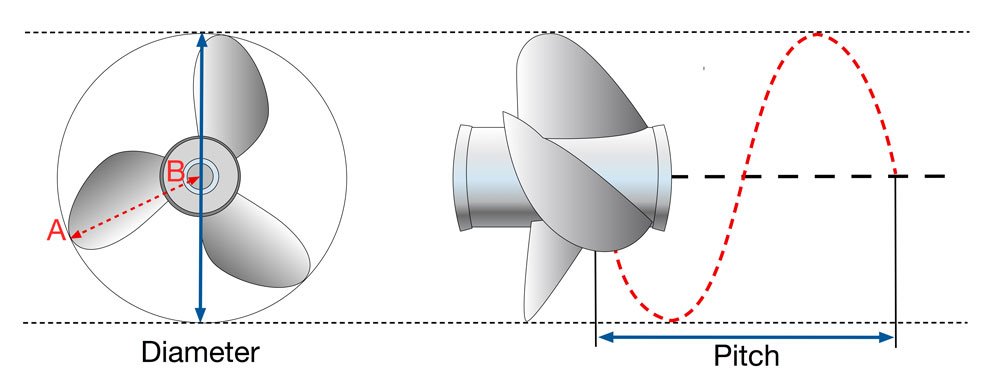
Going back to the screw analogy, if a propeller was screwing its way through a piece of wood, the distance it would move in one revolution is equivalent to the propeller’s pitch, so for example 20cm. The diameter or width of the propeller might be 40cm. Diameter and pitch are the two key dimensions given to describe a propeller and are usually marked on the hub of  a propeller, for example in this case 40 x 20.

Two other factors to be aware of are “advance” and “slip”. Advance refers to the actual distance a propeller moves through one rotation and slip refers to the difference between the pitch and the advance.

Number of blades and folding props

Why the different number of blades? What about props that fold? The quick answers are as follows:

  • Two blade propellers are the best option for sailing boats under 10m in length, giving adequate performance under power and causing less drag through the water when under sail.
  • Three blade propellers give greater thrust than two blades but increase drag. Three blade props are more commonly used for power boats but some larger sailing boats use them. Three blades usually give a slightly better top speed performance than four blades.
  • Four blade propellers tend to be quieter and vibration free. They produce more lift at the stern which can help with acceleration.
  • Folding or feathering props are designed for sailing boats and minimise drag when the boat is under sail. These are very effective but a lot more expensive than standard propellers.
  • Boat type, engine power, displacement and desired boat speed are all factored in when choosing the exact type and specification of propeller.
How to cope with an emergency at sea

A safe skipper will be mentally prepared for all kinds of potential emergencies happening at sea, including medical emergencies, engine failure, fire, a holed hull, capsize and dismasting.

Boat electrics

All boat owners should have a basic knowledge of electrics, both to avoid encountering electrical problems at sea and to stand a chance of solving them should they occur.

Seized fixings and fastenings

Maintaining a boat can be a rewarding experience but at times it can also be frustrating. A prime example of this is when you come across a seized fixing or fastening that refuses to budge. Read our tips on how to release and fix them:

Essential Knots: Sheet bend

Essential Knots: Sheet bend Use: Joining two ropes together. A sheet bend is particularly useful for joining two ropes of different...

Essential Knots: Round turn and two half hitches

Essential Knots: Round turn and two half hitches Use: Tying a rope to a pole or a ring. Step 1. Pass the end around the object. Step 2....

Essential Boat Spares for Safety

  Boats Spares Tool kit What you carry in the boats tool kit will be useful for many boat repairs, but you might want...

Repairing a leaking hull-to-deck joint

If you suspect a hull-to-deck joint has failed, then being absolutely sure where the actual leak is occurring is of prime...

Going aground – what to do if it happens to you

When a yacht runs aground, it can be a stressful situation, especially on a falling tide in an exposed position with a swell running. There are several steps you can take to address the situation in order to ensure the safety of your vessel and its occupants. Here are some tips should this happen to you.

Boat maintenance log

Keeping a boat maintenance log is an ideal way of reminding owners what needs to be done to a boat and when. Read on for some tips,...

Wooden Hull Repairs

While wooden boat hull maintenance is mostly straightforward, it is always a good idea to take expert advice on any repair job needed doing to a wooden boat, unless you have done the job before and know what you are doing.

Boat surveys

A full boat survey assesses the condition of the hull, mechanical gear and means of propulsion. The survey is carried out with the boat...

Rudders and steering systems – Part 3

In the third of our three blog articles on rudders and steering systems, we look at how to replace rudder bearings and repair a water-saturated core.

Five dangers a vessel may encounter at sea

What are the main dangers a vessel may face at sea and what should skippers do to reduce the risk of these happening?

Competent crew skills: mooring lines

Mooring lines are used when arriving or leaving a berth. One of the most important competent crew skills is to know how to...

Understanding tides

If you are used to sailing in tidal waters, you will know that tides can be both a benefit and a hindrance to the sailor. In many ways,...

Boating Etiquette: Do’s and Don’ts on the Water

Boating etiquette is essential for ensuring the safety, enjoyment, and harmony of everyone on the water. Whether you’re a seasoned boater or new to the boating community, it’s important to be aware of the do’s and don’ts of boating etiquette. Take a look at our guidelines:

2023 Rolex Fastnet Race – Part 3

This is our third and final article about the 2023 Rolex Fastnet Race. It is a first hand account by Simon Jollands who was one of the crew of Lancelot II, a Beneteau First 40 skippered by John Gillard.

VHF DSC radio – how best to communicate at sea

There are many ways to communicate with others at sea. What makes the VHF DSC radio the best form of short range...

Wooden Hulls – Part 1

Traditional wooden boats have a plank on frame construction, a centuries old boat building method that is still in use today. Variations of the traditional method include carvel, clinker and strip planking, which all relate to the way the planking is attached to the frame.

Essential Knots: Bowline

Essential Knots: Bowline Use: Making a secure eye or loop in the end of a rope. Bowlines have many uses on a boat, for example to make a...

Man Overboard Drill

How to respond to crew overboard under sail • Keep the MOB in sight • Tack into the heave-to position, do not adjust the...

Always have an emergency ditch bag ready to go…

An emergency ditch bag (also known as a grab bag, abandon ship bag, or go-bag) is a crucial piece of safety equipment for any vessel venturing out...

Marine toilets – care and maintenance

There are a number of different types of marine toilet, or heads. They fall into one of three categories – manual, electric and vacuum, the most common being the manual, hand pumped type. These have double acting piston-pumps which both discharge the waste and flush the toilet with sea water.

Rig check – how to prevent failure at sea

Regular rig checks prevent the risk of mast and rigging failure at sea. This includes regular rig inspections of the spars, ...

Sterndrive maintenance

Sterndrives are a popular form of propulsion in the powerboat market, but require a fair amount of care and maintenance. The main factors to be aware of are salt water corrosion, lubrication and regular inspection of the bellows, the condition of which is vital to prevent water from entering into the hull.