Select Page

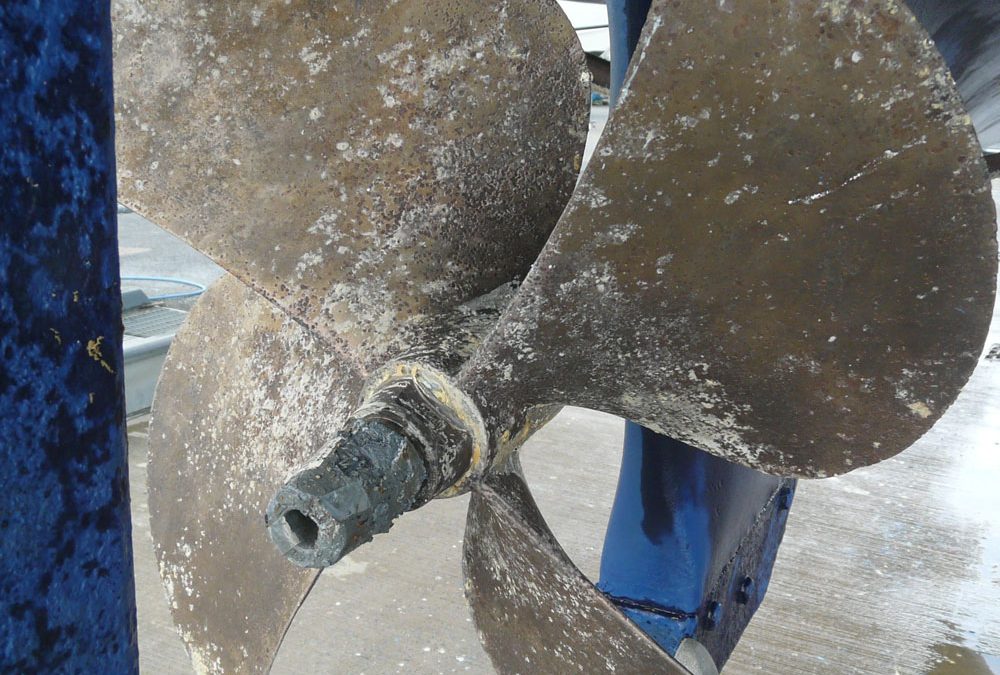
Propellers are complicated and repairs should be done by specialists but owners can carry out checks and some routine maintenance themselves when the boat is in the boatyard.  A propeller is critical to a boat’s performance, fuel consumption and ride, so it makes sense to keep a propeller in good working order.

Here are some checks and maintenance to carry out:

  • Clean the propeller thoroughly, removing all marine growth. Using a plastic scraper to remove barnacles is preferable to a metal one to avoid scratching the blade surface. I find mixing up a paste using white vinegar, flour and salt works well. Apply the paste to the surface and leave it for about 15 minutes. Then rinse with warm water and polish, being prepared to use plenty of elbow grease. Use superfine wire wool to help things along if absolutely necessary but whatever you do, don’t use a grinder.
  • Grease the propeller as recommended by the manufacturer’s instructions. Note that folding and feathering propellers need to be greased and the manufacturers provide advice and a kit for doing this.
  • Check the surface of the blades for any dents, scratches or nicks, paying particular attention to the tips of the blades.
  • Check for any hairline cracks in stainless steel blades, especially around the edges. These can be repaired for much less than the cost of a new propeller, but if ignored then the propeller will soon deteriorate to the point that it will have to be replaced.
  • Minor nicks and scratches can be filed smooth but take care not to grind too much as you could easily alter the blade geometry. Filing the nicks smooth will be worthwhile as the smallest of imperfections will affect performance.
  • Check the propeller and prop shaft stern bearing for signs of fishing line caught around it, which can easily damage shaft seals. This may require removing the propeller to carry out the check.
  • Check the condition of the propeller sacrificial anode if fitted and replace according to manufacturer’s recommendations – it is normal practice to replace an anode when half of it has been wasted away. Anodes do an essential job protecting bronze or aluminium propellers from galvanic interaction with stainless steel propeller shafts. A missing or badly wasted anode will result in very rapid corrosion of the propeller as soon as it is back in the water. Make sure you clean the contact point between the anode and the propeller shaft before replacing it.
  • Check for areas of pitting in the blades of faster boats that can be caused by cavitation. Cavitation is a highly complex phenomenon that causes bubbles to form on the back of a propeller blade due to the negative pressure that is created when a propeller spins at high speeds. Over time these bubbles hammer away at the blade and can cause pitting damage, which leads to vibration. Ask an expert’s opinion on the best course of action to repair the blade and whether they think cavitation is the cause.
  • If a blade has been bent out of shape or chunks of metal are missing then this will not only affect performance but also cause vibration, risking damage to struts, bearings, seals and drive shafts. The solution is to remove the propeller and ask your yard to recommend a specialist who can repair it for you. They will have the right equipment to get the propeller back into the correct shape – if it is repairable. Trying to hammer it back into shape yourself is clearly not an option.

propeller damage boat      Propeller damage boat

Vibration

There are quite a few possible causes of vibration in addition to propeller blades being out of shape and cavitation, as outlined in the checks above. Vibration from the engine and drive system is not good news and several other checks can be done at the same time as checking the propeller if vibration has been an issue:

  • Check the integrity of the bracket or strut supporting the propeller shaft and propeller. If this is at all loose then this should be looked into.
  • The propeller shaft may be worn or slightly bent, so check this over carefully for any signs of wobble when turning it.
  • The engine and shaft may be misaligned – it will probably be best to have this checked over by an engineer unless you have the skills to do this yourself.

Navigation safety: a quick-reference mobile app to learn the ColRegs NavLights and Shapes

 Safety at SeaSafety at sea will always remains a topical and important subject that will no doubt dominate the syllabuses of nautical...

Jester Challenge 2022 – Sailing single handed from Plymouth UK to the Azores: Part 3 – Preparations

Jester Challenge – A modern experiment in old-fashioned self-reliance, self sufficiency, and personal responsibility. This is the third of a 10-part post where solo sailor, Bernie Branfield, shares his first hand account of his single-handed, 2022 Jester Challenge, from Plymouth, UK to the Azores, in his 26′ Invicta Mk2, Louisa.

Learning about diesel engine maintenance

Marine diesel engines are internal combustion engines that are designed specifically for use in maritime applications. These engines are commonly used in a variety of watercraft, ranging from small boats and yachts to large ships and vessels. Learn about marine diesel engine maintenance courses.

Jester Challenge 2022 – Sailing single handed from Plymouth UK to the Azores: Part 9 – Around the Azores

Jester Challenge – A modern experiment in old-fashioned self-reliance, self sufficiency, and personal responsibility. This is the ninth of a 10-part post where solo sailor, Bernie Branfield, shares his first-hand account of his single-handed, 2022 Jester Challenge, from Plymouth, UK to the Azores, in his 26′ Invicta Mk2, Louisa.

Sailing into fog – being prepared and staying safe

Most skippers will sensibly delay their departure, if fog is forecast. However, if fog begins to form when you are at sea it is important to be prepared, and know what precautions to take, to help make your vessel detectable or visible in fog and keep the crew safe.

Understanding tide tables and tidal curves

There are many factors that influence local tidal patterns and it’s essential for every sailor to have a good understanding of tide tables and tidal charts to ensure they can calculate the level of tide at any given time.

First aid at sea – four common emergencies

In this blog we look at what to do in the event of a crew member choking, drowning, or suffering from hypothermia or fatigue. Knowing how to cope with them could well save a life, while not knowing could result in an avoidable tragedy.

Antifouling for leisure boats – Part 2

To prepare for antifouling, as soon as your boat has been lifted out and pressure washed, you need to check all the surfaces of the hull below the waterline, remove any remaining barnacles and check for blisters.

Crew Overboard Drill – Updated

How to respond to crew overboard A Man Overboard (MOB) drill is a crucial safety procedure that every boater should practice regularly. It simulates...

Boating Rules of the Road – International ColRegs

    International ColRegs Rule 7: Risk of Collision Anyone who is responsible for a vessel at sea, from the...

Sailboat rig checks – Part 1

Sailing boat rigs need to be checked regularly to reduce the risk of rig failure at sea. In part one of Sail boat rig checks we run through a series of useful checks that owners and skippers can carry out.

First Aid Afloat – fish spine injury

First Aid Afloat - Here is what to do if somebody stands on a fish spine: • Check for dangers. Is it safe for you to enter...

Sailboat rig checks – Part 2

In part two of Sail boat rig checks we run through some useful rig maintenance tips and then finish with a brief look at what a professional rig check involves.

Tidal terms and definitions

Getting to grips with tidal terms and definitions can seem a little daunting, even to the most experienced sailors! Here we look at some of the key terms and definitions associated with the language of tides.

Rig check – how to prevent failure at sea

Regular rig checks prevent the risk of mast and rigging failure at sea. This includes regular rig inspections of the spars, ...

Nautical paper charts – a reminder of the basics

The nautical chart is an indispensable tool for navigation. A chart is a graphic representation of an area of the sea which might also include coastlines, estuaries and islands. All cruising leisure boats should carry up-to-date paper charts.

Boat batteries

Under-sized battery banks are one of the key factors behind power failure at sea, as well as the premature failure of batteries, so make sure that your boat battery measures up to the use you want to put it to.

Anchoring – getting it right

If you can set an anchor correctly with confidence and know your boat will be safe in a secure anchorage, then you can rest in comfort and will not...

Boat maintenance – what does it involve?

The maintenance of a boat involves things like cleaning, varnishing, painting, polishing, antifouling, servicing the engine, servicing the seacocks, and maintaining the gas and plumbing systems. It all amounts to a fairly considerable amount of work that can’t be ignored if you are to keep your boat in a safe and good condition.

Steel hull maintenance

A steel boat owner’s biggest enemy is corrosion. You don’t have to worry about osmosis or rotting timbers, instead rust is the number one issue that will keep you awake at night.

Top Tips For Learning: ColRegs Boating Rules Of The Road

Colregs Boating Rules Of The Road
The International Regulations for Preventing Collisions at Sea (COLREGs) are a set of rules designed to prevent collisions between vessels. They are essentially the “rules of the road” for boats. Some key concepts within the COLREGs include:

Keel maintenance and repair – Part 1

Keels are designed to act as underwater foils that generate lift as the boat moves through the water, counteracting the leeward force of the wind and enabling the boat to sail closer to the wind. Keel maintenance and repair is essential for the performance of your boat.

Fixing position at sea using traditional methods

This post looks at some traditional methods used for fixing a vessel’s position at sea, within sight of land. Electronic fixes using chart plotters are very straightforward to record, but if for some reason a vessel’s electronics are faulty it is essential that a skipper knows how to use traditional methods.

Peer to Peer yacht charter – How can you monetize your boat?

There is a growing trend in peer to peer yacht charter. How does it work? People already rent rooms, cars and bikes from one...

How to cope with an emergency at sea

A safe skipper will be mentally prepared for all kinds of potential emergencies happening at sea, including medical emergencies, engine failure, fire, a holed hull, capsize and dismasting.