Select Page

Boat interiors on the whole are pretty resilient but over time bulkheads, doors, the cabin sole and surfaces become scuffed, stained and suffer general wear and tear due to the marine environment.

In an ideal world, the best location to undertake such a project is inside a heated boat shed, well protected from the winter weather and with access to power for decent lighting. Unfortunately this was not my recent experience two winters ago, with the boat exposed to the elements and no access to power, but with perseverance I nonetheless achieved some satisfactory results.

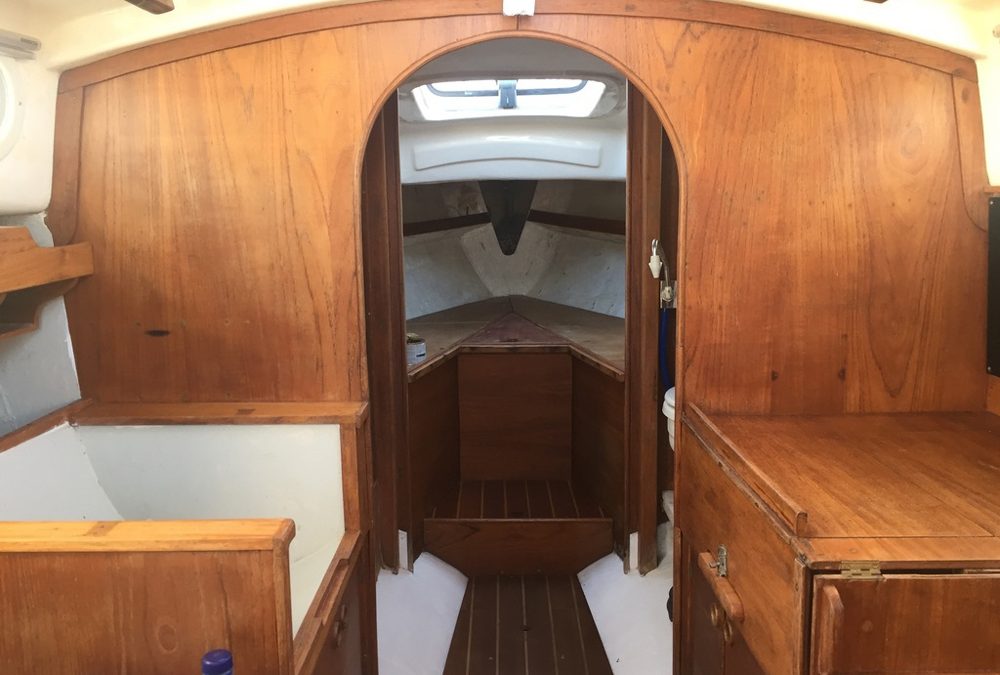
boat interior varnishing

Most boat interiors have a combination of varnished and painted surfaces including solid wooden joinery, plywood laminates with thin hardwood veneers and glass reinforced plastic. When making your assessment of what you are going to do, bear in mind that the varnishing process consumes a lot of time, especially if the existing surfaces are in poor shape. This is because, in order to do a decent job, the preparation takes much longer than the brush work itself.

boat interior varnishing

Preparation

Stripping and refinishing interior woodwork is best approached with some caution. Veneered surfaces are usually very thin and it is possible to sand right through a veneer.

  • Cleaning – start by cleaning surfaces with a mild bleach such as a hydrogen peroxide and water solution to remove any traces of mould. Baking soda is good for removing oil and grease and a Scotch Brite type pad soaked in ammonia works well. Bleached and darkened timber can be restored with oxalic acid in order to achieve a uniform timber surface. Trial and error works best as it all depends on the actual state of the surfaces and whether the wood has been treated with varnish or oil over the years. Solid teak will often have been treated with oil, while a veneer will more likely to have been varnished. Allow everything to dry before sanding.
  • Stripping – if areas of old varnish are cracked and flaking, this will need to be scraped off using a paint scraper. Care needs to be taken not to damage the wood so a plastic scraper is preferable to a stainless steel one – either way proceed with caution. The decision then is whether to use a chemical stripper or proceed to sanding. Rightly or wrongly I chose to use a gel type paint stripper and although this proved a slow, messy process in the end it worked out fine. I wore rubber gloves and a breathing mask to be on the safe side.
  • Filling – some of the bulkheads on my boat had had screw holes drilled into them in the past, presumably for securing instruments, fittings or shelving. I filled these with a teak coloured wood filler before sanding.
  • Sanding – some people just launch straight in with the sanding which may be fine with timber in good condition, but for those who have been cleaning, stripping and filling you are about halfway through the process. Somewhere between an 80-320 grit aluminium oxide paper is recommended for sanding, depending on the surface condition. It is best to use a sanding block to get an even finish and to finish with a 320 grit paper. Remember to sand along the grain of the wood to avoid scratches showing through the varnish. Once satisfied with the finish, some hours or even days later, remove all sanding dust, which is easier said than done in a confined space. This will most likely entail removing overalls and giving them a good shake outside.
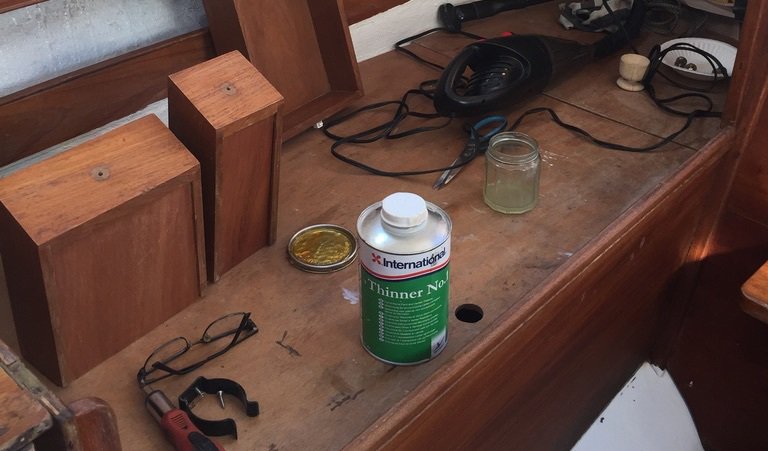
  • Thinners – back inside and with dust removed, now brush the sanded surfaces with thinners and wipe with a clean soft cloth. This will remove traces of dust and also any oil residue on the surface of the wood.
boat interior varnishing

Varnishing

  • Preparing the varnish – I chose International’s Goldspar Satin varnish, which is recommended for interior use. This can be thinned if necessary using thinners and is easy to apply. Good quality brushes are a must with at least two sizes – for fine work and larger areas. Decant the varnish into an old jam jar and seal the lid of the tin to prevent any dust from getting in.
  • Application – when applying varnish on a vertical surface such as a door, brush in a vertical direction. For the first coat, thin the varnish a little as recommended on the instructions label on the tin. Work quickly in a controlled manner, taking care not leave a build up of varnish along the edges. Once you have worked over an area do not be tempted to brush over it again until it is completely dry. If there are any imperfections you notice these are best left until the varnish is dry. Only then can you sand the edges back before applying another coat. Be prepared to apply several coats of varnish to get a good finish, sanding in between coats with 220-320 grit wet and dry paper. Much depends on how much of a perfectionist you are.

boat interior varnishing

Interior painting

If you have invested considerable time and effort varnishing your boat’s interior, then set aside a little extra time to paint the bilges, lockers, galley and heads with a fresh coat of paint. I recommend Danboline bilge paint for this, which is tough, durable and finishes to a thick, hard wearing gloss. After all that varnishing, doing this is a piece of cake by comparison and almost as rewarding as the varnishing.

Sailboat rig checks – Part 2

In part two of Sail boat rig checks we run through some useful rig maintenance tips and then finish with a brief look at what a professional rig check involves.

Navigating Through Rough Waters: Tips for Handling Adverse Weather Conditions in a Sailboat

Navigating through rough waters in a sailboat requires skill, preparation, and a good understanding of both your vessel and the environment. Here are some tips for handling adverse weather conditions including Preparation, Techniques, Safety and much more..

2023 Rolex Fastnet Race

Safe Skipper’s Simon Jollands took part in the 2023 Rolex Fastnet Race – a classic offshore sailing event. This is the first of several articles on the race and focuses on the start.

Keel maintenance and Repair – Part 2

If you have ever witnessed a boat colliding with a rock or other submerged obstacle you will know that there is an almighty thump and the whole boat shakes and judders. While such hard groundings seldom result in catastrophic keel failure, something has to give and even the sturdiest keels can easily be damaged by such an impact.

Boat decks and superstructure

The deck of a boat is constantly exposed to the elements and should be inspected on an annual basis. Particular attention needs to be given to the overall condition of deck fittings such as the stanchions, cleats and chainplates.

How to cope with an emergency at sea

A safe skipper will be mentally prepared for all kinds of potential emergencies happening at sea, including medical emergencies, engine failure, fire, a holed hull, capsize and dismasting.

Jester Challenge 2022 – Sailing single handed from Plymouth UK to the Azores: Part 7 – Motivation

Jester Challenge – A modern experiment in old-fashioned self-reliance, self sufficiency, and personal responsibility. This is the seventh of a 10-part post where solo sailor, Bernie Branfield, shares his first-hand account of his single-handed, 2022 Jester Challenge, from Plymouth, UK to the Azores, in his 26′ Invicta Mk2, Louisa.

Crew Overboard Drill – Updated

How to respond to crew overboard A Man Overboard (MOB) drill is a crucial safety procedure that every boater should practice regularly. It simulates...

Capsize – understanding the risks

A skipper should know how their boat will cope with rough seas. By working within known limits and understanding the risks,...

Essential Knots: Round turn and two half hitches

Essential Knots: Round turn and two half hitches Use: Tying a rope to a pole or a ring. Step 1. Pass the end around the object. Step 2....

Boat ownership

Owning a boat is a big commitment that should bring no end of satisfaction for the owner as well as the owner's family and friends. In...

Sailing Safely at Night – Best Practice

Sailing at night can be a magical experience – the peaceful solitude, starry skies, and gentle lapping of waves create an unforgettable atmosphere. However, nighttime sailing also presents unique challenges and risks that require careful preparation and vigilance. This comprehensive guide will cover essential safety practices to ensure your nocturnal nautical adventures are both enjoyable and secure.

The Round The Island Race 2023

This year’s Round the Island Race turned out to be a really thrilling and competitive event. 1100 boats entered the race, which took place on Saturday 1st July. The race started from the world famous Royal Yacht Squadron line in Cowes UK, with the largest and fastest boats starting first, leaving the rest of us to wait our turn.

Antifouling for leisure boats – Part 4

Applying antifouling. Antifouling is best applied on a dry, calm day. It is best to apply the antifouling in the middle of the day to ensure the hull is dry and as warm as possible.

Keel design – options to consider when choosing a yacht

Keel design is constantly evolving and nowhere is this more apparent than in modern racing yachts such as the Imoca Open 60...

Understanding your mast and rigging

The rig of a sailing boat is put under huge stresses and strains so it is important for inspections of a yacht's spars and rigging to be...

Antifouling for leisure boats – Part 1

Boats that are kept afloat can very quickly become a home for small marine organisms such as barnacles, weed and slime. Applying an antifouling paint to your hull is necessary to protect it from these micro-organisms, as a fouled hull can cause problems and will slow down a boat’s maximum speed considerably if left unchecked.

First Aid Afloat – Jellyfish Stings

Jellyfish stings are a common occurrence when boating or swimming in many parts of the world. While most stings are not serious, some can cause...

Estimating and plotting your position at sea

This post covers how we go about estimating and plotting our position using traditional methods, when out of sight of land – covering Dead Reckoning, Estimated Position, Tidal Streams, Leeway and more…

The give-way hierarchy at sea – who gives way to whom?

Whatever their size or type, all skippers have a responsibility to avoid collisions with other boats at sea.  It is...

Tools and spares for your boat

Tools and Spares to take to sea!

You won’t regret taking a look at our essential tips and checklist to make sure you’re prepared for routine maintenance and those unexpected jobs that come up whilst you’re afloat!

Repairing a leaking hull-to-deck joint

If you suspect a hull-to-deck joint has failed, then being absolutely sure where the actual leak is occurring is of prime...

Wooden Hulls – Part 2

It is important to ensure the essential hull maintenance of a wooden boat is done, even if you are paying others to look after your boat for you. The priority is to prevent rot from taking hold. The protective layers of paint and varnish over wood are far more critical than on GRP boats, where the topsides are painted more for cosmetic reasons.

Top five windvane self steering installation questions

Top five windvane self steering installation questions answered by Sarah Curry of Hydrovane International Marine, courtesy of Viki Moore from Island Cruising NZ

Docking a Motorboat

Docking a motorboat can be a challenging task, especially for beginners, but with practice and attention to detail, it becomes much easier. Here’s a step-by-step guide to help you dock your motorboat safely and efficiently.