Select Page

Reducing the risks of an accident happening at sea is a priority for every skipper of a leisure vessel, as is reducing the chance of any of the crew becoming ill.

The first line of defence against a medical emergency at sea is to avoid it in the first place, which may sound obvious but should be at the forefront of a skipper’s mind. This can be done in a positive, relaxed manner and it is worth reassuring your crew that medical emergencies at sea are a rarity.  At the same time there is a genuine need for the skipper to adopt a responsible attitude which means looking out for early signs of seasickness, making sure everyone moves about the boat safely, is wearing appropriate clothing, using sunscreen, is keeping hydrated and getting adequate rest.

It is important to make your crew aware of the potential hazards that a yacht underway presents, things like correct winch handling, the companionway steps and the boom, and ensure no one works on the engine when it is running.  It is also important to be aware of any of the crew’s medical conditions and to make a note of any medication they have with them before you depart.

first aid at sea shock

Knowledge and skills

At least one person on board should be trained in first aid and know how to administer the contents of the first aid kit, ensuring there are adequate supplies for the planned duration of the trip. All skippers and people who crew regularly are advised to do their basic marine first aid training ashore.

In the UK the one day RYA First Aid At Sea Course provides basic support and a working knowledge of first aid for those sailing within 60 nautical miles from a safe haven.

first aid at sea bleeding

What to do in an emergency

If there is a medical emergency aboard, a swift response plus basic knowledge and first aid skills can help you get a dangerous situation under control and a potential disaster avoided.  As skipper, you will need to decide which of the following courses of action to take:

  1. Does the situation call for immediate evacuation of the casualty?
  2. Should you sail directly to the nearest port?
  3. Should you sail to a port that is more convenient for you?
  4. Should you continue with your original passage plan?

In the absence of professional medical advice on board, it is vital to know how to assess the casualty’s condition and if needs be to administer first aid, to communicate the casualty’s condition accurately to professionals ashore and to understand what can be done to alleviate and control the situation.  With this information, the skipper can then decide on a course of action.

While first aid is being given to the casualty, the safety of the crew and vessel must remain paramount. Ensure the vessel is kept well under control and out of danger. If necessary, slow the vessel down and alter course to prevent the casualty being bumped about.

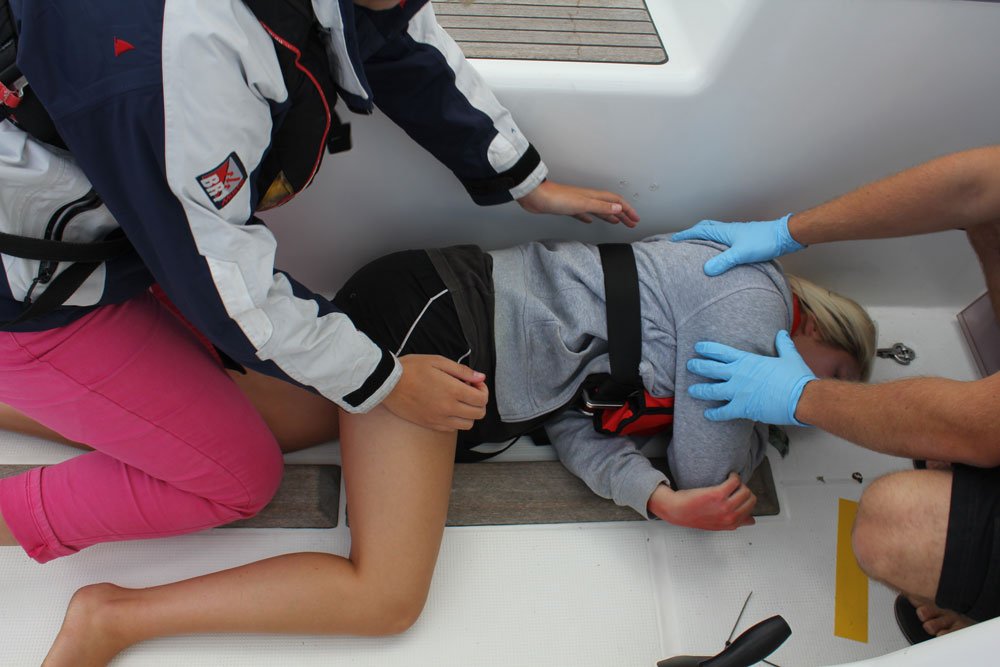
first aid at sea compressions

Assessing a casualty

Start with a Primary Survey. The Primary Survey is also referred to as the ABC check: A for Airway, B for Breathing and C for Circulation.

Airway – First check that the casualty’s airway is open. If conscious, check for choking or suffocation. If unconscious, lift the chin with two fingers and gently tilt the head back to open the airway.

Breathing – Check the casualty’s breathing. Look, listen and feel for breathing for 10 seconds. If the casualty is not breathing, begin CPR immediately – ie chest compressions and rescue breathing (mouth-to-mouth).

Circulation –  Check for signs of external or internal bleeding. Control severe bleeding with direct or indirect pressure.

Boating Etiquette: Do’s and Don’ts on the Water

Boating etiquette is essential for ensuring the safety, enjoyment, and harmony of everyone on the water. Whether you’re a seasoned boater or new to the boating community, it’s important to be aware of the do’s and don’ts of boating etiquette. Take a look at our guidelines:

Is Boating Good for Your Health and Happiness?

Absolutely! Boating offers a wealth of benefits for both your physical and mental well-being, making it a fantastic activity for overall health and...

Boat surveys

A full boat survey assesses the condition of the hull, mechanical gear and means of propulsion. The survey is carried out with the boat...

Crew Overboard Drill – Updated

How to respond to crew overboard A Man Overboard (MOB) drill is a crucial safety procedure that every boater should practice regularly. It simulates...

Essential Knots: Round turn and two half hitches

Essential Knots: Round turn and two half hitches Use: Tying a rope to a pole or a ring. Step 1. Pass the end around the object. Step 2....

Medical Emergency at Sea

How to deal with a medical emergency afloat   If you are planning a boating trip, it is important to have at least one...

Navigating narrow channels

Navigating narrow channels can present challenges for boat operators due to limited space, restricted manoeuvrability, and potential hazards such as shallows, rocks, or other vessels. To ensure safe passage through narrow channels, it’s essential to follow specific strategies and techniques.

Keel maintenance and repair – Part 1

Keels are designed to act as underwater foils that generate lift as the boat moves through the water, counteracting the leeward force of the wind and enabling the boat to sail closer to the wind. Keel maintenance and repair is essential for the performance of your boat.

Understanding marine sealants & adhesives

Sealants, adhesives and adhesive sealantsThere is a bewildering variety of sealants, adhesives and even adhesive sealants available for...

Antifouling for leisure boats – Part 2

To prepare for antifouling, as soon as your boat has been lifted out and pressure washed, you need to check all the surfaces of the hull below the waterline, remove any remaining barnacles and check for blisters.

Antifouling for leisure boats – Part 1

Boats that are kept afloat can very quickly become a home for small marine organisms such as barnacles, weed and slime. Applying an antifouling paint to your hull is necessary to protect it from these micro-organisms, as a fouled hull can cause problems and will slow down a boat’s maximum speed considerably if left unchecked.

Fractures, sprains and dislocations at sea

Moving about a boat at sea often results in a few knocks and bruises, but if a crew member has a fall or major bump and is in serious pain, they should be examined and treated accordingly.

Learning about diesel engine maintenance

Marine diesel engines are internal combustion engines that are designed specifically for use in maritime applications. These engines are commonly used in a variety of watercraft, ranging from small boats and yachts to large ships and vessels. Learn about marine diesel engine maintenance courses.

Distress flares – which flare, how & when to use?

How to use distress flares at sea To effectively use distress flares at sea, you need to understand the different types, their purpose, and the...

Nautical paper charts – a reminder of the basics

The nautical chart is an indispensable tool for navigation. A chart is a graphic representation of an area of the sea which might also include coastlines, estuaries and islands. All cruising leisure boats should carry up-to-date paper charts.

Marine toilets – care and maintenance

There are a number of different types of marine toilet, or heads. They fall into one of three categories – manual, electric and vacuum, the most common being the manual, hand pumped type. These have double acting piston-pumps which both discharge the waste and flush the toilet with sea water.

A simple guide to understanding tides when passage planning

Understanding tides when passage planning When planning a trip in tidal waters, check the tides before going afloat. Use...

Keel design – options to consider when choosing a yacht

Keel design is constantly evolving and nowhere is this more apparent than in modern racing yachts such as the Imoca Open 60 class. These fast...

Engine failure at sea – keeping the boat safe

If the engine stops when you are underway, or your have to shut it down when a warning buzzer sounds, you also need to make sure the boat remains safe. It’s important therefore to recognise situations in which the boat would be immediately put in danger if the engine were to fail.

Estimating and plotting your position at sea

This post covers how we go about estimating and plotting our position using traditional methods, when out of sight of land – covering Dead Reckoning, Estimated Position, Tidal Streams, Leeway and more…

Light characteristics – how do navigators identify lights at night?

How do navigators identify the different types of light around our coasts at night and what are their characteristics?Navigating at...

How to read nautical charts

Whilst most sailors today rely on GPS to find their way at sea, nautical charts are a crucial tool for any sailor to navigate safely and effectively. Here is a reminder of some of the basic steps involved in reading a nautical chart:

Feeling anxious at sea

  Some people feel anxious at sea. Will they be seasick? What if they get caught in a violent storm? Could the boat...

Stern gear maintenance

The stern gear of a boat needs to be checked carefully when the boat is ashore as this is something that can only be done when it is out of the water. The same applies for any maintenance and repairs that may need doing, so it is best to check it all over as soon after an end of season lift out as possible.

Boat batteries

Under-sized battery banks are one of the key factors behind power failure at sea, as well as the premature failure of batteries, so make sure that your boat battery measures up to the use you want to put it to.