Select Page

I recently had two new sails made by Sanders Sails, based in Lymington UK.  The first to arrive was the new genoa and it took me a little while to get to know it and learn how to adjust it correctly.  Here is an aide memoire for getting to know how to trim a genoa so that it will deliver the best performance.

It is easier to get to know your sails in moderate conditions, ideally in winds up to Force 4.

Step 1. Getting started

Sailing upwind in 10-14 knots of breeze, sheet the sail in until the leech is just off the shrouds. Look up to make sure the sail is not hard up against the spreaders. In lighter airs, ease the sheet a little further.

Sheet lead position determines the relative position of the leech and the foot. Here there is even tension in the foot and the leech. The sail is well set and will create maximum drive.

The sheet lead position is forward, allowing the foot to sag, which makes the sail fuller. This is ok in light airs but when the breeze increases less power will be needed.

The car is moved well back, pulling the foot tight. The leech is open and there is twist in the top of the sail, de-powering the sail.

Step 2. Check the telltales

Telltales tell you whether the wind is flowing smoothly across the luff. The aim is to have all of them, on both sides of the sail, streaming together – but it is not always easy and takes practice. Here are a few tips to help you practice:

 Your first check is to luff gently from a close-hauled course while watching the windward telltales.
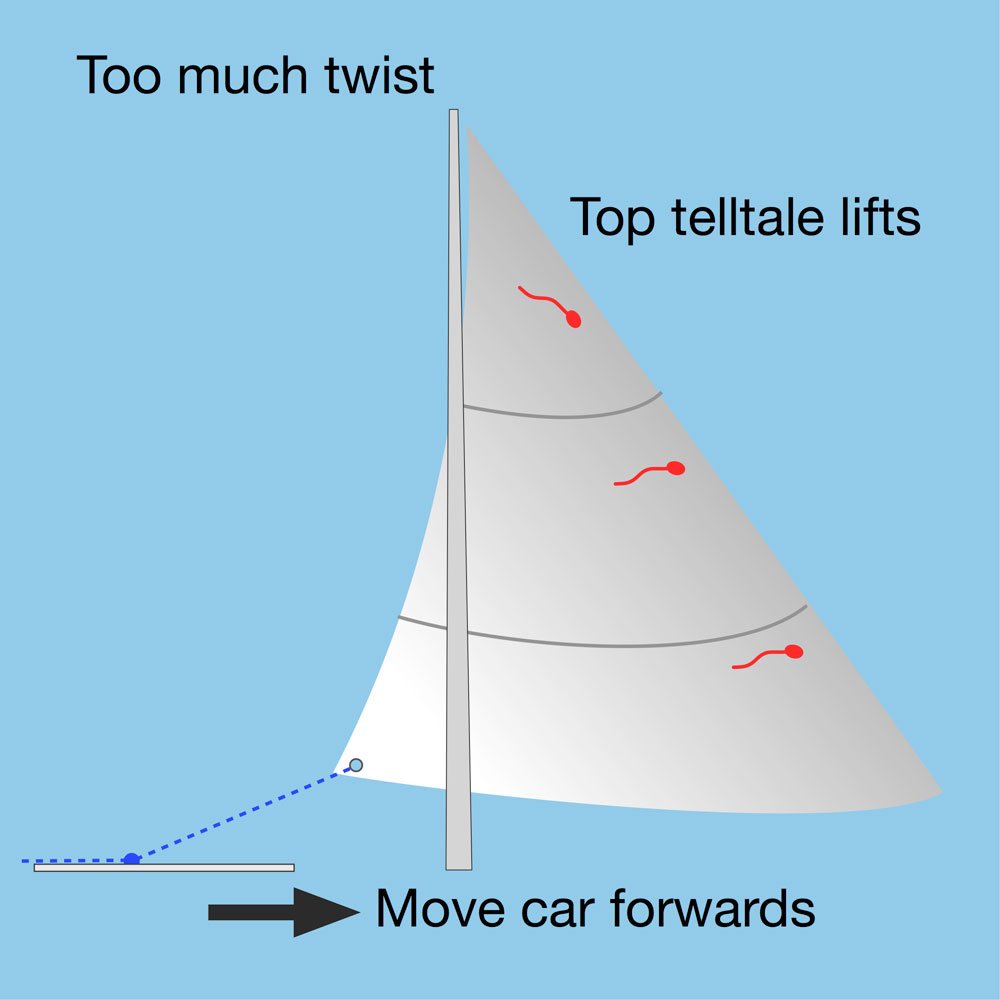
If the top telltale lifts first this means the leech is too slack and the sail has too much twist. Moving the car forward along the track.

  • If the top telltale starts lifting first, the sail has too much twist, meaning the leech is too slack because the sheet lead is too far aft. Move the car forward a little along the track.
  • If the bottom telltale starts lifting first, the sail has too little twist. Move the car aft a notch or two.
  • When they all lift together, you have got it right. After that, you only need to watch the bottom one while sailing. It is a good idea to mark the track with an indelible pen in order to remember the optimum settings in light, medium and high wind strengths.

If the bottom telltale starts lifting first, the sail has too little twist – move the car aft.

Other telltale signs:

  • If the leeward telltales are lifting, you either need to ease the sheet or sail closer to the wind.
  • If the windward ones are lifting, you should sheet in or bear away.
  • In strong winds when you are beginning to get over-powered, you will probably need the windward tales lifting slightly all the time.
  • Once you have freed away from a close-hauled course, the top of the sail will tend to twist open so the telltales will no longer stream.

Step 3. Adjust the fullness

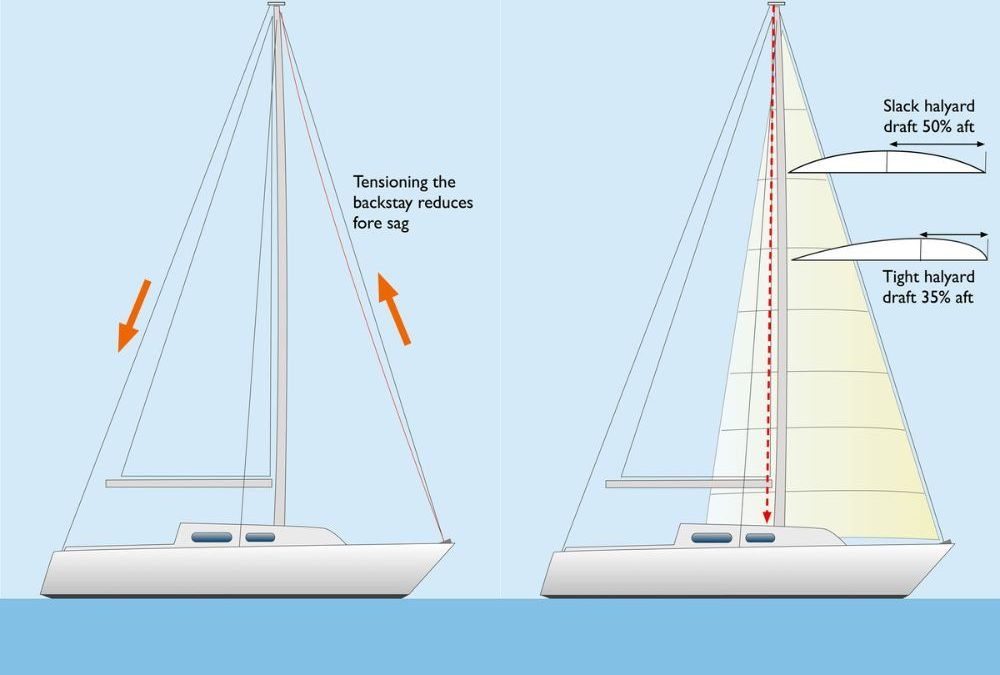
In light to moderate winds – especially in a chop – you need a relatively full sail for power. That means minimal backstay tension to induce some forestay sag and not too much halyard or sheet tension either. If you find you are not moving, try letting everything off a little.

Tightening the backstay increases forestay tension, which reduces the fullness of the sail. So, increasing forestay tension helps to improve speed and pointing ability in strong winds.

When the breeze picks up, you need less power or you will be sailing on your ear with terrible weather helm. The problem is that the extra wind pressure increases forestay sag and makes the sail fuller. So, to flatten it, tighten the backstay, increase the halyard tension and sheet in harder. You may also need to move the car back a hole to flatten the foot and de-power the top of the sail.

 Step 4. Adjust the draft position

Draft position plays a major part in determining pointing ability and ease of sailing. Moving it forward (increasing halyard tension) means you won’t point so high, but reduces the heeling force in fresh conditions. The boat will also be more forgiving to sail, especially in a chop. So, if you just can’t get those telltales to settle no matter how hard you concentrate, make the sail a little rounder in the luff by tensioning the halyard.

A slack genoa halyard results in a fuller sail with the draft further back, which will help performance in light airs. Tightening the halyard will move the draft forward, better for stronger winds.

Tips and advice for staying safe on a sailboat at sea

Here we focus on how to stay safe on a sailboat at sea. We cover key things to ensure you have on board before you set sail as well as covering the most common cause of incidents on sailboats and how to deal with them.

Crew Overboard Drill – Updated

How to respond to crew overboard A Man Overboard (MOB) drill is a crucial safety procedure that every boater should practice regularly. It simulates...

Boat surveys

A full boat survey assesses the condition of the hull, mechanical gear and means of propulsion. The survey is carried out with the boat...

Boat ownership – some fundamentals

Owning a boat is a big commitment that should bring no end of satisfaction, but the costs of maintaining and keeping a boat are significant and should never be underestimated.

The dangers of running aground in a motor boat

The peril of grounding a motor boat is not only an inconvenience; it can lead to substantial risks for both the vessel and its passengers. . In this article, we’ll explore the potential dangers of running aground and highlight the importance of proper navigation and preparedness to avoid these hazards!

Wooden Hulls – Part 2

It is important to ensure the essential hull maintenance of a wooden boat is done, even if you are paying others to look after your boat for you. The priority is to prevent rot from taking hold. The protective layers of paint and varnish over wood are far more critical than on GRP boats, where the topsides are painted more for cosmetic reasons.

Marine engine electrical system

The typical basic electrical system associated with a marine engine includes a dedicated engine starting battery, a starter motor, a charger in the form of an alternator, a solenoid and some engine sensors and instruments.

Jester Challenge 2022 – Sailing single handed from Plymouth UK to the Azores: Part 10 – The Return Trip

Jester Challenge – A modern experiment in old-fashioned self-reliance, self sufficiency, and personal responsibility. This is the final instalment of a 10-part post where solo sailor, Bernie Branfield, shares his first-hand account of his single-handed, 2022 Jester Challenge, from Plymouth, UK to the Azores, in his 26′ Invicta Mk2, Louisa.

Narrowboating on the Kennet and Avon Canal

A recently cancelled sailing event I was due to take part in left us with a free weekend in the diary. Given that my wife and I were celebrating a bumper wedding anniversary and the weather forecast was for fine weather, we decided to hunt around for a last minute canal holiday.

Navigating Through Rough Waters: Tips for Handling Adverse Weather Conditions in a Sailboat

Navigating through rough waters in a sailboat requires skill, preparation, and a good understanding of both your vessel and the environment. Here are some tips for handling adverse weather conditions including Preparation, Techniques, Safety and much more..

Safety Equipment Checklist for Boats

Safety Equipment Checklist for Boats   Liferaft line attached The liferaft will not work unless the trigger line is...

Jester Challenge 2022 – Sailing single handed from Plymouth UK to the Azores: Part 3 – Preparations

Jester Challenge – A modern experiment in old-fashioned self-reliance, self sufficiency, and personal responsibility. This is the third of a 10-part post where solo sailor, Bernie Branfield, shares his first hand account of his single-handed, 2022 Jester Challenge, from Plymouth, UK to the Azores, in his 26′ Invicta Mk2, Louisa.

Rudders and steering systems – Part 3

In the third of our three blog articles on rudders and steering systems, we look at how to replace rudder bearings and repair a water-saturated core.

Essential Boat Spares for Safety

  Boats Spares Tool kit What you carry in the boats tool kit will be useful for many boat repairs, but you might want...

Passage planning and pilotage

Passage planning and pilotage help skippers navigate safely from one port to another. A passage plan takes into account all...

Sector lights, directional lights, leading lights – how do they differ?

Sector lights, directional lights and leading lights guide vessels safely through hazardous waters or narrow channels at...

Jester Challenge 2022 – Sailing single handed from Plymouth UK to the Azores: Part 6 – Communications

Jester Challenge – A modern experiment in old-fashioned self-reliance, self sufficiency, and personal responsibility. This is the sixth of a 10-part post where solo sailor, Bernie Branfield, shares his first-hand account of his single-handed, 2022 Jester Challenge, from Plymouth, UK to the Azores, in his 26′ Invicta Mk2, Louisa.

Sailing & Motoring in Fog

Sailing & Motoring in Fog You can only measure the visibility accurately if sailing & motoring in fog when you have...

Fire prevention on boats

  Fire prevention on boats - common causes of fire: • Smoking below decks • Galley cookers • Build-up of butane or...

Understanding your mast and rigging

The rig of a sailing boat is put under huge stresses and strains so it is important for inspections of a yacht's spars and rigging to be...

Going aground – what to do if it happens to you

When a yacht runs aground, it can be a stressful situation, especially on a falling tide in an exposed position with a swell running. There are several steps you can take to address the situation in order to ensure the safety of your vessel and its occupants. Here are some tips should this happen to you.

Saildrive maintenance

There are less maintenance tasks to carry out on a saildrive transmission than on a traditional inboard shaft drive system with its associated stern gear. However, there are a few critical things that require maintenance, as recommended in detail by the engine manufacturers, and should be adhered to.

Understanding your boat’s compass

Article submitted by Mike Rossiter, Certificated Compass Adjuster. Since the magnetic compass was first used by the Chinese...

Top Tips For Learning: ColRegs Boating Rules Of The Road

Colregs Boating Rules Of The Road
The International Regulations for Preventing Collisions at Sea (COLREGs) are a set of rules designed to prevent collisions between vessels. They are essentially the “rules of the road” for boats. Some key concepts within the COLREGs include:

2023 Rolex Fastnet Race – Part 3

This is our third and final article about the 2023 Rolex Fastnet Race. It is a first hand account by Simon Jollands who was one of the crew of Lancelot II, a Beneteau First 40 skippered by John Gillard.