Select Page

Have a look around any boatyard and you will notice quite a variety of propellers – some have two blades, some have three and others have four or more. While most propellers are completely rigid some have blades that fold. Propellers can be right handed, where they turn clockwise as they move forward, or left handed where they turn anti-clockwise. All these variations come about because different types of propeller are suited to different types of boats, engines and transmissions.

Propeller theory basics

The scientific theory behind how a propeller works is quite complex and if you are contemplating buying a replacement propeller for your boat then it would be advisable to read up about propeller theory and hydrodynamics in some detail – what follows here are just a few basics.

A ship’s propeller is often referred to as a “screw”, but since water is a liquid rather than a solid this analogy is a little misleading as a propeller can also be described as a type of foil or pump, which are nothing like a screw.        

A propeller works by converting torque (a force that causes something to rotate) into thrust. A turning propeller moves water downwards and behind the blades, in other words an action which produces a thrust of water from the blades. Each blade has a distinctive curved shape which as it turns helps to move the water down and behind it, acting like a foil in the process and then pumping the water out behind. It acts like a foil because the angle of the blade creates lift as it moves through the water, in a similar way to how a wing creates lift through the air, with a positive pressure, or pushing, on the underside and a negative pressure, or pulling effect on the top side. This accounts for why a propeller blade is also twisted – its shape helps it create lift.
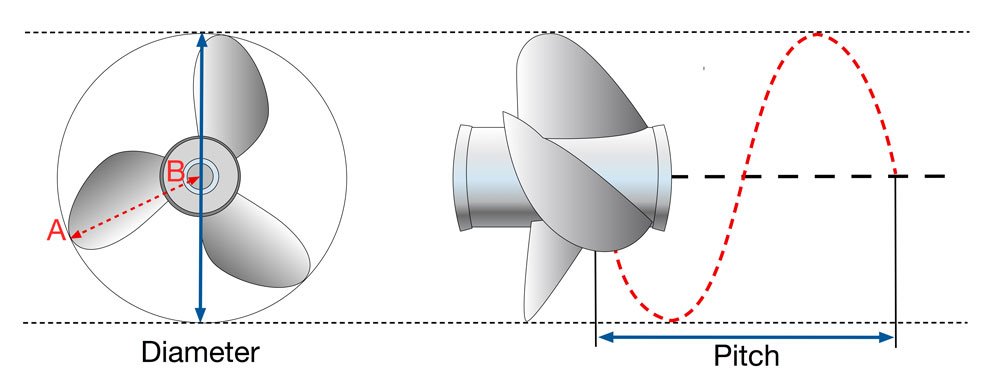
Going back to the screw analogy, if a propeller was screwing its way through a piece of wood, the distance it would move in one revolution is equivalent to the propeller’s pitch, so for example 20cm. The diameter or width of the propeller might be 40cm. Diameter and pitch are the two key dimensions given to describe a propeller and are usually marked on the hub of  a propeller, for example in this case 40 x 20.

Two other factors to be aware of are “advance” and “slip”. Advance refers to the actual distance a propeller moves through one rotation and slip refers to the difference between the pitch and the advance.

Number of blades and folding props

Why the different number of blades? What about props that fold? The quick answers are as follows:

  • Two blade propellers are the best option for sailing boats under 10m in length, giving adequate performance under power and causing less drag through the water when under sail.
  • Three blade propellers give greater thrust than two blades but increase drag. Three blade props are more commonly used for power boats but some larger sailing boats use them. Three blades usually give a slightly better top speed performance than four blades.
  • Four blade propellers tend to be quieter and vibration free. They produce more lift at the stern which can help with acceleration.
  • Folding or feathering props are designed for sailing boats and minimise drag when the boat is under sail. These are very effective but a lot more expensive than standard propellers.
  • Boat type, engine power, displacement and desired boat speed are all factored in when choosing the exact type and specification of propeller.
Antifouling for leisure boats – Part 2

To prepare for antifouling, as soon as your boat has been lifted out and pressure washed, you need to check all the surfaces of the hull below the waterline, remove any remaining barnacles and check for blisters.

Tools and spares for your boat

Tools and Spares to take to sea!

You won’t regret taking a look at our essential tips and checklist to make sure you’re prepared for routine maintenance and those unexpected jobs that come up whilst you’re afloat!

Understanding tides

If you are used to sailing in tidal waters, you will know that tides can be both a benefit and a hindrance to the sailor. In many ways,...

Boat surveys

A full boat survey assesses the condition of the hull, mechanical gear and means of propulsion. The survey is carried out with the boat...

Essential Knots: Figure of eight

Essential Knots: Figure of eight Use: Stopper knot, prevents a rope from being pulled through a hole e.g. through a block or...

Docking a Motorboat

Docking a motorboat can be a challenging task, especially for beginners, but with practice and attention to detail, it becomes much easier. Here’s a step-by-step guide to help you dock your motorboat safely and efficiently.

Marine engine oil system maintenance

The regular maintenance of a marine diesel is key to preventing engine failure at sea. This means doing regular checks of the fuel, cooling, electrical and oil systems.

VHF DSC radio – how best to communicate at sea

There are many ways to communicate with others at sea. What makes the VHF DSC radio the best form of short range...

Sailing & Motoring in Fog

Sailing & Motoring in Fog You can only measure the visibility accurately if sailing & motoring in fog when you have...

Understanding your boat’s compass

Article submitted by Mike Rossiter, Certificated Compass Adjuster. Since the magnetic compass was first used by the Chinese...

How to read nautical charts

Whilst most sailors today rely on GPS to find their way at sea, nautical charts are a crucial tool for any sailor to navigate safely and effectively. Here is a reminder of some of the basic steps involved in reading a nautical chart:

Right boat vs Wrong boat – Over 30 Ways to Cut the Cost of Your Sailing and Cruising

Sailing and cruising offer unparalleled freedom and adventure, but they can quickly become costly. Fortunately, there are numerous strategies to help you enjoy the open water without breaking the bank. Here are over 30 practical ways to cut your sailing and cruising costs.

Sail care and maintenance – Part 1

When thinking about the care, maintenance and repair of sails it helps to have some understanding of the properties of the ever growing range of modern sailcloth and the fibres they are made from, as opposed to the traditional canvas sails of the past.

Safety at sea principles

Safety at sea is not as simple as just spending money adding shiny new emergency equipment such as liferafts, danbuoys, distress flares, EPIRBs and so on.

Gybing a sailing boat

Gybing is the sailing manoeuvre used to change a boat's direction through a following wind. As with the tacking manoeuvre,...

Boat Engine Failure – what to check

Engine failure If your engine fails or is overheating there are a number of things to check immediately: • Air filter...

Safety Briefings – leave nothing to chance

Before giving your crew a safety briefing, it is worth considering the specific circumstances of the planned trip, the...

Fire safety advice at sea from the Marine & Coastguard Agency

Fire safety advice for boaters Top fire safety advice at sea: 1. Fit smoke alarms, carbon monoxide and gas detectors 2. Turn...

Understanding tide tables and tidal curves

There are many factors that influence local tidal patterns and it’s essential for every sailor to have a good understanding of tide tables and tidal charts to ensure they can calculate the level of tide at any given time.

ColRegs Rule 14 – Head-on Situation

  ColRegs Rule 14: Head-on Situation (a) When two power-driven vessels are meeting on reciprocal or nearly reciprocal...

Learn ColRegs: Traffic Separation Schemes

Learn ColRegs Rule 10: Traffic Separation Schemes. (c) A vessel shall, so far as practicable, avoid crossing traffic lanes...

Marine toilets – care and maintenance

There are a number of different types of marine toilet, or heads. They fall into one of three categories – manual, electric and vacuum, the most common being the manual, hand pumped type. These have double acting piston-pumps which both discharge the waste and flush the toilet with sea water.

How to use tides and currents to your advantage

If you are contemplating a cruise through tidal waters and strong currents, then planning your trip carefully in advance is essential to enable you to take advantage of favourable tides rather than constantly fighting against them.

Steel hull maintenance

A steel boat owner’s biggest enemy is corrosion. You don’t have to worry about osmosis or rotting timbers, instead rust is the number one issue that will keep you awake at night.

Fractures, sprains and dislocations at sea

Moving about a boat at sea often results in a few knocks and bruises, but if a crew member has a fall or major bump and is in serious pain, they should be examined and treated accordingly.