Select Page

Simon Jollands took part in the 2023 Rolex Fastnet Race. This is the second of his articles on the race aboard Lancelot II, a Beneteau First 40.

The first night of the 2023 Rolex Fastnet Race proved to be a major challenge for the fleet, including us. Many yachts sought shelter after encountering 40+ knot winds and confused seas at the Hurst Narrows that intensified down the Needles channel. A trio of French offshore racing legends were among a group that returned to Cowes: Marc Guillemot’s WellnessTraining/MG5, Roland Jourdain’s Outremer 59 We Explore and the Fife classic Moonbeam on which round the world record breaker and former Vendée Globe race director Jacques Caraes was skipper. Michael Orgzey’s Swan 48’s Dantes anchored in Osborne Bay east of Cowes, others chose Newtown Creek, with an additional 13 yachts in Yarmouth. Having braved Poole Bay, four were in Poole Harbour; five in Studland Bay, one in Swanage, three in Weymouth and 15 in Portland Harbour. The majority resumed sailing the next day as the conditions improved.

Rolex Fastnet Race 2023

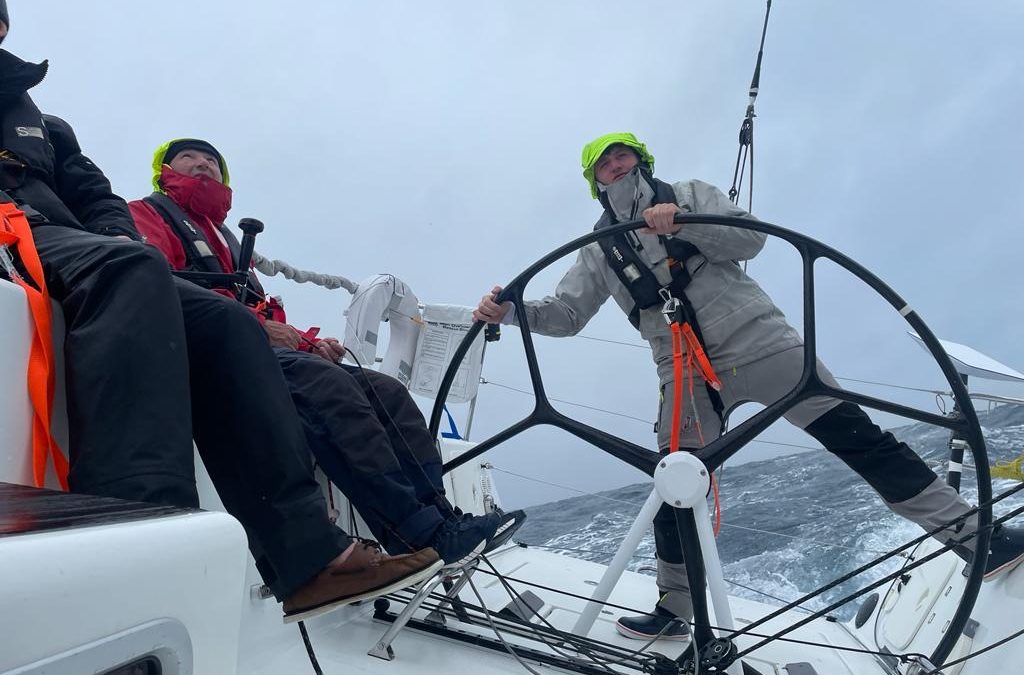
Our skipper John Gillard made the wise decision of avoiding a brutal beat down the Needles Channel and instead opted to head further north into Christchurch Bay. The sea state was rough but hopefully not as severe as at the Needles, where there tends to be a funnelling effect in wind against tide conditions. Lancelot II was going along like a bucking bronco and everyone was hanging on with safety harnesses attached when on deck. By going the northern channel route we would also have the option to shelter in Poole Harbour should the conditions continue to worsen through the night. We received news that several of the other Beneteau First 40s taking part had retired so we knew that keeping safe was the top priority.

Watch keeping

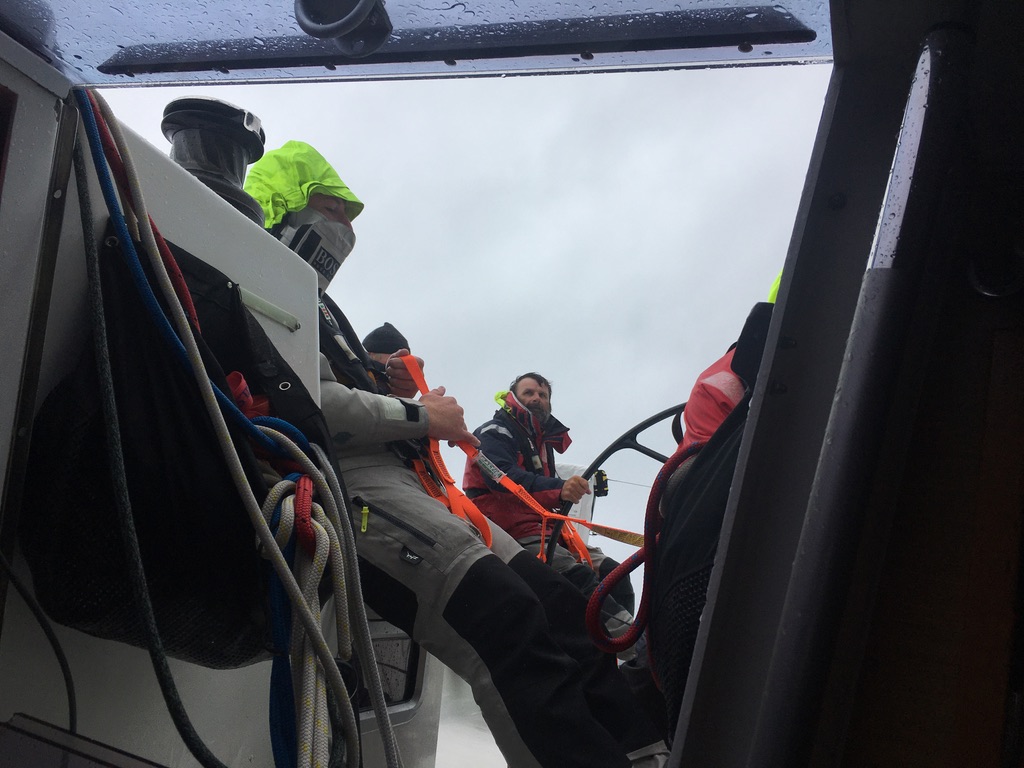
With nine crew on board, John divided us into two watches of four, leaving him to spend time with both watches while allowing himself short naps and occasional longer longer rests over the coming days. Each watch did three hours on and three hours off during the nights, followed by a four hour watch during daylight to stagger the 24 hour pattern. In theory this was fine, but sleeping down below during the rough weather was not at all easy. It takes a couple of days to adjust being at sea during the best of times. Most of us chose to sleep in our foul weather gear during the stormy weather as wet gear takes ages to get on and off, especially in the bouncy conditions.
Rolex Fastnet Race 2023

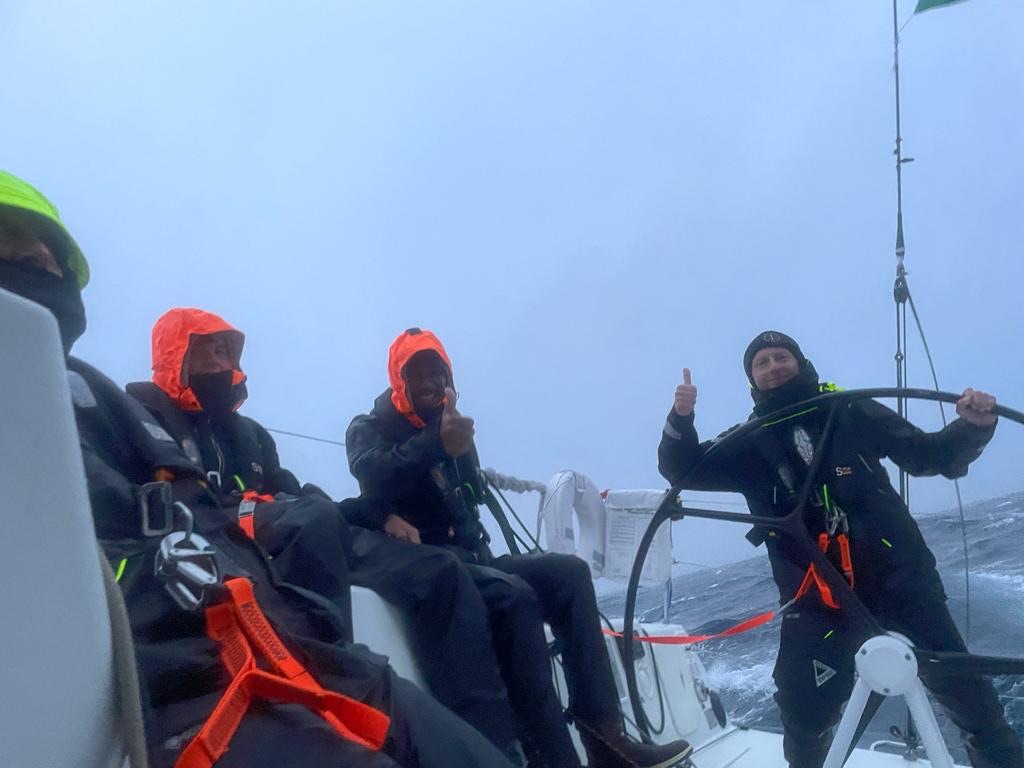
We all took turns at the various tasks involved in keeping Lancelot II moving as efficiently as possible from sail trimming, helming, keeping a lookout, making tea, cooking (when the weather improved), as well as group tasks such as sail changing. Crew morale was excellent, despite half of us being seasick during the first couple of days. Yes, this did interfere with but never entirely dampened our high spirits – after all we were racing in the Fastnet and knew this was never intended to be a pleasure cruise.

Rolex Fastnet Race 2023

ROGAN JOSH, Skipper: Richard Powell, Class: IRC 1, Sail No: GBR1428R, LOA: “12, 24”, Design: Beneteau First 40, County/State: UK

Rolex Fastnet Race 2023

BULLDOG, Skipper: Derek Shakespeare, Class: IRC 1, Sail No: GBR942R, LOA: “12, 19”, Design: J/122, County/State: UK

Navigating the English Channel

The Fastnet Race is tactically demanding for navigators. There are multiple tidal gates to contend with as well as the unpredictable weather patterns found both in the English Channel and Celtic Sea, all of which keep the navigators on their toes.
Rolex Fastnet Race 2023

Once into the Channel, the first tidal gate to be aware of is Portland Bill off the Dorset coast. The Bill is notorious for its strong tidal race and is about 50 NM west southwest of Cowes, as the crow flies. With a favourable tide you can remain inshore and be swept along in the right direction but if the tide is against you it is a different story. We encountered problems at Portland as the wind dropped off quite dramatically as we approached it – the tides were against us too. We headed further out to sea to avoid the tidal race and had to contend with wind shifts which all resulted in us heading backwards for a while.

Rolex Fastnet Race 2023

The second tidal gate is off Start Point, a further 50 NM west of Portland Bill. Start Point is the most southerly point of the Devon coast which we passed just over 24 hours after the start. We felt reassured that we were still very much in the race, keeping a watchful eye on the fleet tracker. The boat was going well and the crew were in excellent spirits.

At 07:00 on 24 July we rounded the Lizard, the rocky, southernmost point of the British mainland and site of many maritime disasters. It was a fabulous morning and we were sailing at 7 to 8 knots in the right direction.  Later that morning we had Land’s End in sight, less than 48 hours after leaving Cowes, a straight line distance of 180 NM; our tracks showed significantly more than that (see the official record of our track in the graphic).

Rolex Fastnet Race 2023

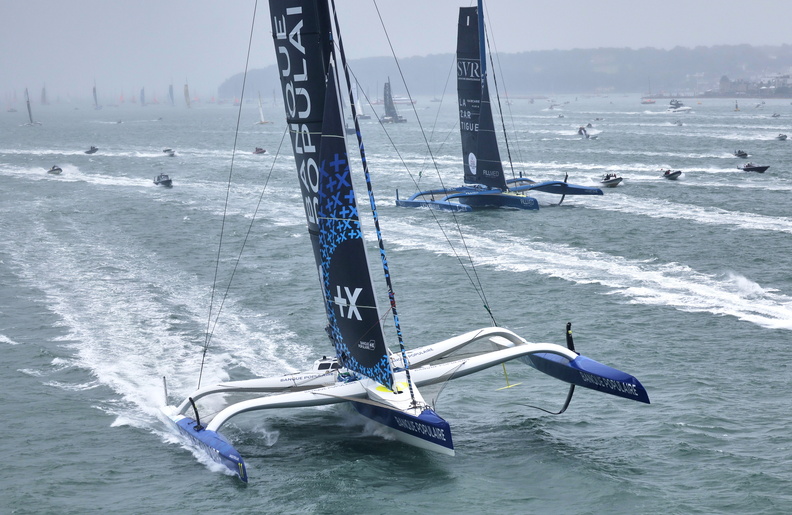
At this stage of our race, it felt like we had been making excellent progress. Then we discovered that François Gabart and his team, racing the giant 32m long flying trimaran SVR Lazartigue, had already crossed the finish line of the 50th anniversary Rolex Fastnet Race, winning the Ultim class. SVR Lazartigue set a new record of 1 day 8 hours 38 minutes 27 seconds, breaking the time set by Franck Cammas and Charles Caudrelier on Maxi Groupe Edmond de Rothschild two years ago by 36 minutes 27 seconds.

Rolex Fastnet Race 2023

Francois Gabart

The 32m long by 23m wide, foil-borne, flying Ultim trimarans are by far the biggest, fastest offshore race boats on the planet. Many believe that their covering 1000 miles in a day is a case of ‘not if, but when.’ Inevitably they are sailed by the best of the best offshore sailors: Gabart and Le Cléac’h, for example, are both Vendée Globe winners (2012 and 2016) respectively. To help put this remarkable achievement in perspective we were still in the English Channel somewhere between Plymouth and Falmouth when Gabart crossed the line.

We still had a very long way to go.
Rolex Fastnet Race 2023

BANQUE POPULAIRE, Skipper: Armel Le Cléac’h, Class: Ultim 32/23 , Sail No: FRA11, LOA: 32, Design: Ultim, County/State: FRANCE SVR LAZARTIGUE, Skipper: François Gabart, Class: Ultim 32/23 , Sail No: 1, LOA: 32, Design: Ultim, County/State: FRANCE

Boat Improvements

My Boat - practical improvements Author - Mike Rossiter Most boat owners who have had their craft for any length of time will have made what they...

Always have an emergency ditch bag ready to go…

An emergency ditch bag (also known as a grab bag, abandon ship bag, or go-bag) is a crucial piece of safety equipment for any vessel venturing out...

Seized fixings and fastenings

Maintaining a boat can be a rewarding experience but at times it can also be frustrating. A prime example of this is when you come across a seized fixing or fastening that refuses to budge. Read our tips on how to release and fix them:

Sail care and maintenance – Part 2

At the end of the sailing season sails should be washed and inspected carefully for damage, including small tears, stitching failure, ultraviolet damage, stains and mildew.

Estimating your position at sea

Navigators use a combination of techniques to estimate their position at sea. The primary method used today is GPS (Global Positioning System), a network of 24 satellites that became fully operational in the 1990s and was originally restricted for use by the United States military.

Boatyard Health and Safety

Boat storage facilities are potentially hazardous environments and it is the responsibility of both boat owners and boatyards to ensure that the...

Boat plumbing maintenance & troubleshooting

A boat’s fresh water system needs annual maintenance to keep it in good condition. Some boats have far more complex systems than others, with pressurised hot and cold water, associated pumps, an accumulator, calorifier and pressure valves, all to keep a boat owner busy.

2023 Rolex Fastnet Race

Safe Skipper’s Simon Jollands took part in the 2023 Rolex Fastnet Race – a classic offshore sailing event. This is the first of several articles on the race and focuses on the start.

Understanding tides

If you are used to sailing in tidal waters, you will know that tides can be both a benefit and a hindrance to the sailor. In many ways,...

Navigation safety: a quick-reference mobile app to learn the ColRegs NavLights and Shapes

 Safety at SeaSafety at sea will always remains a topical and important subject that will no doubt dominate the syllabuses of nautical...

Crew Overboard Drill – Updated

How to respond to crew overboard A Man Overboard (MOB) drill is a crucial safety procedure that every boater should practice regularly. It simulates...

Sailing into a storm

Weather forecasting has become increasingly accurate, but despite this, I was caught out recently by a forecast that considerably underestimated the wind strengths and consequently was sailing single handed in to a Force 8 gale, which proved to be challenging!

Pleasure craft safety equipment recommendations

Safety equipment is an important part of boat preparation and it is advisable for all pleasure craft skippers to check their vessel is...

Jester Challenge 2022 – Sailing single handed from Plymouth UK to the Azores: Part 3 – Preparations

Jester Challenge – A modern experiment in old-fashioned self-reliance, self sufficiency, and personal responsibility. This is the third of a 10-part post where solo sailor, Bernie Branfield, shares his first hand account of his single-handed, 2022 Jester Challenge, from Plymouth, UK to the Azores, in his 26′ Invicta Mk2, Louisa.

Narrowboating on the Kennet and Avon Canal

A recently cancelled sailing event I was due to take part in left us with a free weekend in the diary. Given that my wife and I were celebrating a bumper wedding anniversary and the weather forecast was for fine weather, we decided to hunt around for a last minute canal holiday.

Anchoring – getting it right

If you can set an anchor correctly with confidence and know your boat will be safe in a secure anchorage, then you can rest in comfort and will not...

Tidal heights and the rule of twelfths

For those skippers who need to make a quick calculation or don’t have access to specific tidal curves for their location, it is possible to make an approximation using a system called the Rule of Twelfths. This is a simple method used to estimate the height of tide at any given time during the tidal cycle. It is based on the idea that the rise and fall of the tide is not constant, but follows a predictable pattern than can be divided into twelve parts.

ColRegs Nav Lights & Shapes, Rules Of The Road and IALA Buoys Apps

ColRegs Nav Lights & Shapes, Rules Of The Road and IALA Buoys Apps Make Learning Rules on iPhone, iPad, iPod and Android...

Safe Skipper – crew management tips

Effective crew briefings are a vital part of the good on-board communication that helps everything to run smoothly on a sailing vessel at sea, whether it is cruising or racing.

Essential Boat Spares for Safety

  Boats Spares Tool kit What you carry in the boats tool kit will be useful for many boat repairs, but you might want...

2023 Rolex Fastnet Race – Part 3

This is our third and final article about the 2023 Rolex Fastnet Race. It is a first hand account by Simon Jollands who was one of the crew of Lancelot II, a Beneteau First 40 skippered by John Gillard.

Liferafts

Liferafts should be stowed where they are ready for immediate launching. All crew should know the location of the liferaft and know how to launch, inflate and board it. They should also know what equipment it contains.

Sending distress signals

In an emergency situation at sea, it is a top priority is to know how to send and receive emergency radio calls and alert others of your predicament. Likewise, if you receive a distress signal, you must be ready to go to the help of others.

Top Tips For Learning: ColRegs Boating Rules Of The Road

Colregs Boating Rules Of The Road
The International Regulations for Preventing Collisions at Sea (COLREGs) are a set of rules designed to prevent collisions between vessels. They are essentially the “rules of the road” for boats. Some key concepts within the COLREGs include:

ColRegs when sailing single handed

  Don’t neglect the Colregs when sailing single handed Sailing single-handed represents several challenges for skippers, not least how to...