Select Page

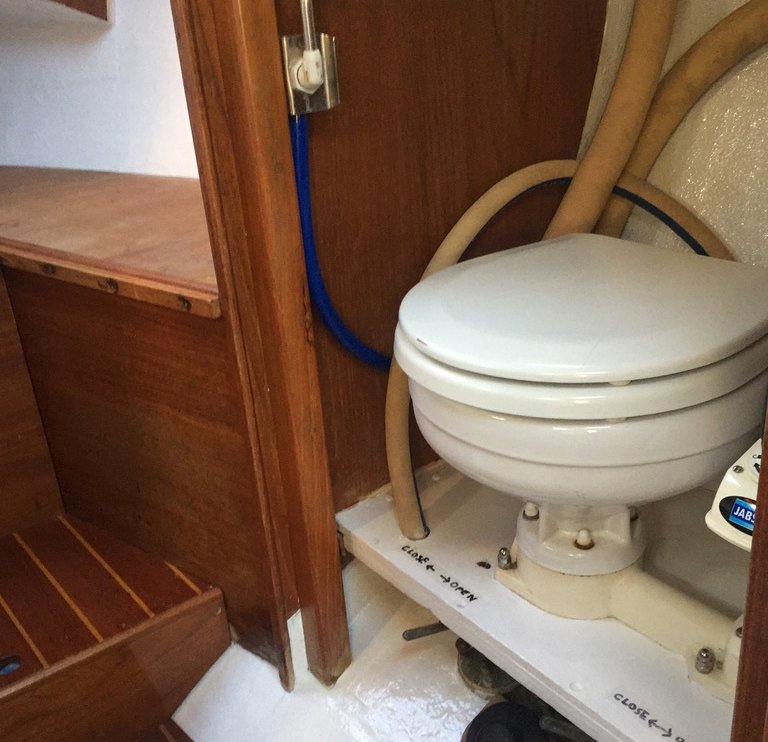
There are a number of different types of marine toilet, or heads. They fall into one of three categories – manual, electric and vacuum, the most common being the manual, hand pumped type. These have double acting piston-pumps which both discharge the waste and flush the toilet with sea water.

Marine toilets have an inlet hose and outlet hose connected to seacocks, which need regular servicing. Toilets below the waterline must have a vented loop fitting to prevent water from being siphoned into the boat via a leaking inlet valve. The vented loop should be fitted above the level of the waterline according to manufacturer’s instructions. Allowance should be made for sailing boats where angle of heel which will change the level of the waterline.

The main issues that cause problems with the heads through the boating season are scale deposits, blockage and unpleasant odours.

Scale deposits

A build up of scale deposits in the hoses and toilet system cause the heads to become harder and harder to flush and the valves no longer function either. I have found the easiest way to avoid this happening is to flush the system with white vinegar from time to time. The vinegar dissolves the scale and will keep the problem under control.

One technique used is to remove the clogged pipes from the boat when it is in the boatyard and bash them against a wall or hard surface, which breaks down the calcium and this then falls out of the pipe.

Blockage

At some time or other most boat owners have had to deal with a marine toilet blockage or malfunction which they would rather forget about. This is seldom the fault of the system but more often than not is because an object other than human waste has been put in the toilet. Clear instructions need to be given to all those who come aboard how to use a marine toilet and these instructions should be provided in the heads also, to remind users and avoid embarrassment. Keeping a small waste bin in the heads is also advised.

Clearing a blockage in a manual toilet is done as follows:

  • Close both seacocks. Repeat, close both seacocks.
  • Follow instructions for servicing the pump.
  • Remove the pump and non-return valve in the discharge pipe, which will cause a leakage, so be ready with a bucket and sponge.
  • Clear any debris between the bowl and the non-return valve.
  • Check the pump for any debris.
  • If no debris has been found, the problem lies in the pipework to the seacock or holding tank if fitted.
Bad odours

The main source of bad odours comes from anaerobic bacteria which break down sewage. These bacteria do not need oxygen to live while aerobic bacteria, which also break down raw sewage, do. Keeping the system aerated is therefore desirable as non smelly aerobic bacteria will thrive. This can be done by ensuring holding tanks have proper air vents fitted and that stagnant effluent is not allowed to remain trapped in hoses. Chemical treatments are available as are fresh water flush systems.

Poor quality outlet hoses that are not of a recommended sanitary grade should not be fitted to a toilet system as odours can find their way through the piping, even if liquid does not. To check if a hose is the culprit, the easiest way to do this is to rub a clean cloth along it and then smell the cloth. The remedy here is to replace such permeable hoses with the correct grade, which may be expensive but necessary. If your boat does not have sanitary grade piping then this might be a boatyard job worth considering.

Leaks are another cause of bad smells, so it is worth keeping a check of all the joints in the sanitary system through the season, as the smallest leak will need to be dealt with.

Other causes of bad smells come from rotting organic matter such as seaweed and small marine organisms becoming trapped in the water inlet system or even in the toilet itself. One remedy for this is to fit a raw water strainer, similar to the strainers used for engines. Another is to get into the habit of doing fresh water flushes of the heads which entails closing the seacocks and connecting to fresh water in order to do so.

Winterisation

Marine toilets should be drained completely, both as protection against frost damage and to prevent anaerobic bacteria from growing in the pipework which causes unpleasant smells. Follow the manufacturer’s instructions on how to drain the system ashore, which typically include the following steps:

  • Open any secondary valves.
  • Remove the base drain plug.
  • Disconnect the discharge flange from the pump.
  • Loosen hose clips and disconnect the hose end from both seacock hose tails. Pump the handle to drain the toilet pump and ensure all water is drained from the toilet system.

Note: the use of anti-freeze is not recommended as it is impossible to ensure that it penetrates the complete toilet system. If it is used, it must be glycol based.

Marine sea Toilet

Servicing

Servicing the heads or replacing worn parts is not too horrendous a job when done ashore. Service kits and replacement parts are readily available and comparatively easy to instal – though with boats we all know that is easier said than done.

Manual heads have a pump with a system of valves and seals which need replacing periodically as they become worn or damaged by calcification. When this happens they begin to leak. A service every year or two, depending on usage, is advisable and service kits are available. Make sure you have the correct service kit for your model of toilet together with the manufacturer’s instructions. Here is a very abbreviated list of instructions to give an idea of what is involved:

  • Remove the pump assembly.
  • Dismantle the pump assembly.
  • Clean and disinfect all parts.
  • Remove scale.
  • Replace the piston O-ring and pump seals.
  • Replace top and bottom valve gaskets and the joker valve, unless in perfect condition.
  • Reassemble the pump, lubricating the cylinder bore with petroleum jelly.
  • Vent loop valves can sometimes become blocked by salt crystals in the line. It is therefore a good idea to unscrew the valve and wash it in warm water.

The give-way hierarchy – sail boats and power boats

Who gives way to who at sea? Even seasoned sailors sometimes get this wrong and in a crowded harbour this can easily lead to a collision or at best considerable embarrassment for a boat that mistakenly thinks it has right of way over another.

How to Avoid Collisions At Sea With The ColRegs

      Every Skipper Needs Accurate Knowledge of the IRPCS ColRegs As a responsible skipper it is every skipper’s duty to learn and apply the IRPCS...

Preparing for sailboat cruising

Preparing for a sailing trip entails a lot of planning. In this blog, we take a look at some of the many safety aspects that a skipper needs to consider before heading off on a cruise.

Essential Knots: Round turn and two half hitches

Essential Knots: Round turn and two half hitches Use: Tying a rope to a pole or a ring. Step 1. Pass the end around the object. Step 2....

Jester Challenge 2022 – Sailing single handed from Plymouth UK to the Azores: Part 7 – Motivation

Jester Challenge – A modern experiment in old-fashioned self-reliance, self sufficiency, and personal responsibility. This is the seventh of a 10-part post where solo sailor, Bernie Branfield, shares his first-hand account of his single-handed, 2022 Jester Challenge, from Plymouth, UK to the Azores, in his 26′ Invicta Mk2, Louisa.

Cleaning & polishing painted topsides

The gelcoat topsides of a GRP boat can be pampered and restored to their former glory relatively easily when it is ashore. Gelcoat is only a very thin outer layer of the hull, often less than 1mm thick, so you should avoid cleaning it with highly abrasive cleaners, or an-ything that could potentially damage its surface.

Finding your way at sea: waypoints

Any sea voyage needs a certain amount of planning before it is undertaken. It makes sense to think about where you are going, how you will get there and what factors might influence your plan. Planning the route itself is also critical. One of the essential parts of modern navigation is the use of waypoints.

Jester Challenge 2022 – Sailing single handed from Plymouth UK to the Azores: Part 3 – Preparations

Jester Challenge – A modern experiment in old-fashioned self-reliance, self sufficiency, and personal responsibility. This is the third of a 10-part post where solo sailor, Bernie Branfield, shares his first hand account of his single-handed, 2022 Jester Challenge, from Plymouth, UK to the Azores, in his 26′ Invicta Mk2, Louisa.

Estimating your position at sea

Navigators use a combination of techniques to estimate their position at sea. The primary method used today is GPS (Global Positioning System), a network of 24 satellites that became fully operational in the 1990s and was originally restricted for use by the United States military.

How to operate a winch

Winches are drum shaped mechanical devices used to handle halyards, sheets and control lines. One of the important crew...

Liferafts

Liferafts should be stowed where they are ready for immediate launching. All crew should know the location of the liferaft and know how to launch, inflate and board it. They should also know what equipment it contains.

How to use tides and currents to your advantage

If you are contemplating a cruise through tidal waters and strong currents, then planning your trip carefully in advance is essential to enable you to take advantage of favourable tides rather than constantly fighting against them.

Antifouling for leisure boats – Part 1

Boats that are kept afloat can very quickly become a home for small marine organisms such as barnacles, weed and slime. Applying an antifouling paint to your hull is necessary to protect it from these micro-organisms, as a fouled hull can cause problems and will slow down a boat’s maximum speed considerably if left unchecked.

Boat maintenance below decks

While most interior maintenance work can be done when a boat is afloat, some jobs such as servicing the seacocks have to be done ashore. It makes sense to do any major interior repairs and improvements with the boat hauled out in the boatyard.

Rig check – how to prevent failure at sea

Regular rig checks prevent the risk of mast and rigging failure at sea. This includes regular rig inspections of the spars, ...

Understanding your boat’s compass

Article submitted by Mike Rossiter, Certificated Compass Adjuster. Since the magnetic compass was first used by the Chinese...

Boat engine cooling systems

Some boat engine breakdowns are unavoidable but those caused by lack of maintenance or regular checks can be avoided. Failure to maintain an engine’s cooling system is a well known example of this, so it is well worth spending time checking over the cooling system both when the boat is ashore and afloat.

Navigating the Unknown: Boating in Limited Visibility

Sailing or Motor Boating in limited visibility, whether due to darkness, fog, or other adverse weather conditions, presents unique challenges for mariners. It requires a combination of skill, experience, and adherence to safety protocols to ensure a safe and enjoyable journey. In this article we will delve into the intricacies of sailing in such conditions, providing insights into preparation, navigation, and collision avoidance.

Navigating narrow channels

Navigating narrow channels can present challenges for boat operators due to limited space, restricted manoeuvrability, and potential hazards such as shallows, rocks, or other vessels. To ensure safe passage through narrow channels, it’s essential to follow specific strategies and techniques.

Boat ownership

Owning a boat is a big commitment that should bring no end of satisfaction for the owner as well as the owner's family and friends. In...

ColRegs Nav Lights & Shapes, Rules Of The Road and IALA Buoys Apps

ColRegs Nav Lights & Shapes, Rules Of The Road and IALA Buoys Apps Make Learning Rules on iPhone, iPad, iPod and Android...

Weather forecasting resources and tips

All competent sailors need to have a good basic understanding of how to interpret a weather forecast. They also need to be able to interpret the actual conditions they are experiencing.

Sending distress signals

In an emergency situation at sea, it is a top priority is to know how to send and receive emergency radio calls and alert others of your predicament. Likewise, if you receive a distress signal, you must be ready to go to the help of others.

Going aground – what to do if it happens to you

When a yacht runs aground, it can be a stressful situation, especially on a falling tide in an exposed position with a swell running. There are several steps you can take to address the situation in order to ensure the safety of your vessel and its occupants. Here are some tips should this happen to you.

Marine diesel exhaust checks

You should inspect the exhaust system for corrosion damage regularly, especially around the injection bend. If you have noticed the engine exhaust smoking a lot during the sailing season this can also indicate a number of potential problems.