Select Page

Boating Rules of the Road - International ColRegs

Boating Rules of the Road – International ColRegs


International ColRegs Rule 7: Risk of Collision

Anyone who is responsible for a vessel at sea, from the smallest dinghy to an ocean going supertanker, must be able to recognise other vessels around them day or night, whatever the visibility.

They need to be able to quickly interpret what other vessels are doing, who has right of way and what action they should take to prevent a possible collision. This is not always easy, especially in crowded coastal waters and harbor.

Rule 7: Risk of Collision.

(a) Every vessel shall use all available means appropriate to the prevailing circumstances and conditions to determine if risk of collision exists. If there is any doubt such risk shall be deemed to exist.
(b) Proper use shall be made of radar equipment if fitted and operational, including long-range scanning to obtain early warning of risk of collision and radar plotting or equivalent systematic observation of detected objects.
(c) Assumptions shall not be made on the basis of scanty information, especially scanty radar information.
(d) In determining if risk of collision exists the following considerations shall be among those taken into account:
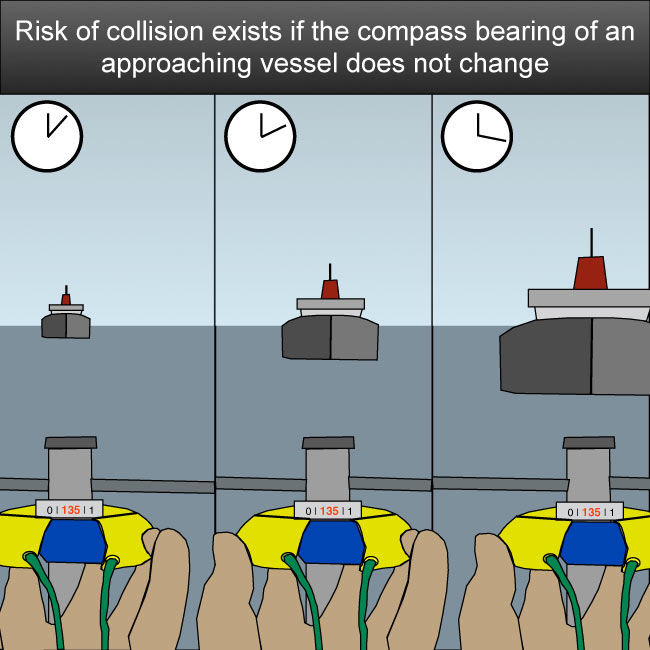
(i) such risk shall be deemed to exist if the compass bearing of an approaching vessel does not appreciably change;
(ii) such risk may sometimes exist even when an appreciable bearing change is evident, particularly when approaching a very large vessel or a tow or when approaching a vessel at close range.

Check out Boating Rules of the Road app for iPhone & Android for a great easy way to keep the rules handy when you’re out on the water.

2023 Rolex Fastnet Race – Part 3

This is our third and final article about the 2023 Rolex Fastnet Race. It is a first hand account by Simon Jollands who was one of the crew of Lancelot II, a Beneteau First 40 skippered by John Gillard.

Peer to Peer yacht charter – How can you monetize your boat?

There is a growing trend in peer to peer yacht charter. How does it work? People already rent rooms, cars and bikes from one...

Tacking a sailing boat

Tacking is the sailing manoeuvre used to change a boat's direction through an oncoming wind. Tacking a sailing boat calls for the crew to work as a...

Leaking decks

Leaking decks are perceived as a nuisance by some boat owners, but if leaks are ignored a much more serious situation may well be developing, especially in the case of boats with balsa or plywood deck cores. So deck leaks do need to be investigated and dealt with.

Sailing & Motoring in Fog

Sailing & Motoring in Fog You can only measure the visibility accurately if sailing & motoring in fog when you have...

Understanding your boat’s compass

Article submitted by Mike Rossiter, Certificated Compass Adjuster. Since the magnetic compass was first used by the Chinese...

Is Boating Good for Your Health and Happiness?

Absolutely! Boating offers a wealth of benefits for both your physical and mental well-being, making it a fantastic activity for overall health and...

You Need To Understand The IRPCS ColRegs To Pass Your Yachtmaster, Master of Yachts and Coxswain Certificate of Competence

IRPCS ColRegs Rules of the Road at Sea and Yachtmaster Learning, understanding and remembering the International Regulations...

Care of boat batteries

Boat batteries need to be kept properly charged, which means never allowing the batteries to discharge below 50 per cent of their total charge. As well as the batteries themselves, keeping a boat’s charging systems in good shape will also help to keep batteries topped up to a higher level of charge.

Boat Engine Failure – what to check

Engine failure If your engine fails or is overheating there are a number of things to check immediately: • Air filter...

ColRegs Nav Lights & Shapes, Rules Of The Road and IALA Buoys Apps

ColRegs Nav Lights & Shapes, Rules Of The Road and IALA Buoys Apps Make Learning Rules on iPhone, iPad, iPod and Android...

Boat maintenance below decks

While most interior maintenance work can be done when a boat is afloat, some jobs such as servicing the seacocks have to be done ashore. It makes sense to do any major interior repairs and improvements with the boat hauled out in the boatyard.

How diesel engines work

The basic principle of a diesel engine is less complex than that of a petrol engine. No spark plug or ignition system is needed, making the basic diesel engine a comparatively straightforward system that results in fewer faults and has lower maintenance costs than a petrol engine.

Common medical emergencies at sea

A medical emergency aboard a boat at sea requires immediate attention to ensure the safety of the casualty and the crew in general. The skipper needs to know which crew members, if any, have had medical training or have a first aid qualification. All boats should carry first aid handbooks to help an untrained crew cope with a medical emergency.

ColRegs when sailing single handed

  Don’t neglect the Colregs when sailing single handed Sailing single-handed represents several challenges for skippers, not least how to...

Essential Knots: Reef knot

Essential Knots: Reef knot Use: Tying two ends of rope together, often used for tying up a bundle of loose sail around the boom. Step...

Sector lights, directional lights, leading lights – how do they differ?

Sector lights, directional lights and leading lights guide vessels safely through hazardous waters or narrow channels at...

Weather forecasting resources and tips

All competent sailors need to have a good basic understanding of how to interpret a weather forecast. They also need to be able to interpret the actual conditions they are experiencing.

Keeping boat records and doing checks

A boat’s records should provide information about maintenance schedules, when major work was done and when equipment was replaced or added to the boat. Without this information you are left guessing when things are likely to need replacing in the future and also what the costs are likely to be.

Dag Pike’s Boat Survey

We're really pleased to be working with Dag Pike on some great new apps for iPhone & Android. Here'a a bit more about the first app: Dag Pike's...

2023 Rolex Fastnet Race

Safe Skipper’s Simon Jollands took part in the 2023 Rolex Fastnet Race – a classic offshore sailing event. This is the first of several articles on the race and focuses on the start.

Sailing Boat Rig Care

The rig of a sailing boat is put under huge stresses and strains so it is important for inspections of a yacht’s spars and rigging to be carried out at regular intervals.

Fire prevention on boats

  Fire prevention on boats - common causes of fire: • Smoking below decks • Galley cookers • Build-up of butane or...

Jester Challenge 2022 – Sailing single handed from Plymouth UK to the Azores: Part 7 – Motivation

Jester Challenge – A modern experiment in old-fashioned self-reliance, self sufficiency, and personal responsibility. This is the seventh of a 10-part post where solo sailor, Bernie Branfield, shares his first-hand account of his single-handed, 2022 Jester Challenge, from Plymouth, UK to the Azores, in his 26′ Invicta Mk2, Louisa.

ColRegs Rule 14 – Head-on Situation

  ColRegs Rule 14: Head-on Situation (a) When two power-driven vessels are meeting on reciprocal or nearly reciprocal...