Select Page

The two metals used for hull construction are steel and aluminium. These are both very strong materials and will last a long time as long as they are cared for, which primarily means protecting steel boats from rust and aluminium boats from electrolytic action.

Metal boats have a long history dating back 200 years and of course most modern ships are made from steel. It is only in comparatively recent times that steel and aluminium have been used in leisure boat construction. Steel and aluminium are both strong materials and are popular with blue water cruising boats designed for living aboard. Each material has its advantages, but as a rule of thumb aluminium will be favoured by racing skippers as it is much lighter. Steel on the other hand may be heavier but it is a cheaper material, so for those not so concerned about top speed performance, this may be their choice.

Both steel and aluminium boats can be built by competent amateurs. This means that someone with good welding skills can save a lot of cost by buying a boat in kit form and constructing it themselves.

Steel hull construction

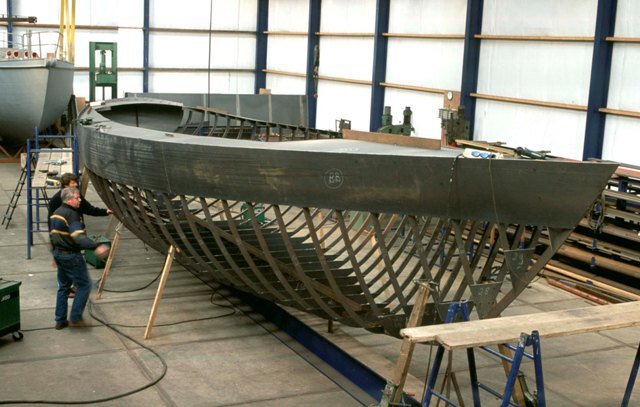
Steel hulls are constructed of a frame with steel plates welded to it. As soon as steel is exposed to the air it begins to rust, where the steel reacts with oxygen to form iron oxide. If seawater is added into the mix then the process accelerates rapidly. Steel boats built before the introduction of epoxy coating systems in the 1980s are more prone to rust and their hulls need to be closely monitored and re-painted frequently. Those with epoxy paint systems tend to be far more resilient, as long as the paintwork is not damaged. If it is, rust will very soon begin to appear.
Aluminium hull construction

Aluminium hulls are constructed in a similar way to steel hulls, but the two metals are quite different from each other. If you leave aluminium exposed to the air it will not rust, which gives it a big advantage over steel. However, aluminium suffers from electrolysis, which is the form of corrosion caused by different metals coming into contact with each other. The tell-tale sign, the equivalent to rust with steel, is a white powder which literally crumbles the aluminium away as you touch it. The two main preventative measures taken by builders of aluminium boats are firstly to ensure that different metals, such as aluminium and stainless steel, are very well insulated from each other and secondly through the use of sacrificial anodes.

If you are interested in purchasing a metal hulled boat or are already an owner of one, then the metal hull inspection checklist below will hopefully be of use to you.

Metal hull inspection

  • Check for any distortion in the hull that might have been caused by an impact or collision.
  • Check the outside of steel hulls for any signs of rust. If the rust is only on the surface it can be rubbed down and treated. If the surface is pitted it indicates a deeper level of corrosion and this will need to be taken back to the bare steel and treated.
  • Check for corrosion around the stern gear and through hull fittings, which could be caused by electrolytic action. Pay particular attention to where the heads through hulls are located as this is a known problem area.
  • Check that the paintwork is in good condition and the surfaces are all sound. Look for any signs of the paint bubbling which could indicate rust is about to break through.
  • Check all the anodes and replace if necessary.
  • Check the inside of the hull for any signs of corrosion, which will most likely entail reaching into inaccessible places using lights, mirrors and cameras. For a thorough hull inspection it helps to know where specific areas of vulnerability are. These include beneath fresh water, black water and fuel tanks. This is not necessarily due to the tanks leaking, but because of the condensation build up in these areas that can lead to pools of water forming. Another obvious place to inspect is the hull areas beneath where the shower or heads and galley are located. Seepage of water can work its way to these inaccessible areas, collecting along the frames with nowhere to go.
  • Look inside all the bilge areas and make sure they are dry. If water is allowed to sit in the bilges of a steel boat it will soon cause problems.
  • Check along the welding that joins the frame to the plating, as this is a common place for rust to start inside the hull.
  • Look carefully at the edges of any timber that is fastened to the steel. Check for signs of rust, as timber is notorious for taking up moisture which works its way between the timber and the steel, which then rusts.

Propeller care and maintenance

Propellers are complicated and repairs should be done by specialists but owners can carry out checks and some routine maintenance themselves when the boat is in the boatyard. A propeller is critical to a boat’s performance, fuel consumption and ride, so it makes sense to keep a propeller in good working order.

ColRegs Nav Lights & Shapes, Rules Of The Road and IALA Buoys Apps

ColRegs Nav Lights & Shapes, Rules Of The Road and IALA Buoys Apps Make Learning Rules on iPhone, iPad, iPod and Android...

Seasickness – how can you prevent it?

Seasickness is a common problem at sea and affects both seasoned sailors and novices. What are the causes and symptoms of seasickness?...

The VHF DSC Radio jargon buster

AIS - Automatic Identification System This system is used by shipping. It allows another vessel or coast station to use...

Jester Challenge 2022 – Sailing single handed from Plymouth UK to the Azores: Part 8 – Arriving at the Azores

Jester Challenge – A modern experiment in old-fashioned self-reliance, self sufficiency, and personal responsibility. This is the eighth of a 10-part post where solo sailor, Bernie Branfield, shares his first-hand account of his single-handed, 2022 Jester Challenge, from Plymouth, UK to the Azores, in his 26′ Invicta Mk2, Louisa.

Fractures, sprains and dislocations at sea

Moving about a boat at sea often results in a few knocks and bruises, but if a crew member has a fall or major bump and is in serious pain, they should be examined and treated accordingly.

Essential Knots: Figure of eight

Essential Knots: Figure of eight Use: Stopper knot, prevents a rope from being pulled through a hole e.g. through a block or...

Understanding tide tables and tidal curves

There are many factors that influence local tidal patterns and it’s essential for every sailor to have a good understanding of tide tables and tidal charts to ensure they can calculate the level of tide at any given time.

Learn ColRegs: Traffic Separation Schemes

Learn ColRegs Rule 10: Traffic Separation Schemes. (c) A vessel shall, so far as practicable, avoid crossing traffic lanes...

Understanding your boat’s compass

Article submitted by Mike Rossiter, Certificated Compass Adjuster. Since the magnetic compass was first used by the Chinese...

Boat engine basics

Boat engines come in all shapes and sizes and include inboards, outboards, petrol, diesel, electric and hybrid systems. Some engines are...

Sector lights, directional lights, leading lights – how do they differ?

Sector lights, directional lights and leading lights guide vessels safely through hazardous waters or narrow channels at...

Nautical paper charts – a reminder of the basics

The nautical chart is an indispensable tool for navigation. A chart is a graphic representation of an area of the sea which might also include coastlines, estuaries and islands. All cruising leisure boats should carry up-to-date paper charts.

2023 Rolex Fastnet Race

Safe Skipper’s Simon Jollands took part in the 2023 Rolex Fastnet Race – a classic offshore sailing event. This is the first of several articles on the race and focuses on the start.

Sail care and maintenance – Part 2

At the end of the sailing season sails should be washed and inspected carefully for damage, including small tears, stitching failure, ultraviolet damage, stains and mildew.

Sailing at the touch of a button

Easier and more controlled sail handling can also be achieved by powering up a furling mast. I came across some interesting solutions at the Southampton Boat Show this week on the Selden Mast stand, where they were running demos of their E40i electric winch and SMF furling system.

Sailboat rig checks – Part 2

In part two of Sail boat rig checks we run through some useful rig maintenance tips and then finish with a brief look at what a professional rig check involves.

Sailing Boat Rig Care

The rig of a sailing boat is put under huge stresses and strains so it is important for inspections of a yacht’s spars and rigging to be carried out at regular intervals.

Boat interior inspection and checks

While a boat is ashore, the most critical interior checks to carry out are those that concern the safety of the boat. This entails the integrity of all through-hull fittings and seacocks, the gas system and the electrical system.

Top five windvane self steering installation questions

Top five windvane self steering installation questions answered by Sarah Curry of Hydrovane International Marine, courtesy of Viki Moore from Island Cruising NZ

Jester Challenge 2022 – Sailing single handed from Plymouth UK to the Azores: Part 3 – Preparations

Jester Challenge – A modern experiment in old-fashioned self-reliance, self sufficiency, and personal responsibility. This is the third of a 10-part post where solo sailor, Bernie Branfield, shares his first hand account of his single-handed, 2022 Jester Challenge, from Plymouth, UK to the Azores, in his 26′ Invicta Mk2, Louisa.

Repairing chips and dings in gelcoat

The gelcoat topsides of a GRP boat can be pampered and restored to their former glory relatively easily when it is ashore. Gelcoat is only a very thin outer layer of the hull, often less than 1mm thick, so you should avoid cleaning it with highly abrasive cleaners, or an-ything that could potentially damage its surface.

Marine engine electrical system

The typical basic electrical system associated with a marine engine includes a dedicated engine starting battery, a starter motor, a charger in the form of an alternator, a solenoid and some engine sensors and instruments.

Jester Challenge 2022 – Sailing single handed from Plymouth UK to the Azores: Getting to the Start

Jester Challenge – A modern experiment in old-fashioned self-reliance, self sufficiency, and personal responsibility. This is the start of a 10-part post where solo sailor, Bernie Branfield, shares his first hand account of his single-handed, 2022 Jester Challenge, from Plymouth, UK to the Azores, in his 26′ Invicta Mk2, Louisa.

Fire safety advice at sea from the Marine & Coastguard Agency

Fire safety advice for boaters Top fire safety advice at sea: 1. Fit smoke alarms, carbon monoxide and gas detectors 2. Turn...