Select Page

A rudder is one of the most critical parts of a boat. Rudder failure is a common occurrence on neglected or overworked boats and a very unpleasant and potentially dangerous thing to happen when you are out at sea.

It is important for a boat owner to fully understand how their boat’s steering system works. For example, do you know whether your rudder stock is hollow or solid? Is it made from stainless steel or aluminium, or is it composite? More importantly, do you understand how the system can fail? It is always best with boats to leave nothing to chance and and to know how to spot early signs of trouble. This particularly applies to rudders.
Spade rudder

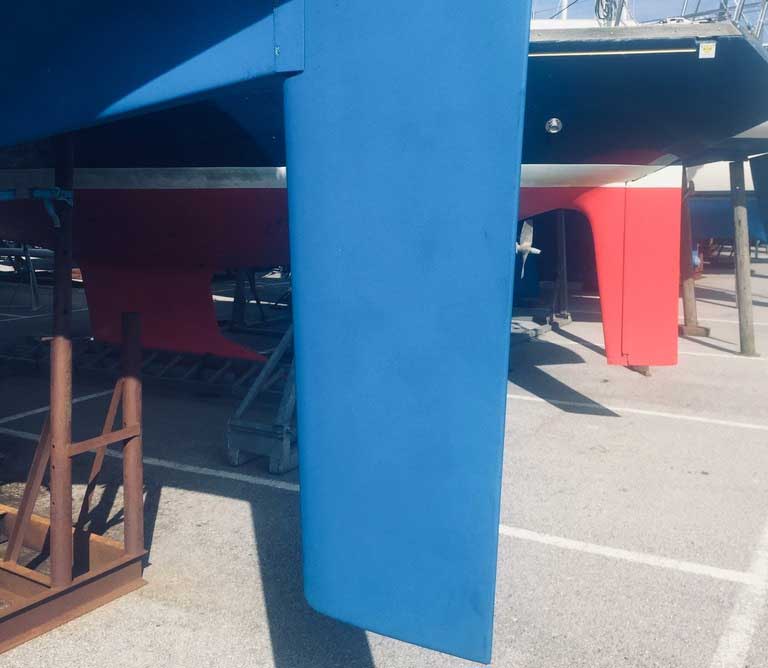
The spade rudder system is common on many modern designs of both sail and power boats. This type is known as a balanced rudder, meaning that it pivots at a point well back from its forward edge (whereas transom hung rudders are referred to as unbalanced rudders). This makes it easier to turn than a transom hung rudder. A spade rudder is suspended beneath the hull, well astern of a fin keel.

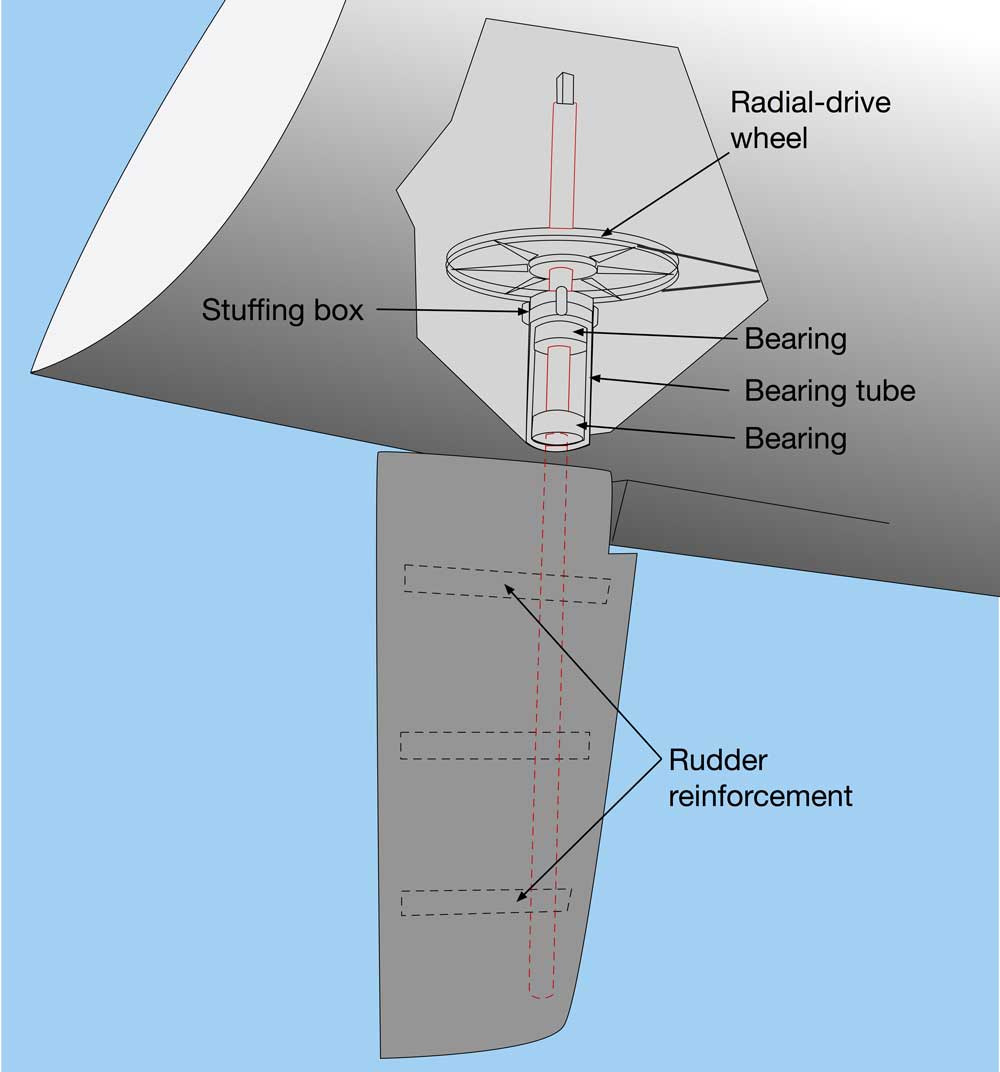
Spade rudders have a rudder stock which reaches from the bottom of the rudder up into the hull. The stock can be hollow or solid and made from stainless steel, aluminium or composite materials. The rudder blade is built around the stock and reinforced with a frame which is welded to the stock. So when the rudder stock is turned, the frame and blade turn as one. The blade itself is usually made in two halves of fibreglass which are bonded together. The core is usually filled either with foam or plywood and occasionally is a solid laminate.

On most spade rudders, there are two bearings contained in a bearing tube. One of these bearings is at the point where the rudder stock enters the hull and another one higher up at the top of the tube which may also have a seal.

Spade rudders are subjected to considerable stresses and some experts would say are more vulnerable to failure than the old fashioned transom hung varieties. This is partly because they are hidden from sight and therefore difficult to inspect when afloat and partly because there is more that can go wrong if a spade rudder isn’t inspected regularly. The big issue is that it is very difficult to prevent water from getting into the core, causing corrosion and eventually, rudder failure.

Spade rudder checks:

  • Check if water continues to drip from the rudder after the boat has been hauled out.
  • Check for any rust-like stains on the the rudder surface, which are an indicator of crevice corrosion.
  • Bearing failure – check bearings for excessive play when ashore by moving the bottom of the rudder blade from side to side. Up to 2mm play is acceptable.
  • Check bearing tube to hull joint for any signs of cracking.
  • Check the flexible rubber, bellows type of seal is in good order.
  • Stiff steering can be caused by plastic bearing failure. Roller bearings can fail suddenly.
  • Rudder stock failure – check seawater has not penetrated the bearing tube which will cause a stainless steel rudder stock to corrode and eventually fail. The rudder stock’s lower bearing where it enters the bearing tube should be inspected for excessive play or signs of crevice corrosion and galvanic corrosion. Check the shaft seal for signs of leaking. If it is leaking it needs to be replaced. Check the upper part of the bearing tube is well supported and not showing any signs of movement.
  • Framework failure – check for water penetration into the rudder blade. This can cause corrosion of the metal frame, resulting in the rudder stock breaking away and failing to turn the blade. Check if there is any movement between the rudder and the rudder stock. If so, the rudder will need to be repaired or replaced.
  • Delamination – check the rudder blade for bulges which indicates water has penetrated the rudder and is causing delamination. Check the edges of the blade for signs of cracking or splits which could allow water to penetrate the blade.


Estimating and plotting your position at sea

This post covers how we go about estimating and plotting our position using traditional methods, when out of sight of land – covering Dead Reckoning, Estimated Position, Tidal Streams, Leeway and more…

Sterndrive maintenance

Sterndrives are a popular form of propulsion in the powerboat market, but require a fair amount of care and maintenance. The main factors to be aware of are salt water corrosion, lubrication and regular inspection of the bellows, the condition of which is vital to prevent water from entering into the hull.

ColRegs – avoiding collisions at sea

ColRegs - avoiding collisions at sea ColRegs Rule 8: Action to avoid collision (a) Any action taken to avoid collision shall...

Boat decks and superstructure

The deck of a boat is constantly exposed to the elements and should be inspected on an annual basis. Particular attention needs to be given to the overall condition of deck fittings such as the stanchions, cleats and chainplates.

Boat batteries

Under-sized battery banks are one of the key factors behind power failure at sea, as well as the premature failure of batteries, so make sure that your boat battery measures up to the use you want to put it to.

How to ensure your boat is in proper working condition

In this article Eva Tucker from Volvo Penta presents a handy check list of all the things that you need to check regularly in order to make sure that your boat is in a seaworthy condition. Including maintenance, safety gear and electrical checks.

Rudders and steering systems – Part 2

One thing all rudders have in common is that they have three main parts that need to be checked: the rudder, or a steerable drive leg in the case of many power boats; the system that joins the rudder to the steering; the steering control itself.

Dag Pike’s Boat Survey

We're really pleased to be working with Dag Pike on some great new apps for iPhone & Android. Here'a a bit more about the first app: Dag Pike's...

Jester Challenge 2022 – Sailing single handed from Plymouth UK to the Azores: Part 3 – Preparations

Jester Challenge – A modern experiment in old-fashioned self-reliance, self sufficiency, and personal responsibility. This is the third of a 10-part post where solo sailor, Bernie Branfield, shares his first hand account of his single-handed, 2022 Jester Challenge, from Plymouth, UK to the Azores, in his 26′ Invicta Mk2, Louisa.

Essential Knots: Sheet bend

Essential Knots: Sheet bend Use: Joining two ropes together. A sheet bend is particularly useful for joining two ropes of different...

First aid at sea – four common emergencies

In this blog we look at what to do in the event of a crew member choking, drowning, or suffering from hypothermia or fatigue. Knowing how to cope with them could well save a life, while not knowing could result in an avoidable tragedy.

Electric motors and hybrid systems

In recent years there have been considerable advances with the development of electrically powered propulsion in the leisure marine sector. This includes developments with inboard and outboard electric motors, hybrid systems, lithium-ion battery technology as well as solar, wind and hydro powered generators.

Boating emergency – how to broadcast a MAYDAY emergency call

How to broadcast a MAYDAY emergency call   How to broadcast a MAYDAY emergency call if a vessel or person is in grave...

Stern gear maintenance

The stern gear of a boat needs to be checked carefully when the boat is ashore as this is something that can only be done when it is out of the water. The same applies for any maintenance and repairs that may need doing, so it is best to check it all over as soon after an end of season lift out as possible.

Repairing a leaking hull-to-deck joint

If you suspect a hull-to-deck joint has failed, then being absolutely sure where the actual leak is occurring is of prime...

Liferafts

Liferafts should be stowed where they are ready for immediate launching. All crew should know the location of the liferaft and know how to launch, inflate and board it. They should also know what equipment it contains.

Boat surveys

A full boat survey assesses the condition of the hull, mechanical gear and means of propulsion. The survey is carried out with the boat...

Antifouling for leisure boats – Part 2

To prepare for antifouling, as soon as your boat has been lifted out and pressure washed, you need to check all the surfaces of the hull below the waterline, remove any remaining barnacles and check for blisters.

Understanding tides

If you are used to sailing in tidal waters, you will know that tides can be both a benefit and a hindrance to the sailor. In many ways,...

A simple guide to understanding tides when passage planning

Understanding tides when passage planning When planning a trip in tidal waters, check the tides before going afloat. Use...

Sailboat rig checks – Part 2

In part two of Sail boat rig checks we run through some useful rig maintenance tips and then finish with a brief look at what a professional rig check involves.

Navigating narrow channels

Navigating narrow channels can present challenges for boat operators due to limited space, restricted manoeuvrability, and potential hazards such as shallows, rocks, or other vessels. To ensure safe passage through narrow channels, it’s essential to follow specific strategies and techniques.

Diesel engine winterisation

An inactive boat engine needs to be protected from corrosion during the winter, caused by the rising humidity levels through the cold months and the salty coastal air. This applies whether the boat is left afloat or hauled out over the winter. Read here about the two important stages of winterisaton for a diesel boat engine.

Hull inspection – the annual checks

With the boat ashore for the winter it is time to do a hull inspection - the annual checks. Are there any scratches and chips in the...

Seized fixings and fastenings

Maintaining a boat can be a rewarding experience but at times it can also be frustrating. A prime example of this is when you come across a seized fixing or fastening that refuses to budge. Read our tips on how to release and fix them: